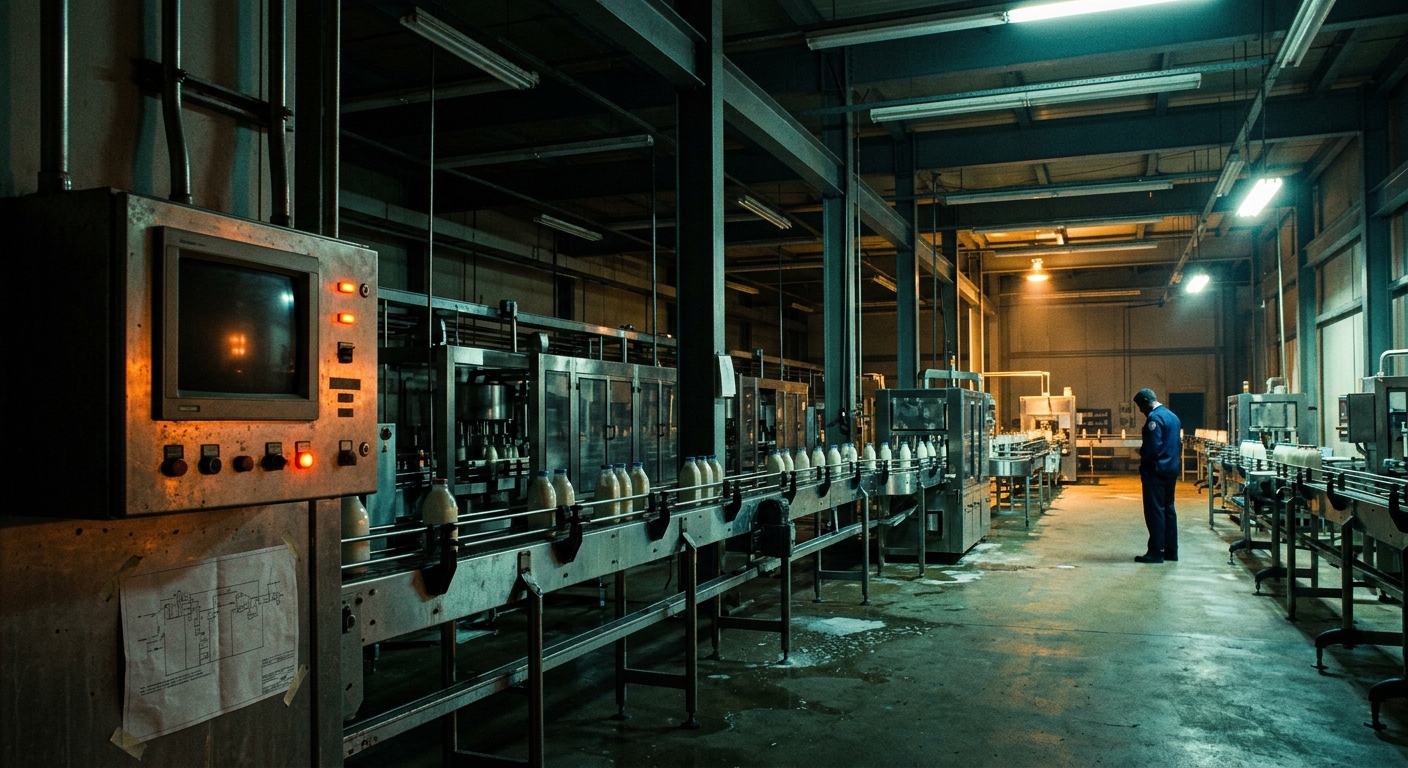
On July 16, 2026, The Coca-Cola Company disclosed that its dairy subsidiary fairlife, LLC had identified unauthorized access by a third party to a portion of its systems, including production-related systems, in connection with a ransomware event. The immediate operational consequence was blunt and public: US production operations at fairlife were temporarily suspended. Canadian production, the company said, was not impacted. A Fairlife facility in the Rochester, New York area paused production.
For compliance and security professionals, the incident is less notable for its novelty than for the precise regulatory pressure point it lands on. Coca-Cola filed a Form 8-K with the U.S. Securities and Exchange Commission the same day, and in doing so had to answer a question that has become the defining challenge of the SEC’s cybersecurity disclosure regime: is this incident material? The company’s answer was candid. It stated it had not yet determined whether the incident is reasonably likely to materially affect the Company. That single sentence captures the structural tension every public company now faces when a production-halting attack arrives before its full scope is understood.
This analysis walks through why this matters, the specific regulatory framework governing the disclosure, what the filing does and does not tell us, the operational-technology (OT) resilience lessons for manufacturers, and a concrete checklist for organizations that operate at the same IT/OT intersection.
Why This Incident Matters
Food and beverage manufacturing is a converged IT/OT environment. The systems that plan production, manage recipes, control filling lines, coordinate cold-chain logistics, and drive programmable logic controllers on the plant floor are increasingly networked to the same corporate infrastructure that runs email and enterprise resource planning. That convergence delivers efficiency. It also means that a ransomware event which historically would have encrypted back-office file shares can now reach production-related systems and stop physical output.
That is precisely what happened here. Fairlife did not merely suffer a data-confidentiality problem; it suffered an availability problem severe enough to suspend US manufacturing. The distinction is important because availability impacts to a manufacturing subsidiary translate directly into lost revenue, supply disruption, contractual exposure with retail customers, and potential shortages of a branded consumer product. Those are the ingredients of financial materiality under securities law, even when no personal data has been confirmed as compromised.
The incident also underscores a recurring pattern seen across recent large-scale events, from the JADEPUFFER agentic-AI ransomware campaign to third-party-driven outages: attackers increasingly target the operational chokepoint rather than just the data crown jewels. Halting a production line is a faster, more legible form of extortion leverage than exfiltrating records whose value must be negotiated.
The Regulatory Framework: SEC Item 1.05 and the Materiality Determination
The centerpiece of the compliance story is the SEC’s cybersecurity disclosure rule, adopted in July 2023 and effective for most registrants since December 18, 2023. It created a new Item 1.05 of Form 8-K and a corresponding disclosure obligation under Regulation S-K Item 106.
Under Item 1.05, a registrant that experiences a cybersecurity incident it determines to be material must file a Form 8-K describing the material aspects of the incident’s nature, scope, and timing, and its material impact or reasonably likely material impact on the registrant, including its financial condition and results of operations. The critical timing rule: the 8-K is due within four business days of the registrant determining that the incident is material — not four business days from discovering the incident itself.
That distinction is the fulcrum of the entire regime, and it is why Coca-Cola’s filing reads the way it does. The four-business-day clock is triggered by the materiality determination, and the SEC’s adopting release and subsequent staff guidance make clear that the determination must be made without unreasonable delay after discovery. A company cannot indefinitely defer the materiality call to avoid the clock. But it also is not required to declare an incident material before it has a reasonable basis to do so.
Coca-Cola’s disclosure states plainly that it has not yet determined whether the incident is reasonably likely to materially affect the Company. In practice, filings of this kind are frequently made under Item 8.01 (Other Events) rather than Item 1.05. Item 8.01 is a voluntary catch-all for information a registrant deems important to security holders; it carries no four-business-day trigger and does not represent a materiality admission. The choice between framing a cyber disclosure as an Item 1.05 filing versus an Item 8.01 filing has become a closely watched signal. Filing under 8.01 while a materiality assessment continues lets a company be transparent about a disruptive, publicly visible event — a shuttered production line is hard to conceal — without prematurely conceding the legal conclusion of materiality, and without starting a clock that the facts may not yet support.
Two further points about the framework are worth emphasizing:
-
Materiality follows the federal securities-law standard. Information is material if there is a substantial likelihood that a reasonable investor would consider it important in making an investment decision, or if it would significantly alter the total mix of available information — the standard articulated in TSC Industries v. Northway and Basic v. Levinson. It is not a bespoke cyber definition. Both quantitative factors (lost sales, remediation cost, potential liabilities) and qualitative factors (harm to reputation, customer relationships, competitive position) are in scope.
-
Ongoing investigations do not excuse delay, but genuine uncertainty is respected. The SEC has repeatedly cautioned that the rule does not permit companies to sit on a materiality determination. At the same time, a registrant is entitled to conduct a reasonable investigation. When production is halted but the scope of data access, the duration of the outage, and the ultimate financial impact are genuinely unknown, a company can legitimately state that the materiality determination is ongoing — provided it revisits that conclusion promptly as facts develop and amends its 8-K when a material impact is determined.
What the Disclosure Shows and What It Leaves Open
The Coca-Cola filing is a useful case study in disclosure discipline under uncertainty. Read carefully, it does several things at once.
It confirms the operational facts that are already observable and cannot be walked back: unauthorized third-party access, involvement of production-related systems, a ransomware nexus, temporary suspension of US production, and the exclusion of Canadian operations from the impact.
It affirms the response posture: the company activated its incident response and business continuity protocols, engaged outside advisors and cybersecurity experts, and notified law enforcement. These are the hallmarks investors and regulators expect to see, and they align with the response-governance disclosures required annually under Regulation S-K Item 106(b), which asks registrants to describe their processes for assessing, identifying, and managing material risks from cybersecurity threats.
It reassures on a specific safety dimension: the company stated product quality and safety were not impacted. For a food and beverage manufacturer this is not incidental. It preempts a distinct line of regulatory concern under food-safety authorities and signals that the event is an availability and business-continuity matter rather than a consumer-safety one.
And it preserves optionality on the open questions. The filing does not yet address whether customer, employee, or supplier personal data was accessed, and it acknowledges that the full scope, nature, and impacts are not yet known. That is significant because if personal data is later confirmed to have been accessed, an entirely separate body of obligations activates: state data-breach notification statutes in all 50 states, each with its own trigger and timing; sector and contractual notification duties; and, where Canadian personal information is involved, breach-reporting obligations under PIPEDA. A production-focused ransomware event can mature into a data-breach event as forensics progress, and the disclosure obligations evolve accordingly.
The prudent reading is that this is an initial disclosure. The company has told the market what is verifiable, declined to overcommit on conclusions it cannot yet support, and left a clear runway to file an amendment if and when a material impact — financial or data-related — crystallizes.
OT and Manufacturing Resilience Lessons
Beyond the securities-disclosure mechanics, the incident offers durable lessons for any organization running converged IT/OT environments.
Segmentation is the difference between a bad day and a shutdown. The single most consequential architectural control in OT environments is rigorous network segmentation between enterprise IT and plant-floor OT, ideally aligned to the Purdue Enterprise Reference Architecture and the guidance in NIST SP 800-82 Revision 3 (Guide to Operational Technology Security). When ransomware can traverse from a corporate foothold into production-related systems, segmentation has failed or was incomplete. The fact that Canadian production was unaffected while US production halted is itself instructive: it demonstrates that appropriately isolated environments can be walled off from a spreading incident. Segmentation between geographies and between IT and OT zones is what converts a company-wide catastrophe into a contained one.
Business continuity must assume production-line loss, not just data loss. Traditional disaster-recovery planning has focused on restoring data and applications. OT-aware continuity planning must additionally answer: How long can we operate manufacturing manually or on isolated islanded systems? What is our recovery time objective for a filling line, a pasteurizer, a cold-chain controller? Where are our validated, offline, immutable backups of PLC configurations, HMI programs, and recipe/batch parameters? The CISA Cross-Sector Cybersecurity Performance Goals (CPGs) and ISA/IEC 62443 provide frameworks for building this resilience into OT specifically.
Food supply chains are critical infrastructure, and the reporting landscape is tightening. The food and agriculture sector is one of the 16 critical infrastructure sectors under U.S. policy. As CIRCIA implementation approaches — with the covered-entity incident-reporting obligations moving toward effect — manufacturers in this sector should assume that a ransomware event affecting operations may trigger federal reporting duties in addition to securities disclosure. Organizations preparing for these overlapping regimes should review our analysis of CIRCIA final-rule incident-reporting readiness, because the reporting clocks, thresholds, and definitions differ meaningfully from the SEC’s.
Third-party and subsidiary risk is parent-company risk. Fairlife is a subsidiary. Coca-Cola, as the parent registrant, carries the disclosure obligation. This mirrors a pattern seen across recent events where a breach at a subsidiary or vendor becomes the disclosing entity’s problem — the same dynamic examined in our coverage of the Deutsche Bank third-party ransomware breach and DORA implications. Enterprise risk governance, cyber insurance structuring, and incident-response playbooks must map cleanly across corporate boundaries, because attackers and regulators do not respect the org chart.
What to Do Now: A Compliance and Resilience Checklist
Organizations operating in food and beverage, or any manufacturing sector with converged IT/OT, should treat this incident as a prompt to validate the following:
-
Pre-wire the materiality process. Establish a written disclosure-committee procedure that connects the security incident-response team to legal, finance, and investor relations so a materiality determination can be made without unreasonable delay. Document who decides, on what information, and how the four-business-day Item 1.05 clock is tracked from the moment of determination.
-
Draft 8-K templates in advance. Maintain pre-cleared language for both an Item 1.05 material-incident filing and an Item 8.01 other-events filing, so counsel is choosing framing under pressure, not drafting from scratch. Include placeholders for the required elements: nature, scope, timing, and material or reasonably likely material impact.
-
Map the parallel obligations. Build a single incident matrix that lays the SEC 8-K clock alongside state breach-notification deadlines, CIRCIA federal reporting (as it comes into effect), sector regulators, food-safety authorities, cyber-insurer notice requirements, and any cross-border duties such as PIPEDA or GDPR where relevant. Overlapping clocks are where organizations stumble.
-
Segment and test IT/OT boundaries. Validate that enterprise IT compromise cannot laterally reach production controllers. Align to NIST SP 800-82 Rev. 3 and ISA/IEC 62443, and confirm that segmentation holds under a red-team or tabletop scenario, not just on the architecture diagram.
-
Protect OT-specific backups. Ensure offline, immutable, tested backups exist for PLC/HMI configurations, recipe and batch data, and control-system images — and that restoration has been rehearsed against a realistic recovery-time objective for a production line.
-
Rehearse a production-halt tabletop. Run an exercise premised on a suspended manufacturing line, forcing decisions on continuity, customer communication, regulatory notification, and public disclosure simultaneously. The goal is to surface the friction between operational recovery and disclosure obligations before it happens live.
-
Plan for the data-breach fork. Assume any production-focused ransomware event may later reveal personal-data access. Pre-stage forensic scoping, notification vendors, and call-center capacity so a pivot from operational disruption to data-breach response does not start cold.
Conclusion
The Fairlife ransomware event is a clean illustration of where cybersecurity risk, operational technology, and securities disclosure now intersect. A ransomware actor reached production-related systems, a US manufacturing operation went dark, and a public-company parent had to speak to investors within a regime built around a materiality determination and a four-business-day clock — all before the full facts were known.
Coca-Cola’s disclosure did what a well-governed initial filing should do: it stated the verifiable facts, described a credible response, protected the specific safety assurance investors and consumers would ask about, and declined to prematurely resolve a materiality question the evidence did not yet support. Whether the incident ultimately proves material, and whether it matures into a data-breach matter, will be answered in the amendments and follow-on filings that come next.
For every other manufacturer watching, the lesson is not to admire the drafting but to prepare the machinery behind it: segmented networks, tested OT backups, a rehearsed disclosure process, and a mapped set of overlapping regulatory clocks. The organizations that fare best under the SEC’s cyber-disclosure regime are the ones that decided how they would answer the materiality question long before an attacker forced them to.
This article is provided for informational purposes only and does not constitute legal advice.