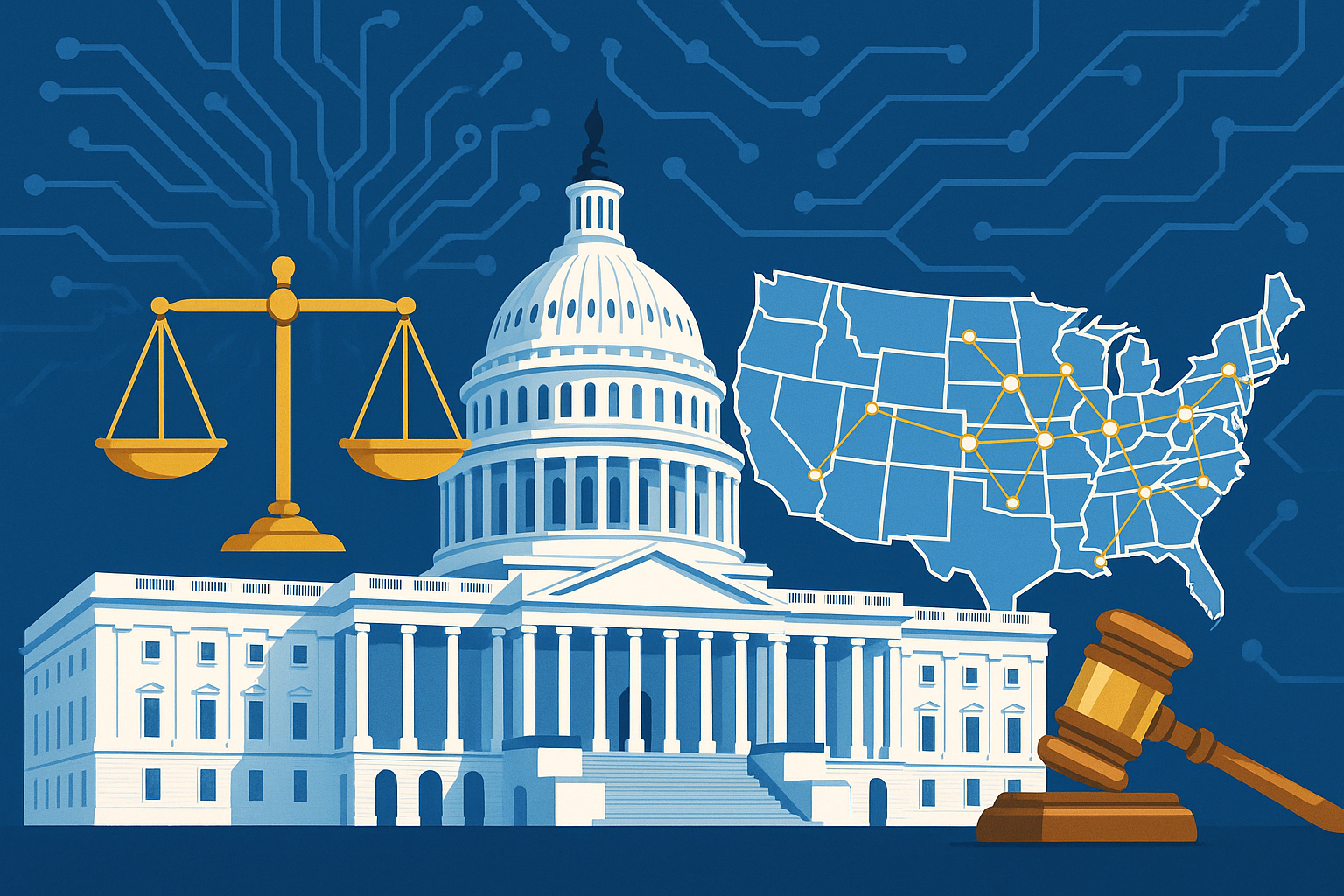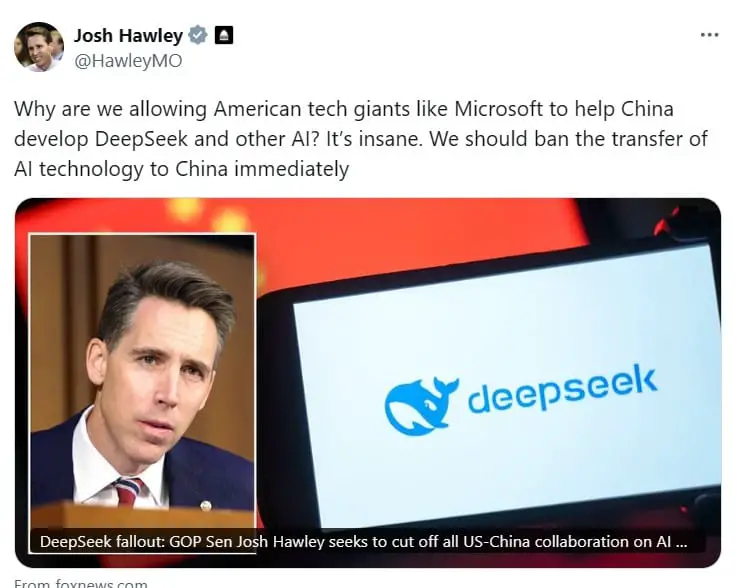
The recent introduction of Senator Josh Hawley’s “Decoupling America’s Artificial Intelligence Capabilities from China Act” marks a pivotal moment in U.S.-China tech relations, following seismic market disruptions caused by Chinese AI firm DeepSeek. The legislation seeks to sever all collaborative AI development ties between the two nations through sweeping measures that could reshape global tech competition.
Download: Hawley-Decoupling-Americas-Artificial-Intelligence-Capabilities-from-China-Act Hawley-Decoupling-Americas-Artificial-Intelligence-Capabilities-from-China-Act.pdf67 KB.a{fill:none;stroke:currentColor;stroke-linecap:round;stroke-linejoin:round;stroke-width:1.5px;}download-circle
Hawley’s Legislative Counterstrike
The bill proposes three core restrictions[2][3]:
- Full trade embargo on AI technology exports/imports with China- Research prohibition barring U.S. companies from conducting AI development in China- Investment ban on American funding for Chinese AI firms
“Every dollar and gig of data flowing into Chinese AI ultimately gets weaponized against us,” Hawley stated, framing the legislation as national security imperative rather than mere economic policy[2][3]. Unlike previous entity-specific sanctions, this legislation casts a wide net over all AI-related technologies to prevent loophole exploitation[2].
DeepSeek’s Market Earthquake
The urgency stems from DeepSeek’s surprise release of a high-efficiency AI model that reportedly:
- Undercut operational costs by 40% compared to OpenAI/Meta equivalents[2]- Triggered Nvidia stock volatility, with shares plunging 12% before partial recovery[2][3]- Topped Apple’s App Store within 72 hours of launch[2]
This breakthrough exposed vulnerabilities in U.S. export controls, with former Biden advisor Jake Sullivan having previously warned of America’s shrinking AI lead (6-18 month advantage)[2]. Microsoft and OpenAI are now investigating whether DeepSeek trained its models using distilled knowledge from their systems[2][3].
Political Crosscurrents
The development has united unusual allies while revealing policy fractures:
- Trump called it a “wake-up call” for U.S. competitiveness but praised cost-saving potential: “Spend less, get same solutions”[2]- Biden-era holdovers accelerated chip export controls in final administrative days[2]- White House AI czar David Sacks cited “substantial evidence” of IP appropriation[2]
Strategic Implications
The legislation arrives as analysts debate whether containment or acceleration should guide U.S. AI policy:
Approach Pros Cons
Decoupling Prevents tech leakage Risks bifurcating global standards
Open Competition Maintains innovation pace Could erode U.S. market share
With the Trump administration vowing to “ensure American AI dominance”[2], the bill’s fate may hinge on balancing national security concerns against Silicon Valley’s global interoperability needs. As DeepSeek demonstrates China’s capacity for rapid commercialization, the legislation underscores a growing consensus that AI leadership requires both technological and legislative innovation[2][3].
DeepSeek Reports Major Cyberattack Amid Rapid Growth
How might other countries be affected by Hawley’s proposed legislation
DeepSeek AI Under EU Scrutiny: Data Privacy & AI Concerns Spark Investigations
Senator Josh Hawley’s proposed “Decoupling America’s Artificial Intelligence Capabilities from China Act” could reshape global tech dynamics beyond U.S.-China relations, with cascading effects on allies, emerging economies, and international AI governance.
Impact on Strategic Allies
- EU and NATO Members:At least 17 EU nations fall into intermediate tiers under expanded U.S. export controls, facing AI chip quotas and compute power restrictions2542.- Trusted-tier exemptions for only 18 countries (e.g., UK, Canada, Australia) risk alienating partners like Poland and Israel2227, potentially weakening transatlantic tech cooperation.- The EU’s AI Act could clash with U.S. restrictions, forcing companies to navigate conflicting compliance regimes4147.
Qwen2.5-Max: A New Contender in AI Performance Benchmarks
Country GroupKey ChallengesTrusted AlliesLimited cloud provider flexibility in tier-two marketsIntermediate TierQuota systems throttling AI infrastructure growthRestricted TierNear-total exclusion from Western AI ecosystems
Shifts in Emerging Markets
- India and Southeast Asia:Face identical export quotas as smaller nations under the “one-size-fits-all” framework22, despite strategic importance.- Risk being pushed toward Chinese alternatives like Huawei’s Ascend chips to meet AI ambitions4243. Latin America/Africa:
- Likely recipients of China’s “AI diplomacy” offering cost-effective solutions unrestricted by U.S. rules22.- Brazil and Mexico’s draft AI laws may align more closely with Chinese technical standards10.
Global AI Law Snapshot: A Comparative Overview of AI Regulations in the EU, China, and the USA
Global Governance Implications
- Regulatory Fragmentation:Contrasts with EU’s risk-based AI Act, creating compliance headaches for multinational firms47.- Could accelerate China’s efforts to set alternative AI standards through forums like SCO and BRICS22. Supply Chain Realignments:
- U.S. cloud giants (Microsoft, Google) must keep 75% of AI compute power domestically or in trusted countries44, limiting global service reach.- Chinese firms like Alibaba Cloud may gain market share in tier-two nations through unrestricted exports42.
AI Weekly Roundup: Major Industry Moves Reshape the Landscape
Economic and Diplomatic Fallout
- Alliance Strains:Israel and Poland openly criticized exclusion from trusted tiers as undermining security partnerships22.- India’s “hedging” strategy between U.S. and China could harden if tech access disparities persist42. Innovation Costs:
- Joint U.S.-EU research projects (e.g., Horizon Europe) face new barriers to Chinese academic collaborators340.- Estimated $7B+ in annual compliance costs for global tech firms adapting to bifurcated systems45.
While the bill aims to secure U.S. AI leadership, its extraterritorial reach risks isolating partners, empowering Chinese alternatives, and fragmenting the global digital economy. Success hinges on balancing security with inclusive frameworks for allied cooperation2241.
Pentagon Staff Used DeepSeek’s Chatbot Before Block
Citations: [1] https://cointelegraph.com/news/us-senator-josh-hawley-bill-deepseek-ai [2] https://www.foxnews.com/politics/deepseek-fallout-gop-sen-josh-hawley-seeks-cut-off-all-us-china-collaboration-ai-development [3] https://www.foxnews.com/politics/deepseek-fallout-gop-sen-josh-hawley-seeks-cut-off-all-us-china-collaboration-ai-development