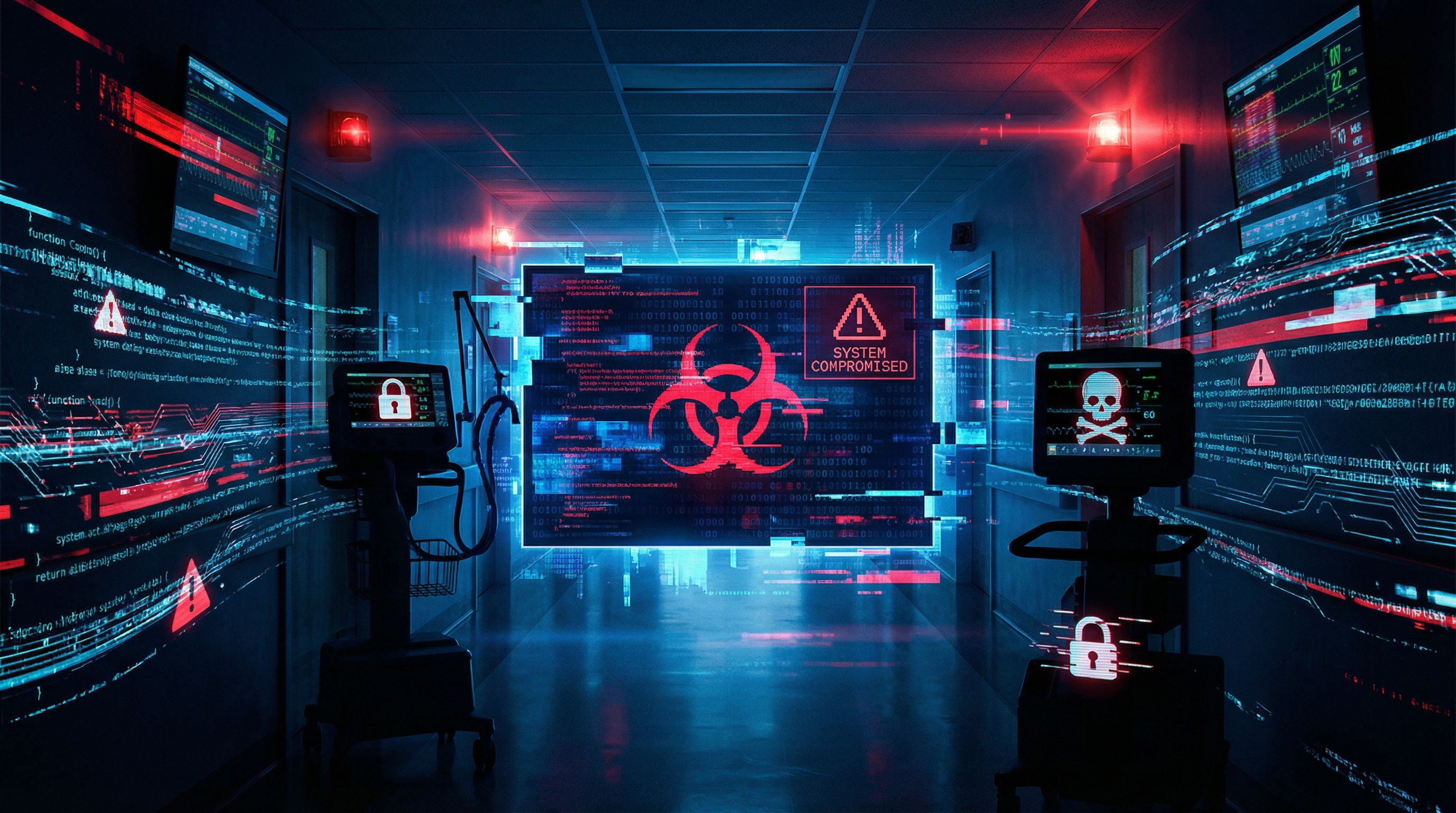
The numbers are staggering. The consequences are deadly. In 2025, ransomware groups launched 1,174 publicly disclosed attacks—a 49% year-over-year increase—and healthcare bore the heaviest burden. With 22% of all ransomware attacks targeting medical organizations, hospitals and health systems have become ground zero for cybercrime. But this isn’t just a story about encrypted files and ransom demands. It’s about patients who can’t get chemotherapy treatments. Emergency rooms that divert ambulances. Medical records sold to criminals who exploit vulnerable people for decades. This is the healthcare ransomware crisis of 2026, and the stakes are literal lives.
Executive Summary
The healthcare sector experienced its most devastating year for ransomware in 2025. According to BlackFog’s 2025 State of Ransomware Report, publicly disclosed ransomware attacks surged 49% year-over-year to a record 1,174 incidents globally. Healthcare accounts for 22% of all disclosed ransomware attacks, making it the single most-targeted sector for cybercriminals.
The consequences extend far beyond financial damage. Ransomware attacks on healthcare organizations cause:
- 67% of incidents result in longer patient hospital stays
- 50% of attacks force emergency department diversions
- 19 days average of treatment disruptions per incident
- 35-40% of breached small practices close within two years
Major 2025-2026 breaches include the catastrophic Conduent incident affecting 25+ million Americans, the ApolloMD breach impacting 626,540 patients, and the still-reverberating Change Healthcare attack that exposed 192.7 million records—the largest healthcare breach in U.S. history.
HHS enforcement is intensifying, with 8 of 14 enforcement actions in 2025 directly involving ransomware attacks. The proposed 2026 HIPAA Security Rule update would mandate MFA, encryption, and network segmentation—transforming recommendations into requirements.
This article examines the scope of the crisis, profiles major breaches, explains why healthcare remains the top target, documents the human cost, analyzes the regulatory response, and provides actionable defense recommendations.
Part I: The Crisis in Numbers
49% Year-Over-Year Increase
BlackFog’s 2025 State of Ransomware Report presents a sobering picture of ransomware’s explosive growth. The headline statistic—1,174 publicly disclosed ransomware attacks in 2025—represents a 49% increase from the previous year. But this number tells only part of the story.
The reality is far worse. According to BlackFog’s analysis, an estimated 86% of ransomware attacks are never publicly disclosed. When factoring in attacks announced only on dark web leak sites, the true scale reaches approximately 7,079 victims in 2025 alone.
“The global impact of ransomware across 2025 has been unprecedented. From high street chains to hospitals, ransomware doesn’t respect borders, the size of organization, or the sector you’re in. It’s brought vital services, established companies—and the smaller partners who depend on them—to a grinding halt.”
— Dr. Darren Williams, Founder and CEO of BlackFog
The ransomware ecosystem is also becoming more diverse. In 2025, 130 different ransomware groups carried out attacks—with 52 new groups emerging during the year alone, a 9% increase from 2024. This proliferation reflects the continued profitability of the ransomware-as-a-service model and lowers barriers to entry for cybercriminals.
Healthcare: 22% of All Attacks
When examining ransomware targeting by sector, healthcare stands alone at the top. The sector absorbs 22% of all publicly disclosed ransomware attacks, making it the most-targeted vertical industry globally.
| Sector | Share of Disclosed Attacks | Year-Over-Year Trend |
|---|---|---|
| Healthcare | 22% | Consistently #1 |
| Services | Growing | +118% YoY (largest increase) |
| Retail | Growing | High-profile luxury brand attacks |
| Education | Declining | -12% YoY (only sector with decrease) |
Within healthcare, the targeting patterns reveal nuanced trends:
- Healthcare provider attacks remained consistent: 437 in 2024 → 445 in 2025
- Healthcare business attacks increased 25%: 153 in 2024 → 191 in 2025
- Q4 2025 alone saw 190 healthcare ransomware incidents—the highest quarterly total recorded
This shift toward healthcare businesses—vendors, service providers, billing companies, and technology partners—reflects attackers’ recognition that supply chain compromises offer greater returns. A single healthcare business breach can cascade across hundreds of hospitals and millions of patients.
Geographic Distribution
The United States bears the overwhelming burden of healthcare ransomware attacks:
Healthcare Providers:
| Country | 2025 Attacks | Year-Over-Year Change |
|---|---|---|
| United States | 292 | 66% of total |
| Australia | 16 | +60% |
| United Kingdom | 12 | Flat |
| Germany | 11 | -35% |
| France | 10 | +150% |
| Canada | 10 | -44% |
Healthcare Businesses:
| Country | 2025 Attacks |
|---|---|
| United States | 97 |
| India | 9 |
| Italy | 8 |
| Canada | 8 |
| Germany | 6 |
| Spain | 5 |
Most Active Ransomware Groups Targeting Healthcare
| Group | Healthcare Provider Claims | Healthcare Business Claims | Total |
|---|---|---|---|
| Qilin | 66 | 30 | 96 |
| INC | 45 | 12 | 57 |
| SafePay | 29 | — | 29 |
| Sinobi | 24 | — | 24 |
| Akira | — | 19 | 19 |
| Medusa | 18 | — | 18 |
Part II: Major Breaches - The Damage Done
Conduent: 25+ Million Americans Exposed
In January 2025, SafePay ransomware breached Conduent, a major government services technology provider. Initial reports suggested approximately 4 million affected individuals in Texas. Then the numbers began to climb.
By February 2026, the true scope emerged:
- Texas: 15.4 million individuals affected (revised from 4 million)
- Oregon: 10.5 million individuals affected
- Additional states: Delaware, Massachusetts, New Hampshire, and others report hundreds of thousands each
- Total: 25+ million Americans with sensitive data stolen
The SafePay group exfiltrated 8.5 terabytes of data including:
- Full names and Social Security Numbers
- Medical diagnoses and treatment records
- Health insurance information
- Addresses and contact information
The Conduent breach exemplifies the third-party risk nightmare: a single vendor compromise affects government programs across multiple states, exposing tens of millions of Americans who never directly interacted with the breached company.
Change Healthcare: The $22 Million Ransom and 192.7 Million Records
While technically occurring in February 2024, the Change Healthcare breach cast a long shadow over 2025 and remains the largest healthcare data breach in American history.
The Attack Timeline:
- Initial access: BlackCat/ALPHV ransomware operators accessed a remote access server lacking multi-factor authentication
- Lateral movement: 9 days of undetected movement through Change Healthcare’s network
- Data exfiltration: 6 terabytes of highly sensitive data stolen
- Ransomware deployment: Systems encrypted, operations halted
- Ransom payment: UnitedHealth Group (Change Healthcare’s parent) paid $22 million
- Recovery: Months of disruption to U.S. healthcare claims processing
The Aftermath:
- 192.7 million individuals affected—the most ever from a single healthcare breach
- Pharmacy operations disrupted nationwide
- Claims processing halted for weeks
- Small medical practices faced cash flow crises
- Some practices were unable to pay staff
- Regulatory investigations continue
The Change Healthcare attack demonstrated how a single vulnerability—one server without MFA—can threaten the operational viability of the entire U.S. healthcare system.
ApolloMD: 626,540 Patients Across 11 Practices
On May 22-23, 2025, Qilin ransomware operators breached ApolloMD, a physician staffing and practice management company. The attack exposed 626,540 patients across 11 affiliated physician practices.
The 4-month gap between Qilin’s public announcement and patient notification raises serious questions about breach disclosure practices. During those 120+ days, stolen patient data could be—and likely was—monetized on criminal markets while affected individuals remained unaware.
Part III: Why Healthcare Remains Ground Zero
The $260 Medical Record: Dark Web Economics
Why do ransomware groups disproportionately target healthcare? The answer lies in the unique value proposition of medical data.
Dark Web Data Pricing Comparison:
| Data Type | Dark Web Price | Exploitation Window |
|---|---|---|
| Credit card (with CVV) | $10-$40 | Hours to days |
| Social Security Number | $1-$6 | Weeks |
| Email/password combo | $5-$15 | Weeks |
| ”Fullz” identity package | $20-$100 | Months |
| Complete medical record | $260-$500+ | Years to decades |
Medical records command a 10x premium over credit cards for a simple reason: they are permanent and immutable. You cannot change your Social Security Number, date of birth, medical history, biometric markers, or insurance identifiers.
This permanence enables “long-tail fraud”—criminal exploitation that recurs for years or decades after the initial breach.
The AI Amplification Effect:
2025 saw AI dramatically increase the exploitation value of stolen medical records:
- Voice cloning fraud: +475% YoY success rate
- Synthetic identity creation: +27% fraud value per SSN
- AI-enhanced phishing: +40% click-through rate
Operational Pressure: When Downtime Threatens Lives
Unlike retailers who can temporarily close stores or manufacturers who can halt production lines, hospitals cannot simply “go offline.” When ransomware strikes a hospital:
- Emergency departments may close or divert patients
- Critical surgeries get postponed
- Chemotherapy treatments are delayed
- Medication dispensing becomes manual and error-prone
- Diagnostic imaging goes dark
- Laboratory results are unavailable
Documented Patient Care Impacts:
| Impact | Percentage of Incidents |
|---|---|
| Longer patient hospital stays | 67% |
| Patient diversions to other facilities | 50% |
| Procedures or tests delayed | 64% |
| Increases in patient complications | 17% |
| Increases in patient mortality | Documented in multiple studies |
The average healthcare ransomware incident causes 19 days of emergency department closures or significant treatment delays.
Financial Devastation:
- Average healthcare breach cost: $9.8-10 million (highest across any sector for 14 consecutive years)
- 35-40% of breached small practices close within two years
- Notable permanent closures: Wood Ranch Medical, ENT Clinic of Michigan, and others
Legacy Systems and the Medical Device Nightmare
Internet of Medical Things (IoMT) Vulnerability Statistics:
| Metric | Finding |
|---|---|
| Hospitals with vulnerable IoMT | 99% have at least one KEV device |
| Vulnerabilities per device | 6.2 average |
| End-of-life devices | 60% no longer receive patches |
| Default/weak passwords | 21% of devices |
| Devices with known critical CVE | 53% |
| Devices supporting endpoint security | Only 13% |
| Publicly accessible medical devices | 1.2 million (3x growth since 2021) |
Third-Party and Supply Chain Risk
- 76%+ of medical devices are impacted by third-party vulnerabilities
- Over 80% of stolen PHI records were stolen from third-party vendors, not hospitals directly
- Over 90% of hacked health records are stolen outside the EHR system
Part IV: The Human Cost - When Cybersecurity Becomes Life Safety
The 213-Day Window
Healthcare organizations take longer to identify and contain breaches than any other sector:
| Metric | Healthcare Average |
|---|---|
| Time to identify breach | 93 days |
| Time to contain breach | 120 days |
| Total breach lifecycle | 213 days |
For more than seven months, on average, patient data circulates through criminal networks while victims remain unaware.
“Every day of delayed disclosure is a day stolen identities are monetized. Every vague notification leaves patients defenseless. Every quarter of regulatory silence sustains a billion-dollar black market.”
— Patient Protect, 2025
Small Practices: Death by Ransomware
While headlines focus on hospital system breaches, small practices face existential threats:
- 35-40% of breached small practices close within two years
- Limited IT resources make recovery difficult
- Insurance coverage may be inadequate
- Patient trust, once lost, doesn’t return
- Regulatory penalties add to financial strain
Part V: HIPAA and HHS Enforcement - The Regulatory Response
2025 Enforcement Statistics
The HHS Office for Civil Rights (OCR) dramatically increased enforcement activity in 2025:
| Metric | 2025 Data |
|---|---|
| Average enforcement fine | $486,000 |
| Enforcement actions citing ransomware | 8 of 14 (57%) |
| Actions citing Risk Analysis failure | 12 of 14 (86%) |
| Penalty range | $25,000 - $3,000,000 |
| Total ransomware enforcement actions to date | 15 |
A consistent theme emerges from enforcement actions: ransomware attacks trigger investigations, but the penalties result from underlying compliance failures—particularly the absence of comprehensive risk analyses.
Proposed 2026 HIPAA Security Rule Updates
On January 6, 2025, HHS published proposed updates to the HIPAA Security Rule—the most significant revision since the rule’s inception. The comment period closed March 7, 2025, with a final rule expected in May 2026 and a compliance deadline 6 months after publication.
Key Proposed Requirements:
| Control | Current Status | Proposed Status |
|---|---|---|
| Multi-factor authentication (MFA) | Addressable | MANDATORY |
| Encryption (at rest and in transit) | Addressable | MANDATORY |
| Network segmentation | Not specified | MANDATORY |
| Regular penetration testing | Not specified | MANDATORY |
| Anti-malware software | Addressable | MANDATORY |
| Data backup and recovery | Addressable | MANDATORY |
| Real-time monitoring | Not specified | MANDATORY |
| Software Bill of Materials (SBOM) | Not specified | Required for medical devices |
The rule would transform many “addressable” safeguards—which organizations could decline to implement with documented justification—into absolute requirements.
What Regulators Look For
Organizations preparing for potential HHS investigation should understand the enforcement focus areas:
- Enterprise-wide Risk Analysis: The #1 cited violation. OCR expects documented, comprehensive assessment of all systems containing ePHI.
- Risk Management Plans: Identifying risks isn’t sufficient; organizations must document and implement plans to address identified vulnerabilities.
- Access Controls: Particularly MFA. The Change Healthcare breach began with a single server lacking MFA.
- Encryption: Both data at rest and in transit.
- Staff Training: Documented, regular security awareness training.
- Business Associate Agreements: Proper contracts with all vendors handling PHI.
- Incident Response Plans: Documented procedures for breach detection, containment, and notification.
Part VI: Defense Recommendations - Building Resilience
Tier 1: Immediate/Foundational Controls
Multi-Factor Authentication (MFA)
The Change Healthcare breach began with a single server lacking MFA. This vulnerability enabled a $22 million ransom payment and the largest healthcare breach in history.
Implementation Priorities:
- Mandate MFA everywhere—no exceptions for “internal” or “legacy” systems
- Deploy phishing-resistant MFA (FIDO2/WebAuthn) where possible
- Implement context-aware MFA that triggers additional verification for unusual locations, devices, or access patterns
- Eliminate SMS-based MFA (susceptible to SIM swapping) for high-privilege accounts
Network Segmentation
Implementation Priorities:
- Isolate medical devices onto dedicated VLANs with restricted communication paths
- Segment clinical networks from administrative networks
- Separate guest WiFi from all internal networks
- Implement microsegmentation for high-value systems
- Apply zero trust architecture principles
Backup and Recovery
Implementation Priorities:
- Deploy immutable backup solutions that prevent encryption or deletion
- Maintain offline/air-gapped backup copies physically disconnected from production networks
- Test recovery procedures quarterly—untested backups aren’t backups
- Ensure backup administration paths are isolated and require separate MFA
Tier 2: Risk Management and Visibility
Enterprise Risk Analysis
With 86% of enforcement actions citing risk analysis failures, this is both a security and compliance imperative.
Third-Party Risk Management
Over 80% of stolen PHI comes from third-party vendors. Your security is only as strong as your weakest vendor.
Implementation Priorities:
- Inventory all business associates and vendors with PHI access
- Verify vendor security controls through questionnaires, audits, or certifications
- Require SOC 2 Type II or equivalent attestations
- Implement least privilege access for all third parties
- Use time-bound access with automatic expiration
Continuous Monitoring
- Deploy Endpoint Detection and Response (EDR) on all systems supporting it
- Implement Security Information and Event Management (SIEM) for log correlation
- Establish or contract 24/7 Security Operations Center (SOC) monitoring
- Deploy specialized IoMT monitoring platforms (Claroty, Cynerio, Medigate)
Tier 3: Medical Device Security
- Create comprehensive inventory of all IoMT devices
- Identify and prioritize end-of-life devices for replacement
- Change all default passwords—21% of devices still use factory defaults
- Conduct specialized IoMT penetration testing annually
Tier 4: Organizational Resilience
- Develop IoMT-specific incident response plans addressing clinical continuity
- Practice tabletop exercises quarterly with both clinical and administrative staff
- Recognize that phishing-resistant MFA > phishing simulation training
- Document regular penetration testing for cyber insurance requirements
Recommended Frameworks
- HHS Cybersecurity Performance Goals (CPGs): Developed with AHA and HSCC, tailored for healthcare
- Healthcare Industry Cybersecurity Practices (HICP): CISA and HHS collaboration
- NIST Cybersecurity Framework 2.0: Comprehensive risk management guidance
- IEC 81001-5-1: Medical device security standard
“If you follow a good cybersecurity framework and develop a program around general security, any regulation that comes out, you’re going to be OK with.”
— Monte Coulter, CISO, OU Health
Part VII: Looking Forward - What 2026 Holds
Regulatory Evolution
The proposed HIPAA Security Rule updates will likely become final in mid-2026, with a 6-month compliance window. Organizations should:
- Begin implementing MFA, encryption, and segmentation now
- Document current security posture to establish baseline
- Budget for necessary technology and staffing investments
Threat Evolution
AI-Enhanced Attacks: Ransomware groups are adopting AI to generate more convincing phishing content, automate victim research and targeting, and scale operations while reducing personnel.
Supply Chain Focus: Following successful attacks on Change Healthcare and Conduent, expect continued focus on healthcare technology vendors, billing and claims processors, and cloud service providers.
Nation-State Involvement: Healthcare infrastructure increasingly attracts nation-state attention for intelligence collection, economic disruption, and research theft.
Conclusion: Security Is Patient Safety
The numbers are stark: 1,174 ransomware attacks publicly disclosed in 2025. A 49% year-over-year increase. Healthcare absorbing 22% of all attacks. Tens of millions of patient records stolen. Emergency departments closed. Treatments delayed. Lives endangered.
But this is not a problem without solutions. The controls that prevent ransomware attacks are well-understood: multi-factor authentication, network segmentation, immutable backups, risk analysis, vendor management. The challenge is implementation—and the will to prioritize security investment.
For healthcare organizations, cybersecurity has transcended IT concerns to become a patient safety imperative. Every dollar invested in security controls is a dollar invested in protecting patients.
The regulatory environment is evolving to match the threat landscape. Organizations that implement these controls now will be ahead of compliance requirements. Those that delay will face both increased breach risk and regulatory exposure.
The criminals targeting healthcare have made their priorities clear. The question for healthcare organizations is whether they will match that intensity in defense.
The stakes, after all, are literal lives.
References and Further Reading
Primary Research Sources
- BlackFog 2025 State of Ransomware Report
- Health-ISAC Q4 2025 Threat Report
- Comparitech Healthcare Ransomware Roundup 2025
- HIPAA Journal Healthcare Sector Analysis
Regulatory Guidance
- HHS HIPAA Security Rule NPRM (January 2025)
- Ogletree Enforcement Trends 2025
- AHA 2025 Cybersecurity Year in Review
Defense Frameworks
- HHS Cybersecurity Performance Goals (CPGs)
- Healthcare Industry Cybersecurity Practices (HICP)
- NIST Cybersecurity Framework 2.0
- IEC 81001-5-1 Medical Device Security Standard
This article is provided for informational purposes only and does not constitute legal or compliance advice. Organizations should consult qualified legal counsel and compliance professionals for guidance on HIPAA requirements and regulatory obligations.