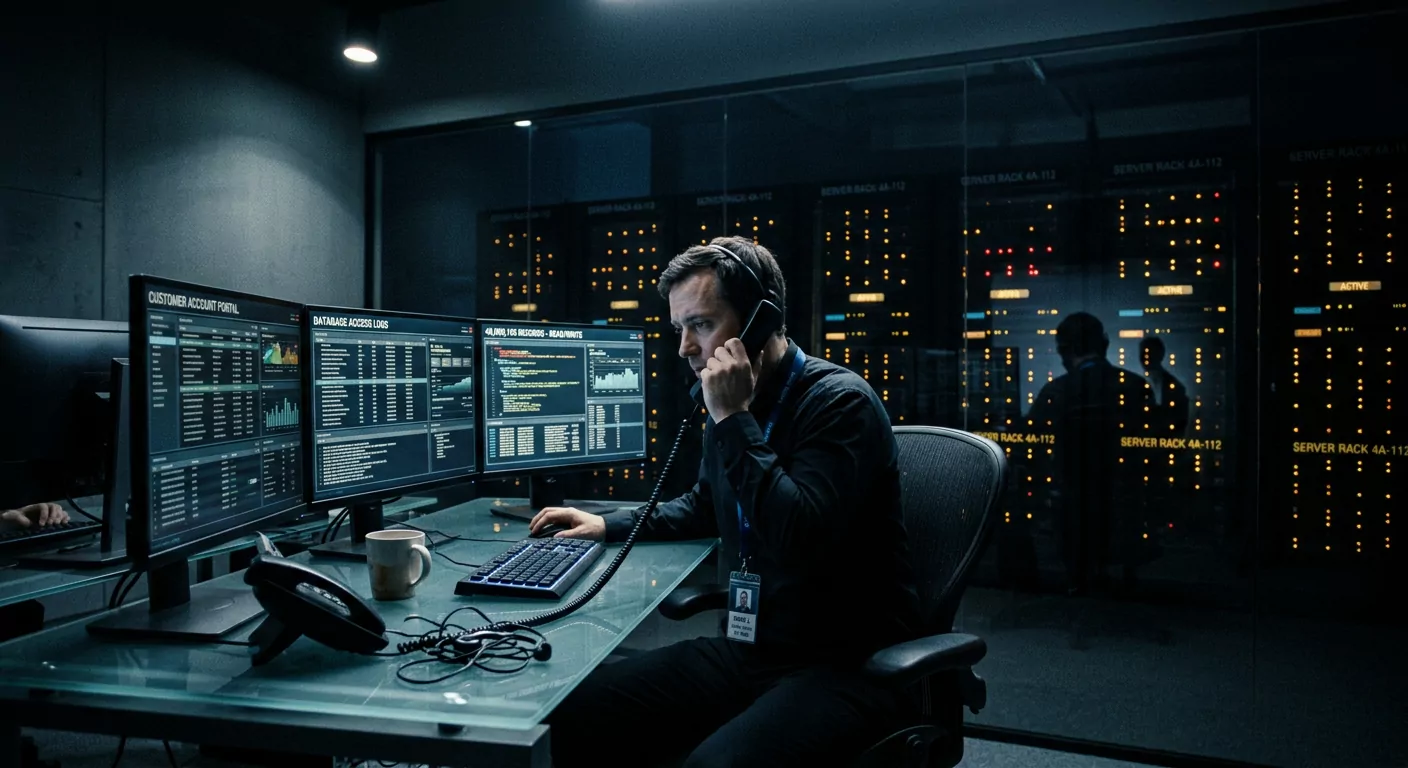
A single phone call may end up costing one of America’s largest telecom operators years of litigation and a hard reckoning with its data security posture. On June 1, 2026, plaintiff Mariah Kent filed a class-action complaint against Charter Communications in Connecticut federal court, the first of at least four such complaints now pending in that venue. The allegation at the center of each is the same: that Charter, which operates the Spectrum brand, failed to put sufficient safeguards in place against a cyberattack in early April 2026 that reportedly exposed more than 42 million records containing personal information.
What makes this case worth the attention of every compliance professional in the telecom and SaaS-dependent sectors is not merely the eye-catching record count. It is the method of compromise and the nature of the data exposed. The attackers did not defeat a firewall or exploit an unpatched server. They talked their way in. And among the data they reached was a category that carries regulatory weight far beyond ordinary personally identifiable information: customer proprietary network information, or CPNI.
Why this breach matters
Most data breach class actions follow a familiar script. A company suffers an intrusion, customer PII spills, and plaintiffs allege the company should have done more to protect it. The Spectrum litigation fits that template on its surface, but two features set it apart.
First, the intrusion vector was social engineering, not a technical exploit. That shifts the negligence conversation away from patch management and toward human-layer controls, help-desk procedures, and identity governance — areas where many organizations have invested far less.
Second, the data reportedly included CPNI, which is governed by a specific federal statute and a dedicated FCC rulemaking regime. When a telecom carrier exposes call history and service usage data, it is not only facing the general patchwork of state breach-notification and consumer-protection laws. It is potentially implicating sector-specific obligations that carry their own enforcement machinery. That combination — a human-engineered breach touching regulated network data at one of the country’s largest carriers — is what puts this case under the microscope.
The anatomy of the breach: how a conversation beat the controls
According to the complaints, cybercriminals associated with the group known as ShinyHunters used voice phishing — vishing — to trick a Charter employee into revealing login credentials for the company’s Microsoft Entra system. Entra is Microsoft’s cloud identity and access management platform, the gatekeeper that decides who is allowed into an organization’s connected applications. Compromise the identity layer, and much of the perimeter becomes irrelevant.
From that foothold, the attackers reportedly moved laterally and accessed the Salesforce customer relationship management (CRM) platform, where sensitive customer data was stored. More than 40 million customer records were reportedly compromised in the process, including certain CPNI such as service usage and call history data.
The chain is worth restating plainly because each link is a lesson:
- A human being received a phone call and, believing it legitimate, handed over working credentials.
- Those credentials unlocked the Entra identity platform.
- From identity, the attackers pivoted into the Salesforce CRM.
- The CRM held a vast trove of customer data, including regulated network information.
Notice what is absent from that sequence. There is no zero-day vulnerability, no brute-forced password, no malware dropped through a phishing attachment. The initial compromise was a conversation. This is precisely why social engineering remains so effective: it routes around the technical controls that security budgets disproportionately favor. An organization can hold a flawless vulnerability-management program and still be undone by an employee who trusts the wrong voice on the line.
It also illustrates why credential theft has become the dominant path into modern cloud estates. Once an attacker holds valid credentials for an identity provider, many downstream systems treat them as a legitimate user. The blast radius is determined not by how many locks were picked but by how broadly that one identity was permitted to roam — and by how much sensitive data sat reachable in the connected SaaS applications.
The CPNI dimension: why call history is not just more PII
The reported exposure of CPNI is the element that elevates this incident from a conventional consumer-data breach to a sector-specific regulatory concern.
CPNI is a defined term under Section 222 of the Communications Act of 1934, as amended. Broadly, it covers information that a telecommunications carrier acquires by virtue of providing service — the kind of data revealed by the customer’s relationship to the network. This includes details such as the services a customer subscribes to, how and how much those services are used, and call history: the to, from, and when of a customer’s communications. It is, in essence, a record of a person’s communications behavior, and Congress singled it out for heightened protection precisely because of how revealing it can be.
Section 222 imposes a duty on carriers to protect the confidentiality of CPNI, and the Federal Communications Commission has built out that statutory duty through detailed rules. The FCC’s CPNI framework historically constrains how carriers may use, disclose, and permit access to this information, and it requires carriers to take reasonable measures to safeguard it. The Commission has also, over time, layered breach-notification expectations onto carriers handling CPNI, and it has shown willingness to pursue enforcement when carriers fail to protect this category of data.
The practical consequence for Charter is that the service-usage and call-history data reportedly caught up in this breach may be evaluated against a federal standard distinct from — and in addition to — the general reasonableness standards invoked in the class-action complaints. Ordinary PII exposure tends to be litigated under negligence theories and state statutes. CPNI exposure can additionally draw the attention of a federal regulator with its own rules about safeguarding, access controls, and notification. A carrier that stored regulated network data in a broadly accessible CRM, reachable through a single compromised identity, will face pointed questions about whether its safeguards met the Section 222 standard.
This is also why telecom breaches deserve their own compliance lens. The same call-detail records that make CPNI valuable to a carrier make it sensitive to a regulator and attractive to an attacker. Storing it alongside marketing and support data in a SaaS CRM, without tight segmentation, concentrates regulated information in exactly the place an identity-based intruder is likely to land.
The class-action theories — and the records-count caveat
The complaints, led by Kent’s June 1 filing, advance the familiar core theory of data-breach litigation: that Spectrum and Charter failed to properly secure and safeguard the personally identifiable information of Spectrum customers and employees. Kent specifically claims the company did not adequately protect that PII. Plaintiffs in cases of this kind typically frame the conduct as negligence and as a failure to implement reasonable data-security measures commensurate with the volume and sensitivity of the data held. With CPNI in the mix, expect plaintiffs to emphasize that the data was not only sensitive but subject to specific statutory protection.
At least four class-action complaints have now been filed in Connecticut federal court, a clustering that often signals plaintiffs’ firms positioning for consolidation and a contest over leadership of the litigation. That pattern echoes the broader settlement wave that has swept the telecom and cable sector, where large carriers have repeatedly found themselves answering for the security of vast customer databases.
A note of caution is warranted on the headline number. The complaints reference more than 42 million records, and more than 40 million customer records are described as compromised. Yet Charter currently serves more than 32 million customers in the United States. A figure of 40 to 42 million records would therefore exceed the company’s entire customer base. That does not mean the breach was small — but it strongly suggests the record count may be inflated by duplicates, by historical or former-customer entries, or by multiple records per account. The 42 million figure may simply not be accurate as a count of distinct affected individuals. Compliance teams reading the coverage should treat the number as a reported, contested figure rather than an established fact, and should expect the actual scope of affected individuals to be litigated and refined as the cases proceed. Overstated counts are common in the early phase of breach litigation, and defendants routinely contest them.
What telecom and SaaS-reliant compliance teams should do
The Spectrum incident is a near-textbook illustration of where modern defenses fail. The lessons translate directly into a program of work.
Treat social engineering as a first-class threat. Anti-vishing and broader social-engineering controls deserve the same rigor as technical vulnerability management. That means realistic, voice-based simulation exercises, clear escalation paths when an employee suspects a manipulation attempt, and a culture in which verifying an unexpected caller is rewarded rather than treated as friction.
Harden the identity layer with phishing-resistant authentication. Credentials that can be spoken aloud over the phone can be stolen over the phone. Phishing-resistant, MFA-resistant-attack-hardened methods — hardware security keys and FIDO2/WebAuthn-based authentication — break the chain because there is no shared secret for an employee to disclose. For an identity platform like Entra, this should be the default for privileged and broadly scoped accounts.
Fortify the help desk and account-verification process. Many vishing attacks succeed by targeting support staff or by impersonating them. Strong, scripted verification procedures — that do not rely on knowledge an attacker can research — are essential at every point where credentials, resets, or access changes can be granted.
Minimize data in the CRM. The breach reached so much because so much was reachable. Practice CRM data minimization: do not store regulated CPNI or excess PII in a customer-support platform unless it is genuinely required, and segment or tokenize what must be kept. The less an identity can touch once compromised, the smaller the blast radius.
Map and constrain third-party SaaS exposure. Salesforce, Entra, and comparable platforms are now where the crown jewels live. Inventory which SaaS applications hold sensitive or regulated data, scope access tightly through least privilege, monitor for anomalous cross-application movement, and ensure logging is sufficient to reconstruct lateral activity after the fact.
Account for sector-specific obligations. For carriers, CPNI safeguarding under Section 222 and the FCC rules is not optional and not subordinate to general practice. Confirm that systems holding network-usage and call-history data meet the heightened standard, and that breach-notification planning accounts for federal as well as state requirements.
Compliance checklist
- Run voice-based (vishing) social-engineering simulations and track results like any other security metric.
- Deploy phishing-resistant authentication (FIDO2/WebAuthn, hardware keys) for identity-platform and privileged accounts.
- Document and enforce help-desk verification procedures that do not rely on publicly discoverable knowledge.
- Apply least privilege and conditional access across the identity provider; review broadly scoped accounts.
- Minimize, segment, or tokenize sensitive data — especially CPNI — held in CRM and support platforms.
- Maintain a current inventory of SaaS applications storing regulated or sensitive data.
- Enable and retain logging sufficient to detect and reconstruct lateral movement between cloud applications.
- Confirm CPNI handling meets Section 222 and FCC safeguarding and notification expectations.
- Build breach-response playbooks that address both federal sector rules and state breach-notification laws.
Conclusion
The Spectrum litigation will turn on contested facts — the true number of affected individuals chief among them. But the strategic lesson does not depend on the final record count. An organization can spend heavily on technical security and still be breached because one employee believed one phone call. When that breach reaches a CRM holding regulated network data, the consequences extend past private litigation into sector-specific federal obligations.
For telecom carriers and the growing universe of SaaS-dependent enterprises, the takeaways are clear. The identity layer is the new perimeter, the help desk is part of the attack surface, and data that does not need to be in a CRM should not be there. CPNI, in particular, demands handling that reflects its special legal status. The companies that internalize these lessons before their own vishing call arrives will be the ones that avoid becoming the next clustered docket in federal court.
This article is provided for informational purposes only and does not constitute legal advice.