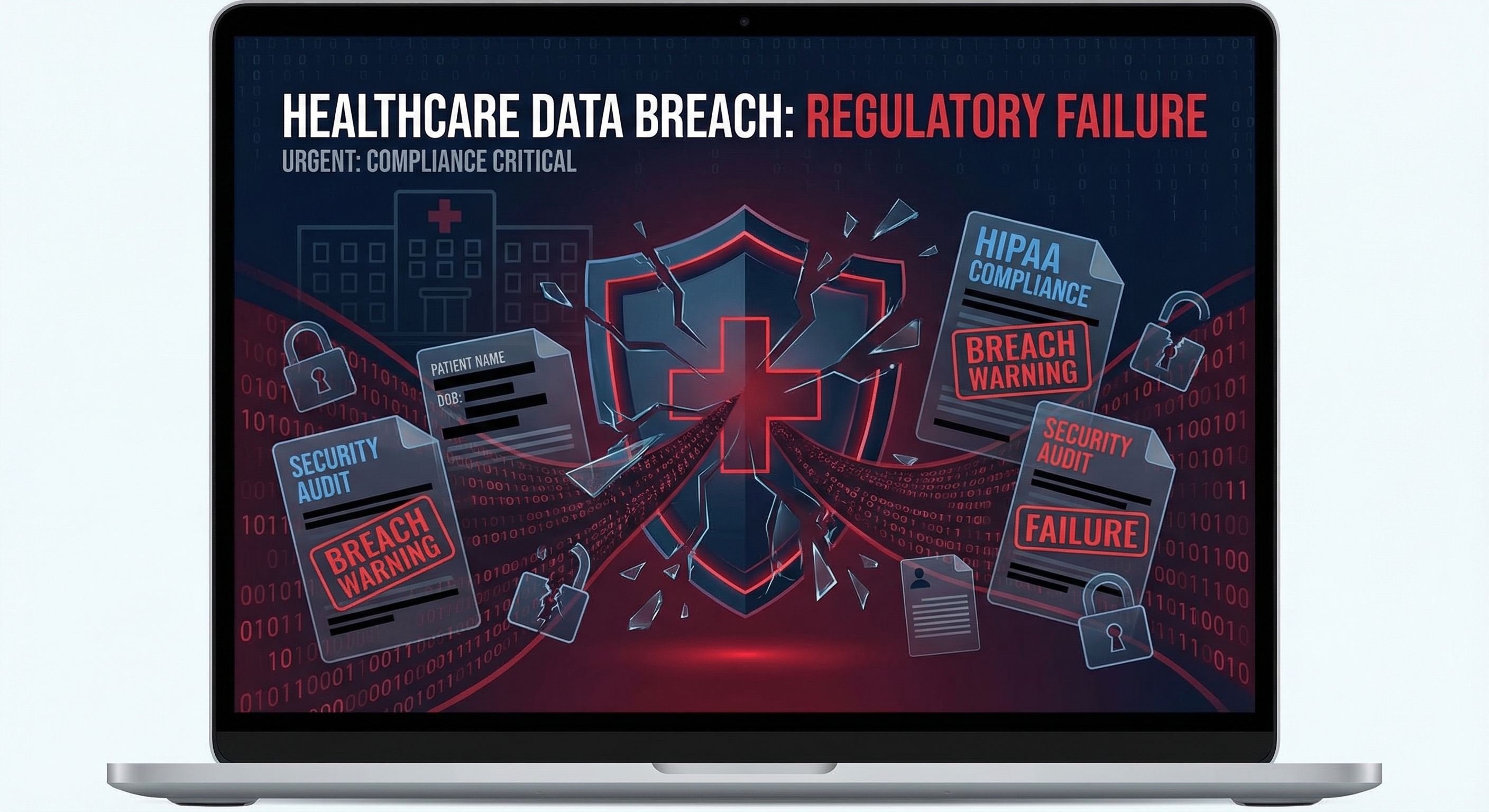
The healthcare industry is reeling from yet another catastrophic data breach, this time striking at the very infrastructure that processes medical claims for hundreds of millions of Americans. TriZetto Provider Solutions, a Cognizant subsidiary that serves as a critical healthcare technology backbone, has confirmed that hackers stole sensitive health and personal data belonging to 3,433,965 patients—a breach that went undetected for nearly eleven months.
This incident represents more than just another entry in the growing ledger of healthcare data breaches. It exposes fundamental failures in HIPAA compliance, third-party risk management, and the healthcare industry’s ability to protect the most sensitive information Americans possess. For compliance professionals, this breach serves as a stark case study in everything that can go wrong when vendor oversight fails.
The Breach Timeline: A Study in Detection Failure
The facts surrounding the TriZetto breach paint a troubling picture of security monitoring gone wrong. According to breach notifications filed with state regulators and the HHS Office for Civil Rights (OCR), the timeline unfolded as follows:
- November 2024: Unauthorized access to TriZetto systems begins
- October 2, 2025: TriZetto finally detects the intrusion—approximately 11 months later
- March 2026: Public disclosure and breach notifications sent to affected individuals
This nearly year-long dwell time represents a catastrophic failure of security monitoring. Under HIPAA’s Security Rule (45 CFR § 164.308), covered entities and their business associates are required to implement procedures to regularly review records of information system activity, including audit logs, access reports, and security incident tracking. The fact that attackers maintained access for eleven months suggests either a complete absence of effective monitoring or a failure to act on warning signs.
To put this in perspective: during those eleven months, threat actors had unfettered access to systems processing claims for healthcare providers serving approximately 200 million people. The potential for data exfiltration, manipulation, or sale on dark web markets was essentially unlimited.
Scope of Compromised Data: The Full PHI Spectrum
The data compromised in this breach represents virtually every category of protected health information (PHI) that HIPAA seeks to protect:
- Personal Identifiers: Full names, dates of birth, home addresses
- Financial Identifiers: Social Security numbers
- Healthcare Information: Names of healthcare providers, demographic data
- Insurance Details: Health insurance information and policy data
- Medical Information: Unspecified health-related details
This combination of data elements creates a perfect storm for identity theft, medical fraud, and targeted social engineering attacks. Unlike a credit card number that can be changed, Social Security numbers and medical histories are permanent. Victims of this breach face a lifetime of elevated risk.
The breadth of compromised information also triggers the full weight of HIPAA’s Breach Notification Rule. Under 45 CFR § 164.404, any breach involving unsecured PHI affecting more than 500 individuals requires notification to affected individuals, the HHS Secretary, and prominent media outlets. With 3.4 million affected individuals, this breach clearly exceeds every threshold in the regulation.
Business Associate Liability: The Compliance Chain Reaction
TriZetto Provider Solutions operates as a business associate under HIPAA, providing healthcare claims processing and revenue cycle management services to healthcare providers nationwide. This status carries significant compliance obligations that appear to have been breached.
Under the HIPAA Privacy and Security Rules, business associates must:
- Implement appropriate safeguards to protect PHI (45 CFR § 164.308-312)
- Report breaches to covered entities without unreasonable delay, and no later than 60 days after discovery (45 CFR § 164.410)
- Ensure subcontractor compliance through business associate agreements (45 CFR § 164.314)
The eleven-month detection gap raises serious questions about TriZetto’s implementation of the Security Rule’s administrative, physical, and technical safeguards. Specifically, the regulation requires:
- Audit controls (45 CFR § 164.312(b)): Hardware, software, and procedural mechanisms to record and examine activity in systems containing PHI
- Information system activity review (45 CFR § 164.308(a)(1)(ii)(D)): Regular review of records of information system activity
- Security incident procedures (45 CFR § 164.308(a)(6)): Procedures to identify, respond to, and mitigate security incidents
A breach remaining undetected for nearly a year suggests material deficiencies in each of these required safeguards.
The Ripple Effect: Downstream Healthcare Providers
The TriZetto breach exemplifies the cascading compliance risks inherent in healthcare’s interconnected vendor ecosystem. OCHIN, a nonprofit health technology organization serving over 300 rural and community healthcare providers, has confirmed its patients were affected by the breach.
For these downstream covered entities, the breach triggers several compliance obligations:
- Breach notification responsibilities: Even though the breach occurred at a business associate, covered entities must ensure affected individuals receive proper notification
- Risk assessment updates: Organizations must reassess their risk analyses to account for this vendor compromise
- Business associate agreement review: Contracts with TriZetto and similar vendors must be evaluated for compliance with current requirements
This incident underscores why HIPAA holds covered entities responsible for their business associates’ compliance. The 2013 HIPAA Omnibus Rule significantly expanded business associate liability, but covered entities cannot simply outsource their compliance obligations. They must conduct due diligence, maintain appropriate agreements, and implement ongoing vendor monitoring programs.
Expected OCR Enforcement Actions
Given the scale of this breach and the apparent compliance failures, the HHS Office for Civil Rights will almost certainly conduct a detailed investigation. Based on OCR’s enforcement history, TriZetto faces potential penalties in several categories:
Tier 4 Penalties (Willful Neglect Not Corrected)
If OCR determines the breach resulted from willful neglect that was not timely corrected, penalties can reach $1.5 million per violation category per year. With multiple Security Rule provisions potentially violated across an eleven-month period, theoretical maximum penalties could reach tens of millions of dollars.
Resolution Agreement and Corrective Action Plan
More commonly, OCR negotiates settlement agreements requiring:
- Substantial monetary payment (recent healthcare settlements have ranged from $1 million to $16 million)
- Multi-year corrective action plan with independent monitoring
- Mandatory security program improvements
- Regular compliance reporting to OCR
State Attorney General Actions
Under HIPAA’s enforcement provisions, state attorneys general can also bring civil actions for HIPAA violations. California, where multiple affected providers are located, has been particularly aggressive in pursuing healthcare data breach enforcement.
Comparisons to Change Healthcare: A Pattern Emerges
The TriZetto breach invites inevitable comparisons to the devastating Change Healthcare attack of 2024, which affected over 100 million Americans and caused unprecedented disruption to the U.S. healthcare system.
Both incidents share troubling commonalities:
| Factor | Change Healthcare | TriZetto |
|---|---|---|
| Position | Claims clearinghouse | Claims processing |
| Scale | 100+ million affected | 3.4 million confirmed |
| Data type | PHI + financial | PHI + financial |
| Vendor status | Business associate | Business associate |
| Systemic risk | Served 30% of claims | Serves 200 million covered lives |
These parallels suggest a systemic vulnerability in healthcare’s concentration of PHI processing in a small number of technology providers. When these chokepoints fail, the entire healthcare ecosystem suffers.
The difference in detection time is particularly notable. Change Healthcare’s breach was detected relatively quickly due to the ransomware deployment that disrupted operations. TriZetto’s breach, apparently involving pure data exfiltration without operational disruption, went unnoticed for nearly a year. This raises the question: how many similar breaches remain undetected across the healthcare industry?
Lessons for Healthcare Compliance Programs
The TriZetto breach offers critical lessons for healthcare compliance and security professionals:
1. Vendor Risk Management Must Be Continuous
Annual vendor assessments are insufficient. Organizations must implement:
- Continuous security monitoring of critical vendors
- Real-time threat intelligence sharing with business associates
- Regular penetration testing requirements in BAAs
- Breach notification SLAs shorter than HIPAA’s 60-day maximum
2. Detection Capabilities Matter More Than Prevention
No security program can prevent all breaches. The TriZetto incident demonstrates that detection and response capabilities are equally critical. Organizations should require:
- Proof of 24/7 security monitoring
- Mean-time-to-detect (MTTD) metrics from vendors
- Incident response plan testing and results
- Threat hunting programs for critical systems
3. Business Associate Agreements Need Teeth
Standard BAA templates often lack meaningful accountability provisions. Consider adding:
- Specific security control requirements beyond general HIPAA references
- Audit rights with reasonable frequency
- Financial penalties for compliance failures
- Cyber insurance requirements with appropriate coverage limits
- Breach cost indemnification clauses
4. Concentration Risk Requires Board-Level Attention
When a single vendor processes PHI for millions of patients, that vendor becomes a critical infrastructure component. Boards and senior leadership must:
- Identify single points of failure in the PHI supply chain
- Evaluate redundancy and business continuity options
- Consider the systemic risk of vendor consolidation
- Factor concentration risk into vendor selection decisions
5. Assume Breach, Plan Accordingly
The “assume breach” mindset should extend to business associates. Organizations should:
- Maintain detailed inventories of PHI shared with each vendor
- Implement data minimization to limit exposure
- Develop breach response playbooks specific to each critical vendor
- Conduct tabletop exercises simulating vendor breaches
Regulatory Reform Considerations
The TriZetto breach, following closely on the Change Healthcare disaster, is likely to accelerate regulatory reform discussions. Potential changes under consideration include:
- Mandatory minimum security standards for healthcare technology vendors exceeding certain size thresholds
- Required threat detection and response capabilities with specific performance metrics
- Enhanced reporting requirements including near-real-time breach notification
- Increased OCR enforcement resources to conduct more proactive audits
- Stricter business associate certification requirements
The healthcare industry’s track record on self-regulation has been mixed at best. These high-profile incidents provide ammunition for advocates of more prescriptive security requirements.
Conclusion: The Compliance Imperative
The TriZetto breach is not an isolated incident but a symptom of deeper structural problems in healthcare cybersecurity and compliance. When a vendor serving 200 million people can be compromised for nearly a year without detection, something is fundamentally broken in our approach to protecting patient information.
For compliance professionals, this breach reinforces several critical imperatives:
First, HIPAA compliance is not a checkbox exercise. The Security Rule’s requirements for monitoring, audit controls, and incident response exist for exactly this reason. Organizations that treat compliance as a documentation exercise rather than an operational program leave themselves—and their patients—exposed.
Second, vendor risk is your risk. The HIPAA Privacy and Security Rules make clear that covered entities cannot outsource their compliance obligations. Business associate failures become covered entity failures. Robust vendor management is not optional.
Third, detection is as important as prevention. An eleven-month dwell time is not a sophisticated attack evading cutting-edge defenses. It’s a fundamental monitoring failure. Organizations must demand—and verify—that their vendors can detect intrusions in hours or days, not months.
The 3.4 million patients affected by this breach are now permanent members of a club no one wants to join: individuals whose most sensitive personal and health information is in the hands of unknown threat actors. Their Social Security numbers cannot be changed. Their medical histories cannot be erased. They will face elevated identity theft and fraud risk for the rest of their lives.
That’s the human cost of compliance failure. It should focus minds across the healthcare industry on building security programs that actually work, not just programs that look good on paper.
This article is provided for informational purposes only and does not constitute legal advice. Organizations should consult with qualified legal counsel regarding their specific compliance obligations.