On July 13, 2026, nineteen government agencies from thirteen countries co-signed a single cybersecurity advisory with an unusually specific title: “Improve Router Hygiene to Protect Against Russian State-Sponsored Targeting.” Cataloged by CISA as AA26-194A and posted to media.defense.gov on July 9, the advisory warns that cyber actors of the Russian Federal Security Service (FSB) Center 16 “continue to exploit poorly configured and vulnerable networking devices worldwide,” and are “opportunistically compromising multiple critical infrastructure sector networks.”
The word doing the work in that sentence is opportunistically. This is not a campaign against named victims with a specific intelligence requirement. It is internet-scale scanning for a class of device that a large fraction of organizations do not patch, do not inventory, do not monitor, and do not put inside an audit scope. Center 16 is not defeating your security program. It is walking through the part of your estate that your security program was never pointed at.
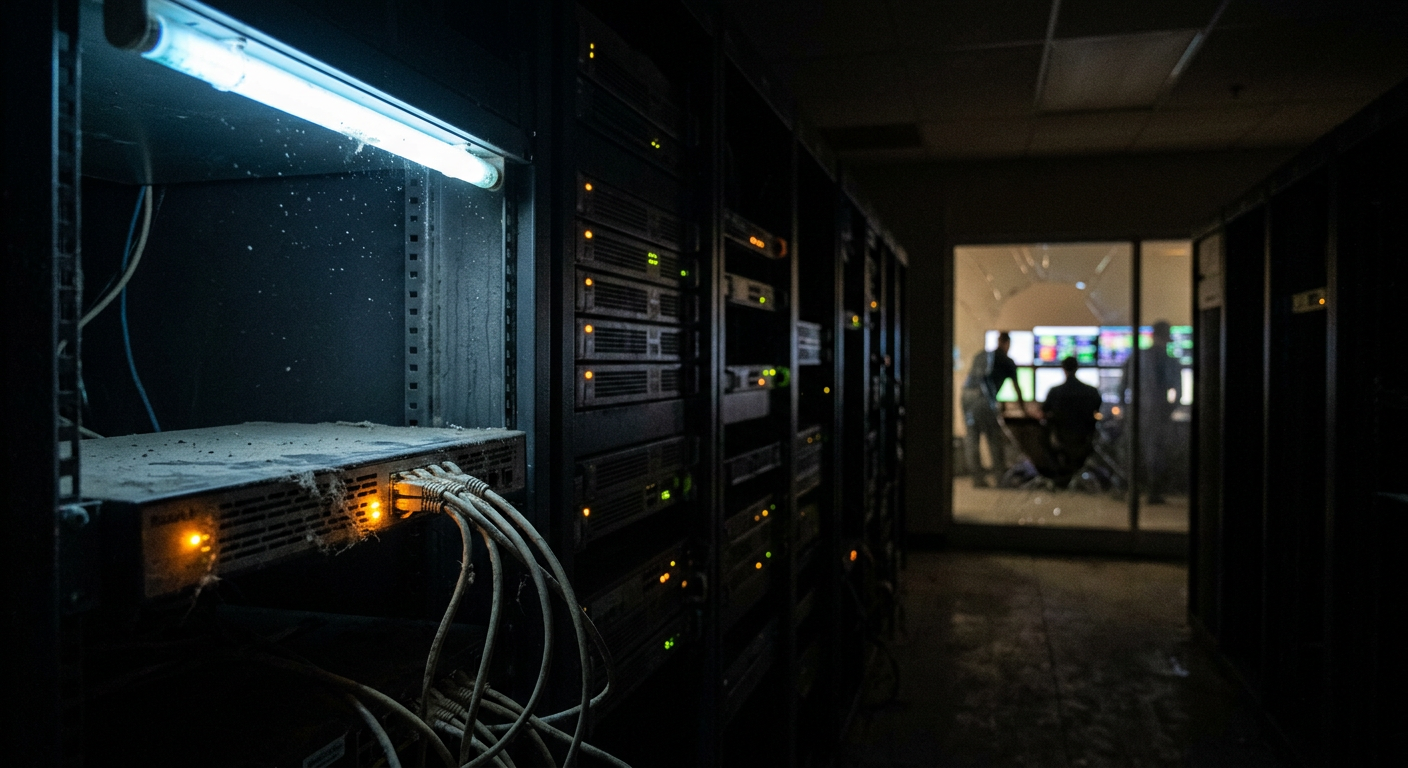
That is the compliance story here, and it is the one this article is about. The router, the edge switch, the aging VPN concentrator — these are the assets that fall between the desks. The endpoint team owns laptops. The cloud team owns tenants. The application team owns code. The network device sits in a closet, was configured once in 2019 by someone who has since left, and answers to no control owner. AA26-194A is, read correctly, a regulator-grade notice that this blind spot is now the preferred entry point for one of the most capable state actors in the world. And joint advisories have a way of becoming the “you were warned” exhibit in the enforcement action that follows.
Who Center 16 Is, and Why the Attribution Matters
The advisory attributes the activity to FSB Center 16, the signals-intelligence arm of Russia’s Federal Security Service. What makes the attribution useful for defenders is the overlap map: Center 16 activity is tracked by industry under a long list of familiar cluster names — Turla, Venomous Bear, Secret Blizzard, Dragonfly, Energetic Bear, Berserk Bear, Crouching Yeti, Ghost Blizzard, and Static Tundra. If your threat-intelligence feed has ever flagged any of those names against your sector, this advisory is describing the same adversary and telling you where it now prefers to knock.
The nineteen co-sealing agencies are themselves the message. Alongside the NSA, CISA, FBI, and the DoD Cyber Crime Center (DC3) from the United States, the advisory carries the seals of cyber authorities from Australia, Canada, New Zealand, the United Kingdom, the Czech Republic, Denmark, Estonia, Finland, France, Italy, Poland, and Sweden. When thirteen governments put their names to one document describing one adversary and one class of technique, the regulatory subtext is unmistakable: this is being treated as constructive notice to every operator in the named sectors. After an advisory like this, “we didn’t know network devices were a target” stops being an available answer.
The sectors the advisory names as targeted are the usual critical-infrastructure roster, and they map directly onto the regimes covered below: Communications, the Defense Industrial Base, Energy, Financial Services, Government Services and Facilities, and Healthcare and Public Health.
How the Compromise Actually Works
The advisory’s technical core is almost anticlimactic in its simplicity, and that is the point. There is no zero-day here. There is old protocol design and older negligence.
SNMP with default or common community strings is the primary door. Center 16 actors scan the internet for routers and other devices running an active Simple Network Management Protocol (SNMP) agent that answers to default or easily guessed community strings — the shared secrets public and private chief among them. SNMP v1 and v2c transmit those community strings in cleartext and offer no real authentication; a community string is a bearer credential in the plainest sense. Once a device answers, the actors issue SNMP Set-Requests, often from spoofed source addresses over UDP, invoking the CISCO-CONFIG-COPY-MIB to instruct the router to copy its own running configuration to an actor-controlled server via TFTP (Trivial File Transfer Protocol, UDP port 69 — itself unauthenticated and unencrypted).
The configuration file is the prize. It contains local account credentials and the SNMP community strings themselves, frequently stored under weak or reversible hashing. With the config in hand, the actors can move from read access to persistent control — creating accounts, enabling remote-access services, and establishing GRE tunnels for durable access into the network behind the device.
The second door is a seven-year-old CVE that will not die: CVE-2018-0171. This is the critical (CVSS 9.8) remote code execution flaw in the Cisco Smart Install feature of Cisco IOS and IOS XE. Smart Install listens unauthenticated on TCP port 4786 and was enabled by default on a generation of switches. An unauthenticated attacker who can reach that port can seize the device. The vulnerability was disclosed in 2018, has a patch, and remains one of the most reliably exploitable footholds in critical infrastructure in 2026 — purely because the affected devices are the ones nobody re-touches. The advisory also flags legacy and end-of-life gear more broadly; CISA concurrently added CVE-2008-4128, a flaw affecting end-of-life Cisco 871 routers, to its Known Exploited Vulnerabilities catalog.
Every element of this is preventable with configuration hygiene that has been standard guidance for a decade. That is precisely why it belongs in a compliance discussion rather than only an engineering one. When the fix has been known for ten years and the failure persists, the failure is not technical — it is a governance gap in who owns the device and whether anyone is accountable for its state.
This is the same pattern the 2026 Verizon DBIR documented at the macro level: vulnerability exploitation has overtaken stolen credentials as the leading breach entry point, and organizations remediate only a fraction of the KEV catalog. AA26-194A is that statistic pointed at one device class.
Why Network Devices Fall Out of Every Framework’s Scope
Before mapping mitigations to controls, it is worth naming precisely how these devices escape governance, because the escape routes are structural and repeat across every organization.
They are absent from the asset inventory. Asset management programs were built around servers, workstations, and — belatedly — cloud instances and SaaS. The router that has an IP but no operating-system agent, no EDR, and no user logging into it interactively is frequently just not in the CMDB. A control that begins “for all assets in inventory” silently excludes it.
They have no patch SLA. Patch management programs are tuned to Patch Tuesday and to agent-reporting tools that network appliances do not feed. Firmware updates on a router require a maintenance window, a change ticket, and someone willing to risk a reboot of a device that “has been fine for years.” The path of least resistance is to leave it, and the SLA that would force the issue was never written to include it.
They are outside the audit scope. SOC 2 and ISO 27001 audits sample the systems the organization declares in scope. Infrastructure network devices are routinely treated as boundary plumbing rather than in-scope assets, so the auditor never asks for their configurations, and the clean report coexists with a switch running SNMP v2c and public as its community string.
They have no control owner. The deepest problem. Endpoints, applications, and cloud each have an accountable team. The device in the closet frequently has none — jointly “owned” by a network team that treats it as available-infrastructure and a security team that assumes the network team has it covered. Diffuse ownership is no ownership.
AA26-194A is the argument for closing all four gaps at once, and the good news is that the corrective controls already exist inside the frameworks organizations are audited against. They simply have to be applied to the device class that has been quietly exempted.
Mapping the Advisory to NIST CSF 2.0 and 800-53
For any organization anchored on NIST, the advisory’s mitigations are not new controls — they are existing controls that must be scoped to include network infrastructure.
Asset inventory: NIST CSF 2.0 ID.AM-01 and ID.AM-02; 800-53 CM-8. The predicate for everything else. CM-8 (System Component Inventory) requires an accurate, maintained inventory of components — and network devices are components. If your CM-8 evidence is a server-and-endpoint export, it is incomplete, and the advisory just told the auditor where to look.
Configuration management and hardening: CSF PR.PS-01; 800-53 CM-2, CM-6, CM-7. CM-6 (Configuration Settings) and CM-7 (Least Functionality) are the direct home of “disable Smart Install,” “disable SNMP v1/v2c,” and “turn off unused management services.” Smart Install listening on TCP 4786 with no operational need is a textbook CM-7 least-functionality finding. A documented, enforced baseline that specifies SNMPv3-only and no Smart Install is exactly the CM-2/CM-6 evidence an assessor wants.
Flaw remediation: CSF ID.RA-01 and PR.PS-02; 800-53 SI-2. SI-2 (Flaw Remediation) covers patching CVE-2018-0171 and retiring the end-of-life gear the advisory calls out. An SI-2 program that reports 98% patch compliance while excluding network firmware is measuring the wrong denominator.
Monitoring and integrity: CSF DE.CM-01; 800-53 SI-4, SI-7, AU-6. SI-4 (System Monitoring) and SI-7 (Software, Firmware, and Information Integrity) cover detecting unauthorized configuration changes — the config-copy behavior at the heart of this campaign. Alerting on unexpected use of the config-copy OIDs, on new accounts, and on GRE tunnel creation is the detective layer.
Framework note: the CSF 2.0 Govern (GV) function is where the ownership gap gets fixed. GV.RR (Roles, Responsibilities, and Authorities) is the control that assigns an accountable owner to the device class that currently has none. Solving this as a pure engineering problem while leaving GV.RR unaddressed guarantees the gap reopens.
CIS Controls: The Fastest Prescriptive Path
For organizations that operate the CIS Controls v8.1, the advisory maps almost line-for-line, which makes CIS the quickest way to turn AA26-194A into a task list:
- Control 1 (Inventory and Control of Enterprise Assets) — get every router, switch, and appliance into the inventory. This is the whole ballgame.
- Control 4 (Secure Configuration of Enterprise Assets and Software) — Safeguard 4.1 (secure configuration process) and 4.8 (disable unnecessary services) directly retire Smart Install and legacy SNMP. This control names network devices explicitly.
- Control 7 (Continuous Vulnerability Management) — bring CVE-2018-0171 and EOL hardware into the remediation cycle.
- Control 12 (Network Infrastructure Management) — the control written for exactly this problem: keep infrastructure on supported versions, use secure management protocols (SNMPv3, SSH — never Telnet, SNMPv1/v2c, or TFTP for management), and manage devices with dedicated, out-of-band administration where possible.
- Control 8 (Audit Log Management) — centralize syslog and NetFlow from network devices so the config-copy and account-creation activity is actually recorded somewhere a defender can see it.
NERC CIP for Energy: The Advisory Names Your Sector
Energy operators subject to NERC Critical Infrastructure Protection standards should read AA26-194A as sector-specific. Routers and switches inside an Electronic Security Perimeter are frequently Electronic Access Control or Monitoring Systems (EACMS) or Cyber Assets in their own right, and the relevant CIP requirements bite directly:
- CIP-005 (Electronic Security Perimeters) — the routers enforcing the ESP are precisely the devices the advisory describes as targets. A compromised perimeter router is a compromised ESP.
- CIP-007 (System Security Management) — ports and services (R1), patching (R2), and malicious-code prevention map onto disabling Smart Install, closing SNMP/TFTP exposure, and remediating CVE-2018-0171. R1’s requirement to disable unneeded logical network accessible ports is the Smart Install fix stated in regulatory language.
- CIP-010 (Configuration Change Management and Vulnerability Assessments) — baseline configurations (R1) and the requirement to detect unauthorized changes (R2) are the config-integrity control at the center of this campaign.
For energy operators, “we were following joint federal guidance” is a meaningful posture in front of a regional entity and FERC. The inverse — a Smart Install exposure or SNMPv2c on an ESP router after this advisory — is the kind of finding that reads as willful in a compliance audit. This sits alongside the broader OT-targeting pattern documented in the CyberAv3ngers water-sector advisory, where the compliance lesson was identical: the joint advisory is the notice, and the enforcement question afterward is what you did with it.
HIPAA for Healthcare: Routers Are In Scope Under the Security Rule
Healthcare organizations sometimes assume the HIPAA Security Rule concerns applications and databases that hold ePHI. It does not stop there. Network devices that transmit ePHI, or that sit on the network path to systems that store it, fall squarely within the Rule’s technical and administrative safeguards, and HHS OCR has been explicit in recent guidance that network security is part of the Security Rule.
- Risk analysis, 45 CFR 164.308(a)(1)(ii)(A) — the risk analysis must consider all systems that could affect the confidentiality, integrity, and availability of ePHI. A router that can be silently reconfigured by a nation-state and used to pivot toward clinical systems is a risk-analysis item. An analysis that omits network infrastructure is, on its face, incomplete — a finding OCR has cited repeatedly.
- Access controls, 164.312(a)(1) and transmission security, 164.312(e)(1) — cleartext SNMP community strings and TFTP config transfers are the antithesis of the access and transmission safeguards the Rule requires.
- Audit controls, 164.312(b) — logging and reviewing activity on devices that touch ePHI networks.
The proposed 2026 updates to the Security Rule tighten expectations around asset inventories and network mapping specifically. An organization that cannot produce an inventory including its network devices is misaligned with where the Rule is heading, not just where it is.
NIS2 and DORA for EU-Exposed Readers
For organizations inside the EU regulatory perimeter, this advisory lands in the middle of the most consequential compliance year in a decade.
Under NIS2, essential and important entities owe risk-management measures under Article 21 covering, among other things, network security, vulnerability handling and disclosure, and asset management — with the transposition and enforcement cycle culminating through October 2026. Network-device hygiene is not a nice-to-have under Article 21; it is a named category of the required measures. And NIS2’s most pointed feature is that it puts management bodies personally on the hook for approving and overseeing these measures — a shift examined in depth in our analysis of the October 2026 deadline and management liability. A board that has approved a cyber-risk program silent on network-device management after a nineteen-agency advisory named the technique is carrying personal exposure, not merely organizational risk.
Under DORA, financial entities — one of the sectors AA26-194A names explicitly — owe ICT risk-management and resilience obligations that plainly encompass the network infrastructure carrying financial transactions. Financial-services readers should treat router hygiene as an in-scope element of the DORA control set, evidenced accordingly.
There is also an incident-reporting dimension. If a Center 16 compromise of a network device is discovered, the reporting clocks may already be running — NIS2’s 24-hour early-warning and 72-hour notification windows, DORA’s major-incident reporting, and, for US critical infrastructure, the CIRCIA reporting requirements taking effect in 2026. The device that was outside your inventory does not fall outside your reporting obligation once it is breached.
The Practical Remediation Program
Mapping to frameworks is the compliance half. Here is the engineering half, sequenced by the advisory’s own priority order, with the audit-evidence artifact each step should produce — because a control you cannot evidence is a control an auditor will treat as absent.
Immediate (this week):
- Disable Cisco Smart Install everywhere it is not operationally required. Verify with
show vstack configon IOS devices. Evidence: before/after configuration captures and a change record. - Block the exposure at the edge — deny inbound TCP 4786 (Smart Install), UDP 69 (TFTP), and SNMP ports (161/162) from untrusted networks. Evidence: firewall/ACL rule set with effective dates.
- Patch CVE-2018-0171 on all affected Cisco IOS/IOS XE devices. Evidence: SI-2 remediation ticket with version confirmation.
- Audit for compromise indicators — rogue local accounts, unexpected SNMP community strings, unexplained GRE tunnels, and enabled Telnet. Evidence: dated audit output and disposition.
Near-term (this quarter):
- Migrate to SNMPv3 with authPriv (authentication plus encryption) and disable SNMP v1 and v2c entirely. Where SNMPv3 is not yet possible, replace default community strings with long random values and restrict source IPs — as a bridge, not a destination. Evidence: standard configuration baseline specifying SNMPv3-only.
- Restrict SNMP access with MIB allow-lists (SNMP views) so that even authenticated queries cannot reach the config-copy OIDs from unauthorized sources. Evidence: view configuration.
- Re-hash device credentials to strong algorithms (Cisco Type 8) and eliminate reversible types (0, 4, 7). Evidence: configuration audit.
- Deploy detection for config-copy OID activity, new-account creation, and tunnel establishment; forward all device syslog and NetFlow to the SIEM. Evidence: detection rules and a sample alert.
Structural (this year):
- Build the network-device asset inventory and merge it into the CMDB, with a named accountable owner per device class. Evidence: CM-8 inventory including firmware versions and support status.
- Establish an EOL-device replacement program with a funded schedule for retiring unsupported hardware — the single control that closes the CVE-2008-4128 class of problem permanently. Evidence: lifecycle roadmap with budget.
- Adopt configuration-integrity monitoring that alerts on any unauthorized change to a device baseline, satisfying CM-2/CM-6, CIP-010, and CIS Control 4 in one stroke. Evidence: tooling output and change-detection alerts.
- Fix the governance gap — assign the control owner, add network devices to audit scope, and write the patch SLA that includes them. Evidence: updated RACI and scoping document.
Documenting the Response as Audit Evidence
The controls above are worth little to a regulator if the organization cannot show what it did and when. After a named joint advisory, the documentation trail is itself a control, because it is the difference between “we assessed the specific threat and acted” and silence that reads as inattention.
Open a tracked advisory-response record dated to July 2026, referencing AA26-194A by number. Record the scoping decision — which devices were assessed, which were found exposed, and the disposition of each. Preserve the before/after evidence for every hardening change. Where a device could not be immediately remediated (a maintenance window constraint, a dependency), record a risk-acceptance or compensating-control decision with a named approver and a review date, rather than leaving a silent gap. Feed the whole record into the next risk-analysis and internal-audit cycle.
This is the same discipline that separates defensible organizations from exposed ones across every incident type: the dated, reasoned, retained decision. Regulators reviewing a future breach — and the plaintiffs’ counsel who follow them — treat a documented, contemporaneous response to a specific named advisory very differently from an organization that received the same notice and did nothing recordable with it.
Conclusion
AA26-194A is, on its surface, a technical advisory about SNMP community strings and a 2018 CVE. Read for what it actually signals, it is something more pointed: a nineteen-agency, thirteen-country statement that a top-tier state adversary has settled on the one class of asset that most compliance programs quietly exempt from inventory, patching, monitoring, and audit. The techniques are old. The fixes are old. The failure that keeps them viable is not engineering ignorance — it is a governance gap in who owns the device in the closet and whether anyone is accountable for its state.
Every framework an organization is already audited against — NIST CSF and 800-53, CIS Controls, NERC CIP, the HIPAA Security Rule, NIS2 and DORA — already contains the controls that close this gap. They were simply never scoped to reach the router. The organizations that come out of this well will be the ones that treat the advisory as what regulators will later treat it as: notice. The blind spot has a name now, an adversary attached to it, and a date on the calendar. The compliance question is no longer whether network devices belong in scope. It is whether you can produce the evidence that you put them there before, not after, the incident that proves you should have.
Sources: CISA — AA26-194A: Improve Router Hygiene to Protect Against Russian State-Sponsored Targeting, Joint CSA PDF (media.defense.gov), NSA — NSA and Partners Release Guidance on Improving Router Hygiene, Picus Security — FSB Center 16: How Russian Hackers Exploit Routers via SNMP and Cisco Smart Install, GBHackers — NSA Warns Russian State-Sponsored Hackers Exploiting Vulnerable Routers, Security Boulevard — Response to CISA Advisory (AA26-194A)
This article is provided for informational purposes only and does not constitute legal advice.