Artificial intelligence is no longer an experimental technology confined to innovation labs.
It is embedded in enterprise operations, customer interactions, hiring workflows, fraud detection systems, and decision automation pipelines.
Regulators have noticed.
The question is no longer whether AI will be regulated.
The question is how rapidly AI oversight frameworks will converge — and whether enterprise security leaders are prepared for the accountability shift.
AI Defense in Action – Feb 21
40% discount code: CISOMP40
The Regulatory Shift Has Already Begun
Multiple regulatory bodies have signaled that AI governance will not be optional.
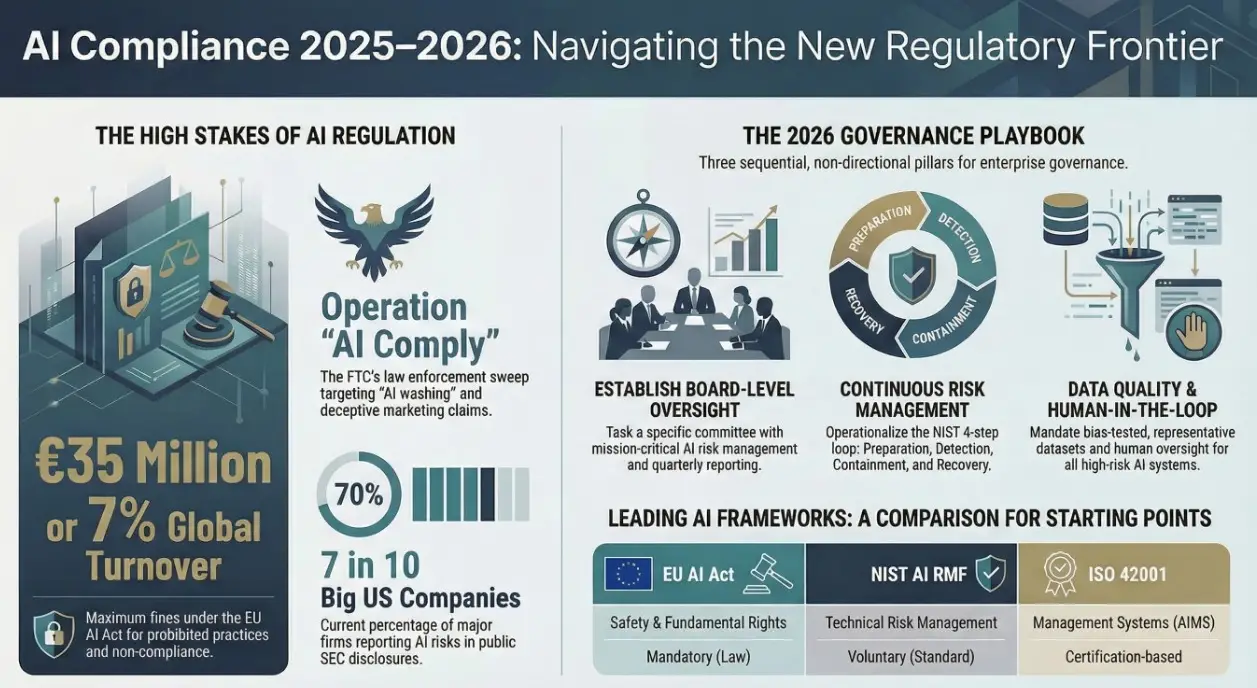
In the United States, the National Institute of Standards and Technology released its AI Risk Management Framework (AI RMF), establishing structured guidance around:
- AI system validity and reliability- Safety and resilience- Accountability and transparency- Explainability and interpretability
While the framework is technically voluntary, it is rapidly becoming a benchmark for reasonable security governance expectations.
Meanwhile, the Federal Trade Commission has warned organizations that AI-driven harm — including biased algorithms and deceptive automation — may trigger enforcement under existing consumer protection laws.
In Europe, the European Commission advanced the EU AI Act, creating tiered risk classifications and compliance obligations for high-risk AI systems.
These developments signal regulatory convergence.
AI governance is being absorbed into existing compliance, privacy, and security accountability structures.
AI Is Expanding the Compliance Surface Area
Traditional compliance programs focus on:
- Data protection- Access controls- Audit logging- Vendor risk management- Incident response
AI introduces new dimensions:
1. Model Lifecycle Governance
How is the model trained, validated, updated, and monitored?
2. Data Provenance
Where did training and input data originate? Was consent established?
3. Bias and Fairness Controls
Are automated outputs systematically disadvantaging protected groups?
4. Transparency and Explainability
Can the organization explain how automated decisions were made?
5. Human Oversight
Is there meaningful review of high-impact automated decisions?
These are not abstract questions.
They are compliance questions.
And they intersect directly with security oversight.
The AI Governance Maturity Gap: Why Most Security Teams Are Behind
The CISO’s Expanding Mandate
Historically, AI governance may have been viewed as a data science or legal issue.
That separation is dissolving.
When AI systems:
- Leak sensitive data- Produce discriminatory outcomes- Enable automated fraud- Violate cross-border data restrictions
The incident response playbook activates.
That places AI governance squarely within the CISO’s risk portfolio.
Security leaders must now understand:
- How AI systems integrate with enterprise architecture- What logging and monitoring exists around AI interactions- Whether adversarial testing has been conducted- How AI risk is escalated to executive leadership
Regulators will not accept “we didn’t know how the model behaved” as a defense.
Convergence of AI, Privacy, and Cybersecurity Law
AI regulation is not developing in isolation.
It is intersecting with:
- Data protection regimes- Consumer protection statutes- Anti-discrimination laws- Sector-specific compliance requirements
This creates a layered compliance environment.
For example:
An AI hiring tool could implicate:
- Data privacy obligations- Equal employment laws- Algorithmic transparency mandates- Cybersecurity safeguards
This convergence amplifies liability exposure.
Organizations that treat AI risk as a narrow technical concern will underestimate its compliance impact.
AI Governance Will Be a Core Skill for the Next Generation of CISOs
Practical Governance Foundations
Forward-looking enterprises are implementing foundational controls:
- Formal AI inventory tracking- Risk classification tiers for AI use cases- Documented model validation procedures- AI-specific incident response playbooks- Cross-functional AI governance committees- Board-level reporting on AI risk posture
These controls mirror what mature cybersecurity programs implemented after major breach cycles.
The difference is speed.
AI deployment is accelerating faster than traditional governance cycles.
Why Waiting Is a Risk Strategy
Many organizations are taking a “wait for regulation clarity” approach.
This is risky for two reasons:
- Enforcement often relies on existing law.2. Public trust damage precedes regulatory action.
A high-profile AI failure can trigger:
- Regulatory scrutiny- Shareholder litigation- Reputational erosion- Executive turnover
Governance maturity is not merely a compliance objective.
It is a resilience objective.
Preparing for the Next Phase
Security leaders preparing for regulatory convergence should:
- Align AI governance efforts with existing cybersecurity frameworks- Integrate AI risk into enterprise risk management reporting- Coordinate with privacy and legal teams on oversight structures- Conduct scenario-based AI failure simulations- Track evolving guidance from major regulatory bodies
The organizations that proactively structure AI governance today will adapt more easily as regulatory requirements crystallize.
AI Defense in Action – Feb 21
40% discount code: CISOMP40
The Strategic Imperative
AI regulation will not replace cybersecurity governance.
It will extend it.
CISOs who understand this convergence will position themselves as strategic leaders rather than reactive operators.
Those who do not may find that AI oversight responsibilities arrive abruptly — triggered by incident rather than preparation.
The maturity gap is narrowing.
Regulatory convergence is accelerating.
The time to formalize AI governance within security programs is now.