Two things happened this week that most people are treating as separate stories. They are not.
In a Los Angeles courtroom, Mark Zuckerberg testified under oath that Apple and Google should verify the identity of every smartphone user, at the operating system level, for every app. Not just Instagram. Every app. Every website. Every message sent from that device.
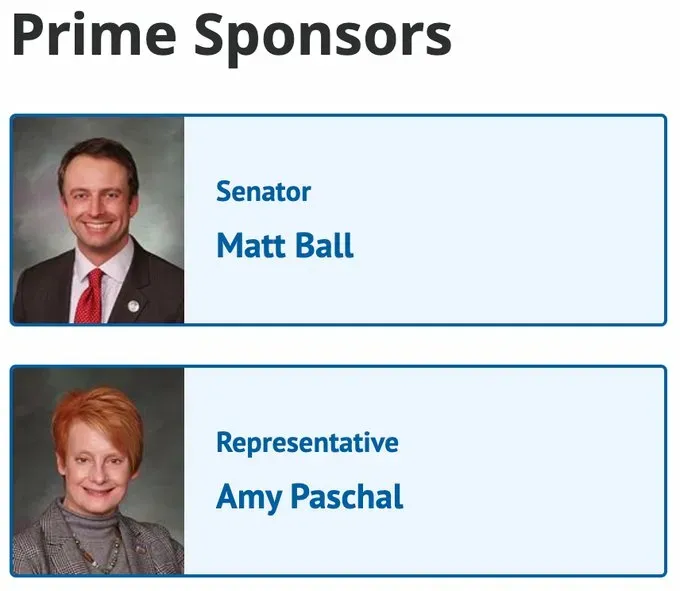
Meanwhile, in Denver, Colorado Senate Bill 26-051 — “Age Attestation on Computing Devices” — is advancing through committee. The bill, sponsored by Democratic Senator Matt Ball and Representative Amy Paschal, would require operating systems to collect and store a user’s age at device setup, then expose that data to third-party apps via API on demand.
These stories are the same story. And the implications for privacy, anonymity, and free expression online are serious.
What Colorado SB26-051 Actually Does
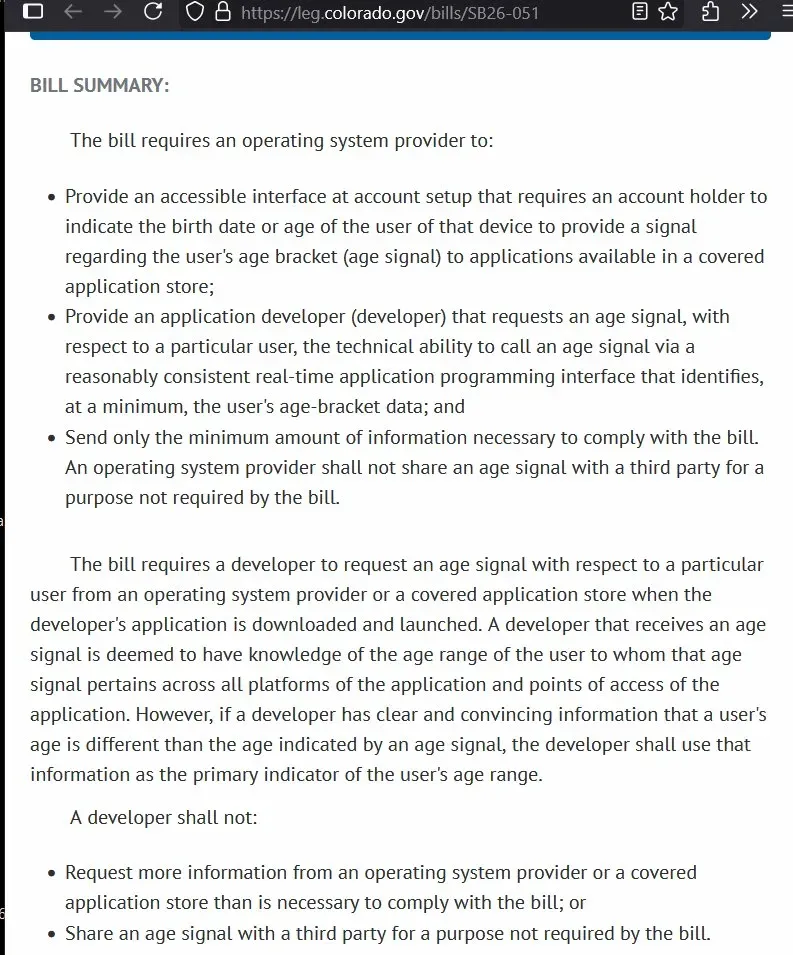
The bill’s mechanics sound reasonable on paper. Rather than requiring every app to independently verify age, it pushes that responsibility to the OS layer. When a user sets up a device, they provide their birth date. The operating system converts that into an “age bracket” — under 13, 13-17, or 18 and older. Apps can then query the OS via API to determine whether to allow access.
The stated privacy benefit: apps never see your exact birthdate, just a bracket. The OS provider is prohibited from sharing the age signal with third parties beyond what the bill requires. Violations carry civil penalties of up to $2,500 per minor for negligent violations and $7,500 per minor for intentional ones — enforcement triggered by the state attorney general.
The bill is currently assigned to the Colorado Senate Business, Labor & Technology Committee, with a hearing scheduled for February 24, 2026.
The Problems Nobody Is Talking About
Problem 1: There’s No Actual Verification
The bill requires users to enter their birth date. It does not require that birth date to be verified against any government-issued ID or external database. A 13-year-old who enters a false date faces no technical barrier. The system creates the infrastructure and the legal liability framework without solving the underlying problem it claims to target.
Critics have already noted this gap. The bill’s design means platforms receive an age signal derived from unverified self-reported data — then bear legal responsibility for acting on it. That’s not child safety. That’s liability shifting dressed up as policy.
Problem 2: The Scope Question
The bill’s language focuses on “operating system providers” and “covered application stores” — language designed for mobile ecosystems where Apple and Google control distribution. But the broader conversation, including the vxunderground thread circulating on social media, is asking the right question: does this extend to Windows and Linux?
Desktop operating systems don’t have the same centralized identity layer as mobile. If the legislative intent is to require age attestation from all computing devices — not just smartphones — the enforcement mechanism would need to be fundamentally different, potentially requiring Microsoft and Linux distributors to implement identity infrastructure that has never existed in those ecosystems.
The mobile-first framing may be a feature, not a bug. Policymakers know they can’t currently mandate this for desktop. But the architecture being built for mobile creates a template.
Problem 3: Every Verification Database Is a Future Breach
Colorado isn’t operating in a vacuum. Last year, a Discord breach exposed approximately 70,000 government-issued IDs submitted through the company’s age verification system. Every centralized collection of identity data is a target. SB26-051’s age bracket approach limits what is stored, but the device-to-identity linkage still exists at the OS level, and that’s valuable data.
Ask yourself: who subpoenas Apple’s or Google’s records of which devices belong to which age brackets when tied to account identities? Law enforcement. Advertisers. Governments. The answer to “who gets this data” is never just “the app checking your age.”
Problem 4: Anonymous Speech Dies Here
This is the consequence that gets buried in every “child safety” discussion: anonymous and pseudonymous access to the internet has genuine social value.
Whistleblowers. Abuse survivors. Political dissidents. People exploring medical questions or identities they aren’t ready to attach their legal names to. Journalists protecting sources. Researchers in hostile environments.
OS-level age verification requires tying a real identity to a device at setup. Once that infrastructure exists, it doesn’t stay limited to restricting minors from social media apps. It becomes the foundation for whatever access control regime comes next.
Zuckerberg Just Handed Legislators Their Preferred Playbook
Here’s the part that should concern every privacy and security professional.
On Wednesday, Zuckerberg spent more than five hours on the stand in a Los Angeles child safety lawsuit — one of 1,600+ related cases pending nationally — defending Instagram’s design choices. Under cross-examination, he repeatedly argued that age verification should be handled not by individual apps but at the operating system level, by Apple and Google.
“Doing it at the level of the phone is just a lot cleaner than having every single app out there have to do this separately,” he told jurors. He added it “would be pretty easy for them” to implement.
Read that carefully. The CEO of Meta, under oath, in a trial where his company faces enormous liability exposure, proposed that Apple and Google build a national digital ID layer into their operating systems. He isn’t proposing that Instagram verify Instagram users. He’s proposing that every device owner be identity-verified at the OS level, for every app, by the two companies that control the world’s dominant mobile platforms.
The liability math is obvious: if Apple and Google own age enforcement, Meta isn’t responsible for enforcement failures. The legal exposure shifts. Zuckerberg’s lawyers get a defense. Two private companies already under antitrust scrutiny get deputized as internet identity gatekeepers.
But the policy consequences extend far beyond Meta’s courtroom strategy. His testimony will appear in legislative committee hearings. It will be cited in bill summaries. It will be used as evidence that the industry itself endorses OS-level verification. Colorado’s SB26-051 sponsors now have the CEO of the world’s largest social platform on record endorsing exactly what they’re trying to legislate.
The Legislative Architecture Already Under Construction
Colorado is not alone. This is a coordinated national push:
California SB 976 (Protecting Our Kids from Social Media Addiction Act) mandates age verification for social media platforms. Implementation rules are due from the California AG by January 2027. The Ninth Circuit has declined to rule on First Amendment implications until regulations are finalized — meaning constitutional review comes after the system is built.
The Kids Online Safety Act (KOSA), pending federally, would direct agencies to develop age verification at the device or OS level. It also carries broad definitions of “harmful” content subject to government influence, with no independent review mechanism.
New York’s SAFE For Kids Act restricts algorithmic feeds for users who haven’t completed age verification. Acceptable alternatives to government ID submission include facial analysis estimating age — biometric data collected to scroll a social feed.
Each law individually sounds defensible. Together, they’re building a surveillance architecture for internet access that didn’t exist five years ago.
What the “Addiction” Framing Does to the Policy Debate
The LA trial matters for reasons beyond the verdict. The lawsuit frames social media as a defective, clinically addictive product — a legal theory that routes around Section 230’s liability protections by targeting platform design rather than user content. If the plaintiff prevails, it gives 1,600+ other cases a tested framework for stripping Section 230 protection from algorithmic decisions.
More importantly, “addiction” is doing heavy rhetorical work in the policy space. A public health emergency framing justifies emergency-style regulatory powers. Emergency powers applied to internet access mean mandatory controls. Mandatory controls require identity verification. Identity verification requires the infrastructure Colorado and a dozen other states are currently trying to build.
The chain isn’t accidental. And the endpoint — where every internet-connected device is tied to a verified identity — is the natural destination of the path being laid.
What Security Professionals Should Watch
The February 24 committee hearing for SB26-051 is the immediate inflection point. If it advances out of committee, expect similar bills to accelerate in other states within weeks.
The LA trial verdict will set precedent for whether platform design decisions can strip Section 230 protection. A verdict for the plaintiff creates immediate pressure on every major platform to implement defensive age verification before the next lawsuit.
Federal KOSA movement — any momentum on the federal bill changes the calculus dramatically, potentially preempting state variation with a single national framework.
The First Amendment gap — courts have been slow to rule on whether age verification mandates for lawful online speech violate the First Amendment. The California Ninth Circuit’s decision to wait until regulations are finalized means the constitutional question remains unanswered as infrastructure gets built.
The Bottom Line
Colorado SB26-051 is a real bill with a real committee hearing in 48 hours. Its stated goal — protecting minors from age-inappropriate content — is one almost nobody opposes. Its mechanism — OS-level age attestation with no real verification requirement — creates infrastructure that far exceeds its stated purpose.
Combine it with Zuckerberg’s courtroom endorsement of the same approach, a national wave of similar legislation, and the “addiction” framing that’s converting a contested behavioral science debate into a public health emergency with attendant regulatory powers, and the trajectory is clear.
The internet as a space where you can speak, read, and connect without tying your government identity to every action is under coordinated legislative pressure from multiple directions simultaneously.
That’s not a conspiracy theory. It’s a committee calendar.
*SB26-051 full bill text: *leg.colorado.gov/bills/SB26-051 Committee hearing: February 24, 2026 — SCR 352, 2:00 PM MT