Executive Summary
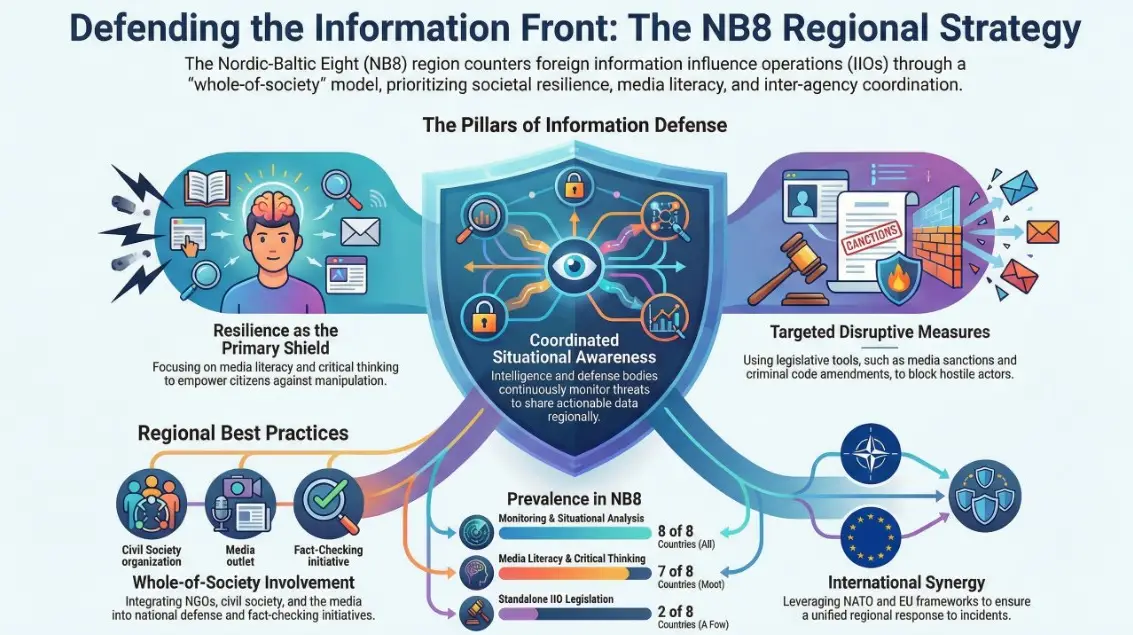
This briefing document synthesizes the strategic approaches and operational measures employed by the Nordic-Baltic Eight (NB8)—Denmark, Estonia, Finland, Iceland, Latvia, Lithuania, Norway, and Sweden—to counter Information Influence Operations (IIOs). As of January 2026, the region serves as a global leader in utilizing “whole-of-society” frameworks to safeguard democratic processes from hostile state manipulation, primarily originating from the Russian Federation and, increasingly, China.
The core findings indicate a regional transition from purely defensive resilience toward more proactive and disruptive legal measures. Key takeaways include:
- Centrality of Resilience: Resilience is defined both as public media literacy and the institutional capacity to manage incidents without service disruption.- Institutional Coordination: Most NB8 nations have established formal inter-agency task forces or dedicated agencies (e.g., Sweden’s Psychological Defence Agency) to synchronize state responses.- Whole-of-Society Engagement: The integration of civil society, “volunteer elves,” and a professional media sector is critical for effective fact-checking and debunking.- Legal Evolution: Countries are increasingly amending criminal codes and media laws to block hostile domains and prosecute domestic actors colluding with foreign intelligence.- Regional Solidarity: The accession of Finland and Sweden to NATO has solidified a unified security architecture, though resource strain from multiple international forums remains a challenge.
Download: counteringinformationinfluence counteringinformationinfluence.pdf2 MB.a{fill:none;stroke:currentColor;stroke-linecap:round;stroke-linejoin:round;stroke-width:1.5px;}download-circle
1. Regional Context and Thematic Framework
1.1 The Nature of Information Influence Operations (IIOs)
IIOs are defined as coordinated, illegitimate efforts to manipulate public opinion, undermine societal trust, and exploit vulnerabilities for the benefit of a hostile state. In the Nordic-Baltic region, these operations frequently pair with cyberattacks, physical sabotage, and disruption of critical infrastructure.
Primary Threat Actors and Narratives:
- Russia: Focuses on migration/integration policies, delegitimizing NATO presence, and accusing Baltic states of fascism or “Russophobia.” These tactics aim to create societal fragmentation and weaken support for Ukraine.- China: Focuses on long-term influence through tech sector espionage, economic coercion (e.g., against Lithuania), and protecting strategic investments in critical infrastructure like 5G and ports.
1.2 Regional Analytical Overview
The following table summarizes the prevalence of counter-IIO activities across the NB8 nations:
Category
High Prevalence (All/Most States)
Moderate/Emerging (Several/Few States)
Frameworks
National security strategies; focus on institutional resilience.
Standalone IIO legislation; formal coordination structures.
Situational Awareness
Monitoring by defense/intel bodies; public release of declassified reports.
Frequent information sharing with regional partners.
Resilience Building
Media literacy in schools; critical thinking campaigns.
Financial grants for NGOs; capability development training.
Response
Case-by-case communicative response; direct/indirect attribution.
Government advice to media; lead coordinating body assumes control in crisis.
Disruption
Enforcement of EU media sanctions; broadcasting license suspensions.
Amendments to criminal codes; direct domain blocking; language instruction reforms.
2. Strategic Pillars of Counter-IIO Activities
2.1 Framework, Policy, and Coordination
Most NB8 countries lack standalone IIO laws, relying instead on broader national security strategies. Coordination varies:
- Formal Structures: Lithuania’s National Crisis Management Centre (NCMC) and Denmark’s Task Force Interference provide centralized leadership.- Informal Networks: Finland and Latvia favor flexible, high-connectivity networks among civil servants that allow for rapid, ad hoc responses.
2.2 Situational Awareness and Monitoring
Monitoring is primarily the domain of defense and intelligence agencies (e.g., Norway’s PST and NIS).
- Transparency: To enhance societal preparedness, most countries now publicly release declassified intelligence reports identifying specific threat actors and methods.- Resource Constraints: Despite high priority, many monitoring units report a lack of financial and expert personnel resources for continuous, robust observation.
2.3 Resilience Building: The Whole-of-Society Model
The NB8 region prioritizes the “psychological resilience” of its citizens.
- Education: Media literacy is integrated into school curricula and adult retraining.- Non-State Actors: Civil society organizations (NGOs) are seen as ideally positioned to enhance resilience. The state provides support through targeted funding and workshops.- Media Cooperation: Governments maintain informal ties with the media, providing contextual information on IIOs while avoiding prescriptive directives to maintain press freedom.
2.4 Communicative and Disruptive Responses
Reactive communication (fact-checking/debunking) is typically led by civil society to avoid the “amplification” of hostile narratives by the state.
- Direct Attribution: States attribute IIOs to specific actors (e.g., Russia or China) when the threat level is high or the evidence is incontrovertible.- Disruption: Measures include blocking IP addresses/domains (Lithuania/Latvia) and amending laws to criminalize “illegal influence”—cooperating with foreign intelligence to affect public opinion (Denmark).
Biotech Risk Calculator - Digital Twin Security Assessment
3. Country Profiles: Individual Approaches
3.1 Denmark: The Intelligence-Led Approach
Denmark utilizes a “Task Force Interference” (established 2017) to coordinate between the Ministry of Justice, Foreign Affairs, and intelligence services (DSIS/DDIS).
- Key Feature: Section 108 of the Criminal Code criminalizes “illegal influence.”- Focus: Monitoring opportunistic IIOs designed to sow discord during elections, particularly regarding Greenland’s political status.
3.2 Estonia: The Digital Frontrunner
Estonia views strategic communication as one of five pillars of national defense.
- Key Feature: The “Communications Reserve,” a pool of 100 specialists from the private and public sectors ready for mobilization.- Strategic Action: Transitioning all schools to Estonian-language instruction by 2030 to mitigate foreign influence via Russian-language media.
3.3 Finland: Comprehensive Security
Finland operates under a “Comprehensive Security Framework” where every citizen is considered a security actor.
- Key Feature: The “Pool System,” which brings together the state and private media industry to ensure preparedness.- Focus: Upholding high levels of institutional trust as the primary defense against psychological manipulation.
3.4 Iceland: Resilience through Preparedness
Iceland leverages its history of managing natural disasters to build resilience against informational threats.
- Key Feature: A Liaison Group under the National Security Council focusing on “information disorder.”- Focus: Increasing media literacy among youth to counter campaigns that exploit Iceland’s strategic Arctic location.
3.5 Latvia: Systematic Defense
Latvia identifies three foundations for a secure information space: strategic communication, the media environment, and media literacy.
- Key Feature: Strict legal amendments allowing for the investigation of domestic pro-Kremlin groups like the “Baltic Antifascists.”- Focus: Compulsory national defense education in secondary schools starting in 2024.
3.6 Lithuania: Coordinated Mobilization
Lithuania possesses some of the region’s most robust disruptive tools.
- Key Feature: The “Elves”—a volunteer network of 5,000 citizens engaged in fact-checking and debunking.- Disruption: Hundreds of domains have been blocked under the Law on the Provision of Information to the Public.
3.7 Norway: Total Preparedness
Norway’s approach is based on the “principle of responsibility,” where the targeted sector leads the response.
- Key Feature: A new National Security Strategy (May 2025) and a resilience strategy for disinformation (June 2025).- Focus: Identifying hybrid actions (sabotage/cyber) that aim to create unrest in the cognitive space.
3.8 Sweden: Psychological Defence
Sweden is unique in having a dedicated government agency—the Psychological Defence Agency (MPF)—established in 2022.
- Key Feature: The “Don’t Be Fooled” handbook and the “In Case of Crisis or War” leaflet distributed to all households.- Focus: Bolstering the “Total Defence” concept, where psychological resilience is as vital as military defense.
4. Discussion and Recommendations
4.1 Persistent Dilemmas
The NB8 nations face ongoing challenges in balancing security with democratic values:
- Freedom of Speech: Determining the threshold for disruptive measures without granting governments excessive power.- Media Autonomy: Assisting the media with threat data without appearing to direct editorial content.- Response Timing: Deciding when state response provides necessary awareness versus when it provides a malicious actor with unwanted visibility.
4.2 Opportunities for Deeper Regional Cooperation
To enhance the collective capacity of the NB8, the following initiatives are suggested:
- Shared Capability Framework: Establish common checklists and training modules for all stakeholders, potentially supported by ISO or EU certification.2. Designated Capability Leaders: One country should lead expertise sharing in specific areas (e.g., Estonia for digital resilience, Sweden for psychological defense).3. Joint Exercises: Regularly simulate diverse IIO scenarios to test collective readiness and cross-border strategic communication.4. Proactive Response Projects: Develop coordinated “offensive” responses to penetrate hostile information environments during periods of escalation, in alignment with NATO procedures.
Conclusion
The NB8 region demonstrates that countering IIOs requires more than technological solutions; it requires a deep, shared sense of societal responsibility. While challenges regarding resource duplication and legal boundaries remain, the Nordic-Baltic model of resilience and coordination offers a definitive point of departure for other democratic nations facing foreign interference.