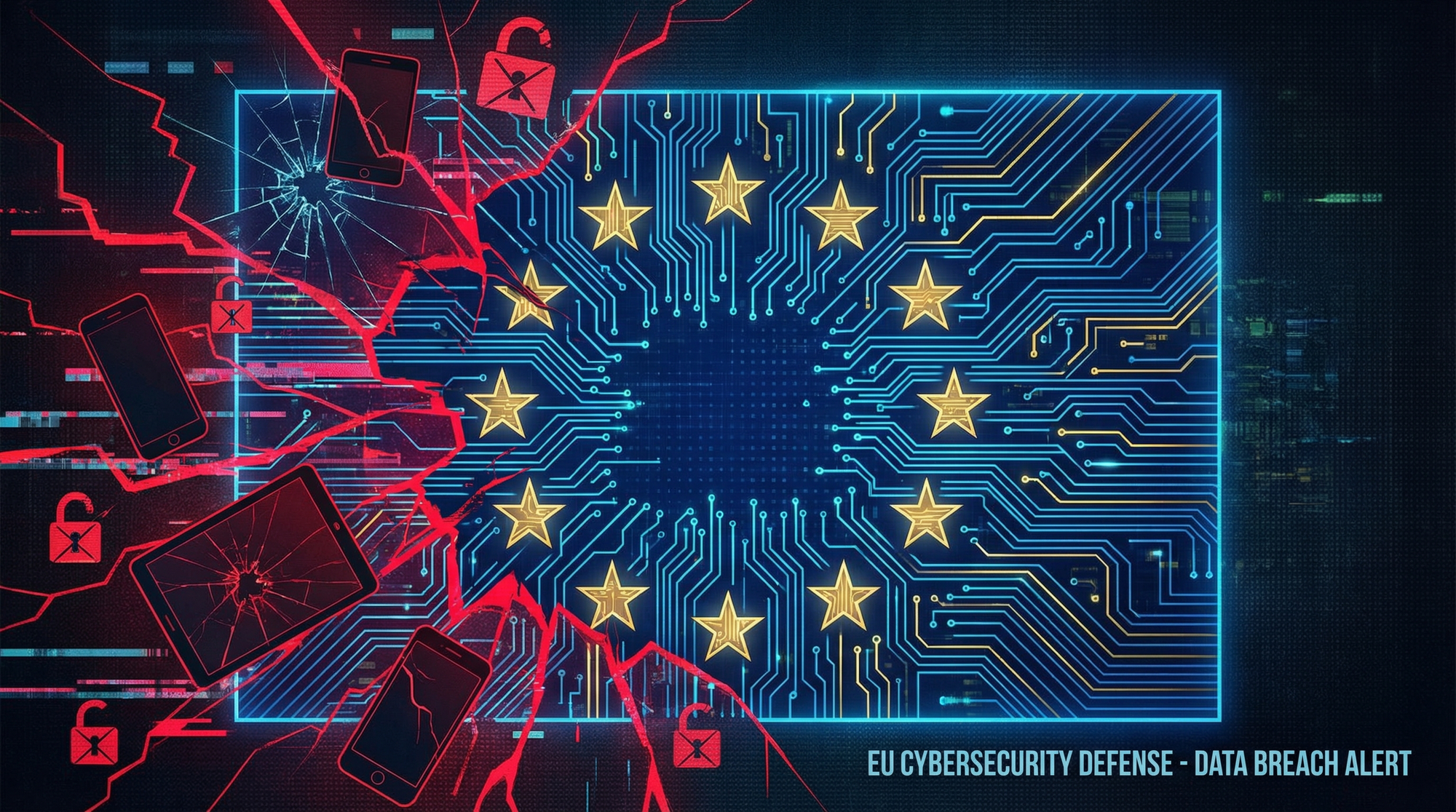
The body responsible for enforcing GDPR across Europe now faces questions about its own data protection practices after attackers compromised its mobile device management infrastructure.
Key Facts at a Glance
Detail Information
Incident Date January 30, 2026
Disclosure Date February 6, 2026 (Friday evening)
Target European Commission MDM backend
Data Exposed Staff names and mobile phone numbers
Containment Time 9 hours
Devices Compromised None (per Commission statement)
Attribution Unknown (state-sponsored suspected)
Staff Potentially Affected Undisclosed (“some staff members”)
The Breach That Undercuts Brussels’ Cybersecurity Credibility
In a disclosure that carries more than a hint of institutional irony, the European Commission—the same body that wields GDPR enforcement powers against organizations failing to protect personal data—has admitted its own mobile device management infrastructure was breached on January 30, 2026.
The attack, detected by CERT-EU, potentially exposed the names and mobile phone numbers of Commission staff members. While officials emphasized that no mobile devices themselves were compromised and the incident was contained within nine hours, the breach raises uncomfortable questions about the security posture of the institution that serves as Europe’s privacy watchdog.
The timing could hardly be worse. Just ten days before the attack, on January 20, 2026, the Commission unveiled an ambitious new Cybersecurity Package featuring supply chain security provisions and measures targeting “high-risk third-country suppliers.” That carefully orchestrated announcement now sits awkwardly alongside revelations that the Commission’s own mobile management systems proved vulnerable to intrusion.
“The Commission responded swiftly, successfully containing the incident and restoring the system within nine hours, with no evidence of compromised mobile devices,” the official statement read. True though that may be, the breach nonetheless demonstrates that even organizations at the apex of European governance remain susceptible to the same threats they warn others about.
Incident Timeline: From Detection to Friday Evening Disclosure
Understanding the sequence of events reveals a pattern familiar to those who track institutional breach disclosures:
January 20, 2026 — The Cybersecurity Package Launch
The European Commission proudly announces its comprehensive Cybersecurity Package, featuring Cybersecurity Act 2.0 and amendments to the NIS2 Directive. The package includes provisions mandating “derisking” of European mobile telecom networks and establishes frameworks targeting high-risk third-country suppliers. Media coverage is extensive and positive.
January 30, 2026 — The Attack
Ten days after the policy announcement, CERT-EU’s 24/7 threat monitoring operations detect signs of a cyber intrusion targeting the Commission’s central mobile device management infrastructure. The attack is identified, contained, and systems are restored within nine hours—a response time that officials would later cite as evidence of their preparedness.
February 6, 2026 — The Friday Evening News Dump
Seven days after the incident, the Commission releases a brief statement disclosing the breach. The timing—late on a Friday afternoon—follows a well-worn playbook for minimizing media coverage. By Monday morning, the story would be competing with a weekend’s worth of fresh news.
The Commission’s statement acknowledged that the attack “may have resulted in unauthorised access to the names and mobile numbers of some staff members” and promised a “comprehensive review of the incident.”
February 9, 2026 — Media Scrutiny Intensifies
Technical outlets including The Register begin examining the breach in detail, raising questions about the specific MDM platform compromised and the full scope of data exposure. Bloomberg’s coverage brings the story to a broader financial audience.
What Mobile Device Management Systems Hold—And Why Attackers Want Them
To understand the significance of this breach, one must first appreciate what MDM systems actually do and the privileged position they occupy within enterprise networks.
Mobile Device Management platforms serve as centralized command centers for organizations managing fleets of smartphones, tablets, and other mobile devices. They’re the administrative backbone that allows IT departments to configure devices, deploy applications, enforce security policies, and—critically—maintain inventories of every managed device along with their associated users.
As the U.S. Cybersecurity and Infrastructure Security Agency (CISA) has noted: “Mobile device management (MDM) systems are attractive targets for threat actors because they provide elevated access to thousands of mobile devices.”
Data Typically Accessible Through MDM Backends
While the Commission confirmed only names and mobile numbers were exposed, standard MDM platforms typically store far more:
User and Device Information:
- Full names and contact details- Device models, serial numbers, and IMEI numbers- Operating system versions and patch levels- User roles and organizational relationships
Configuration and Security Data:
- WiFi credentials and VPN configurations- Email account settings- Certificate authorities and authentication tokens- Security policy compliance status
Operational Data:
- Application inventories- GPS/location history (if enabled)- Device health and battery status- Network connection logs
Administrative Capabilities:
- Remote device wipe functionality- App deployment and removal- Configuration profile management- Lock and locate features
Whether attackers accessed any of this additional data remains unclear. The Commission’s statement was carefully worded to confirm only “names and mobile numbers”—but the backend infrastructure certainly would have contained more.
The GDPR Irony: When the Enforcer Becomes the Victim
The European Commission sits at the heart of GDPR enforcement. It is the institution that has levied billions of euros in fines against companies from Meta to Google for privacy violations. It is the body that wrote the rulebook on data protection that organizations worldwide now follow.
Under GDPR Article 5(1)(f), personal data must be “processed in a manner that ensures appropriate security of the personal data, including protection against unauthorised or unlawful processing and against accidental loss, destruction or damage, using appropriate technical and organisational measures.”
The Commission now finds itself in the uncomfortable position of having failed—even if briefly—to meet its own standards.
This isn’t the first time EU institutions have faced this contradiction. In April 2021, the European Commission and other EU organizations suffered a significant cyberattack that prompted investigations. The European Banking Authority was also hit that year, forcing it to take its email systems offline.
The irony extends beyond optics. The Commission’s mobile number database represents precisely the kind of sensitive personal data that GDPR was designed to protect. Names and phone numbers of government officials—particularly those involved in policy development, regulation, or sensitive negotiations—constitute high-value intelligence targets.
State-Sponsored Shadows: Attribution Theories and Threat Actor Context
The European Commission has not attributed the attack to any specific threat actor. However, the nature of the target and the broader threat landscape suggest this was unlikely to be the work of opportunistic criminals.
The Current Threat Environment
CERT-EU’s January 2026 Cyber Brief documented an escalating campaign of sophisticated attacks against European institutions:
Salt Typhoon Operations: Chinese-attributed threat actors have been implicated in infiltrating UK telecom networks, with reports suggesting access dating back to 2021. The group allegedly targeted communications involving Downing Street officials.
APT28 Resurgence: Russia-linked Fancy Bear has been actively exploiting vulnerabilities in Microsoft Office (CVE-2026-21509) against European targets throughout early 2026.
Sandworm Strikes: Russian military intelligence-linked actors deployed data wipers against Polish renewable energy infrastructure in December 2025, demonstrating continued willingness to target European critical infrastructure.
ESA Breach: The European Space Agency suffered a significant breach with 500GB of data exfiltrated by threat actors identifying themselves as “Scattered Lapsus Hunters.”
Why State Actors Target Contact Information
While names and phone numbers might seem like relatively low-value data, intelligence services prize such information for several reasons:
Spearphishing Enablement: Armed with accurate contact details, attackers can craft highly targeted phishing campaigns. A text message appearing to come from a known colleague’s number, or referencing accurate organizational details, dramatically increases success rates.
Social Engineering: Phone numbers enable vishing (voice phishing) attacks. Knowing the name, role, and mobile number of a European Commission official opens numerous social engineering vectors.
Pattern of Life Analysis: Contact directories help intelligence services map organizational structures, identify key personnel, and understand reporting relationships.
Future Attack Preparation: MDM backend access—even briefly—provides reconnaissance for more sophisticated follow-on attacks. Understanding which devices exist, their configurations, and their security posture enables better targeting.
The Norwegian Precedent
The most relevant historical parallel occurred in July 2023, when APT actors exploited critical vulnerabilities in Ivanti EPMM (formerly MobileIron Core) to compromise 12 Norwegian government ministries.
That attack exploited CVE-2023-35078, a maximum-severity (CVSS 10.0) authentication bypass vulnerability that allowed unauthenticated access to API endpoints. Attackers maintained access from at least April 2023 before discovery, accessing names, phone numbers, and device details—strikingly similar to the data exposed in the Commission breach.
CISA and Norwegian authorities issued a joint advisory (AA23-213A) warning that “APT actors have exploited this vulnerability since at least April 2023 to gather information from several Norwegian organizations.”
The Commission has not disclosed which MDM platform was compromised, but Ivanti’s prevalence in government deployments makes it a reasonable candidate for investigation.
MDM Security: A Systemic Government Vulnerability
The European Commission breach is not an isolated incident but rather the latest manifestation of a systemic security challenge: government organizations worldwide have deployed MDM systems that themselves become high-value targets.
Historical MDM Breaches
Mobile Guardian Incident (August 2024): UK-based MDM provider Mobile Guardian suffered a breach that allowed attackers to remotely wipe thousands of devices. In Singapore alone, 13,000 student devices were wiped in a single attack. The incident demonstrated how MDM access provides not just surveillance capabilities but also destructive ones.
Ivanti Zero-Day Campaign (2023): Beyond Norway, the Ivanti EPMM vulnerabilities were exploited against government targets globally. CISA added the vulnerabilities to its Known Exploited Vulnerabilities catalog and mandated federal agencies patch within tight deadlines.
The “Keys to the Kingdom” Problem
MDM systems occupy a uniquely privileged position in enterprise architectures. By design, they must have extensive access to managed devices—that’s their entire purpose. This creates an inherent security tension:
- Broad Access Requirements: MDM must push configurations, install software, and manage certificates across all enrolled devices2. Administrative Privileges: MDM consoles require high-privilege access for device management functions3. Centralization Risk: A single MDM breach potentially affects every managed device4. Internet Exposure: Many MDM platforms require internet-facing components for device enrollment and management
This combination makes MDM infrastructure simultaneously essential and dangerous—a critical system that, by its nature, presents an attractive attack surface.
Expert Analysis: What This Breach Reveals
Security professionals examining this incident have highlighted several concerning patterns:
The Disclosure Timing Question
The seven-day gap between incident containment (January 30) and public disclosure (February 6) raises questions about transparency. Under GDPR, organizations must notify supervisory authorities within 72 hours of becoming aware of a personal data breach involving risk to individuals’ rights and freedoms.
The Commission’s own institutions operate under Regulation (EU) 2018/1725, which governs data protection for EU institutions and contains similar notification requirements. Whether the timing complied with these obligations—and whether affected staff were individually notified—remains unclear from public statements.
The Friday evening release also suggests conscious media management. While there’s nothing inherently improper about weekend disclosures, the pattern is well-established enough that communications professionals have a name for it: the Friday news dump.
The Scope Ambiguity
The phrase “some staff members” is conspicuously vague for an institution that employs approximately 32,800 people. “Some” could mean a dozen officials in a specific department or thousands across the organization. The Commission has not clarified which interpretation is accurate.
This ambiguity matters because it affects risk assessment. If the breach exposed contact details for senior officials involved in sensitive policy areas—say, sanctions implementation, trade negotiations, or intelligence coordination—the implications are far more serious than if it affected a random subset of administrative staff.
The Attribution Silence
The Commission’s refusal to attribute the attack—even after a week of analysis—can be interpreted several ways:
- Genuine Uncertainty: Sophisticated actors use operational security measures that complicate attribution2. Diplomatic Sensitivity: Attributing an attack to a specific nation-state carries diplomatic consequences3. Investigation Ongoing: Public attribution might compromise ongoing analysis or future legal action
Given the target’s profile and the current threat landscape, state-sponsored involvement remains the leading theory among independent analysts.
Lessons for Enterprise MDM Administrators
Organizations managing their own MDM infrastructure should treat this incident as a case study in enterprise mobile security risks. Several key lessons emerge:
1. Assume MDM Is a Prime Target
Any system with administrative access to hundreds or thousands of devices will attract sophisticated attackers. MDM platforms should receive the same security attention as domain controllers or identity providers—because their compromise carries similar organization-wide implications.
2. Monitor MDM Logs Aggressively
The Commission detected this intrusion within hours, suggesting reasonable monitoring capabilities. Organizations should ensure MDM platforms feed into security information and event management (SIEM) systems, with alerts configured for unusual API access patterns, bulk data queries, or administrative actions outside normal parameters.
3. Segment MDM Infrastructure
MDM backends should not be directly internet-accessible where possible. VPN requirements for administrative access, network segmentation, and zero-trust architectures can limit exposure even if edge components are compromised.
4. Patch Ruthlessly
The Norwegian Ivanti breach succeeded because organizations failed to patch known vulnerabilities quickly enough. When MDM vendors release security updates—particularly for authentication or API vulnerabilities—deployment should happen within days, not weeks.
5. Plan for Breach Scenarios
What happens if your MDM is compromised? Organizations need playbooks for:
- Revoking pushed certificates and credentials- Notifying affected users about spearphishing risks- Investigating whether managed devices were affected- Determining whether the attacker gained persistence beyond the MDM itself
6. Consider Zero Trust Device Posture
Modern security architectures can use device posture as an authentication factor, reducing reliance on MDM-pushed credentials. If a device’s posture is independently verified at access time, MDM compromise doesn’t automatically grant full access to enterprise resources.
What Happens Next
The European Commission has promised a “comprehensive review” of the incident, and CERT-EU will presumably continue monitoring for follow-on attacks. Several developments bear watching:
Short-Term (Next 30 Days)
- Potential spearphishing campaigns targeting exposed officials- Possible additional disclosures if investigation reveals broader scope- Industry response from MDM vendors addressing security concerns
Medium-Term (Next 90 Days)
- Commission security posture improvements- Potential regulatory or legislative implications for government MDM security- Formal incident report from CERT-EU or European Data Protection Supervisor
Long-Term Implications
- Increased scrutiny of MDM security across EU institutions- Potential acceleration of cybersecurity package implementation- Possible procurement changes favoring European or more secure MDM solutions
Conclusion: When Privacy Guardians Need Guarding
The European Commission MDM breach serves as a pointed reminder that no organization—regardless of its mission, resources, or regulatory authority—is immune to cyber intrusion. The institution that enforces data protection standards across Europe has itself failed to prevent unauthorized access to personal data.
This isn’t about schadenfreude or scoring points against regulators. The Commission’s swift containment response—nine hours from detection to restoration—represents competent incident response. Not every organization could claim the same.
But the breach does underscore uncomfortable truths about the state of enterprise security:
MDM systems remain high-value targets that organizations often fail to secure with the same rigor applied to other critical infrastructure.
Government networks face persistent, sophisticated threats from well-resourced adversaries who view institutional contact directories as intelligence gold.
Timing matters in disclosure, and the Commission’s Friday evening announcement fits a pattern that prioritizes reputation management over radical transparency.
The gap between policy and practice persists, even at institutions responsible for setting standards others must follow.
For enterprise security teams watching from the sidelines, the lesson is clear: if the European Commission’s MDM can be breached, so can yours. The question isn’t whether attackers will target your mobile management infrastructure—it’s whether you’ll detect them when they do.
This article is based on public statements, official disclosures, and analysis of available technical information. The European Commission has not disclosed the specific MDM platform compromised or provided detailed technical indicators. Attribution theories presented represent analyst assessment based on threat landscape context, not confirmed intelligence.