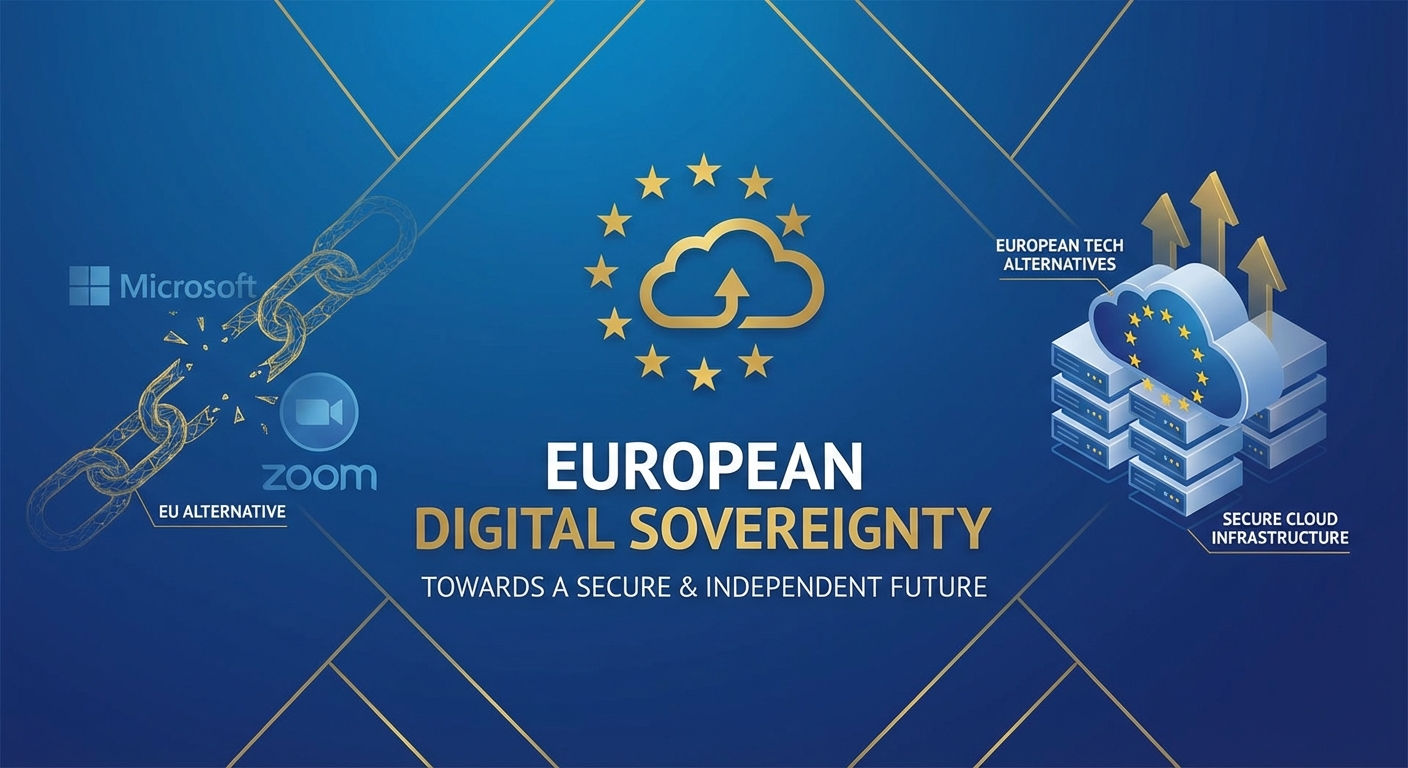
In late January 2026, France made an announcement that sent shockwaves through Silicon Valley: 2.5 million civil servants would stop using Microsoft Teams, Zoom, Webex, and GoTo Meeting by 2027. In their place? A homegrown, open-source videoconferencing platform called Visio, hosted entirely on French sovereign cloud infrastructure.
This isn’t a marginal policy tweak. It’s a declaration of digital independence—and France is far from alone in making it.
France Proposes Sweeping Social Media Ban for Children Under 15
France’s Bold Move Against US Tech
“We cannot risk having our scientific exchanges, our sensitive data, and our strategic innovations exposed to non-European actors,” declared David Amiel, France’s minister for civil service and state reform, when announcing the transition. The language is unambiguous: American technology platforms represent a risk to French national security.
The decision to migrate away from US videoconferencing tools is comprehensive. By 2027, licenses for Teams, Zoom, Google Meet, Webex, and GoTo Meeting will not be renewed as government departments complete their migration. The French government estimates the switch could save around €1 million annually for every 100,000 users who move to Visio—not insignificant when you’re talking about 2.5 million workers.
But make no mistake: this decision isn’t primarily about cost savings. It’s about control.
The move follows France’s 2023 mandate requiring ministers to abandon WhatsApp and Signal in favor of Olvid, a French-developed encrypted messaging application certified by ANSSI (France’s national cybersecurity agency). French officials have already been using Tchap, a government-developed secure messaging platform built on the open-source Matrix protocol, since 2019.
Visio is part of a broader initiative called Suite Numérique—a family of sovereign software tools designed to replace Gmail, Slack, and other American collaboration platforms across the French administration. The platform has been in testing for about a year with approximately 40,000 regular users, and is now expanding rapidly.
Critically, Visio is hosted on Outscale’s sovereign cloud infrastructure, a subsidiary of French software company Dassault Systèmes. No American servers. No American jurisdiction. No American legal claims to French government communications.
The Digital Sovereignty Argument
To understand why European governments are abandoning American tech platforms, you need to understand one law: the US Cloud Act of 2018.
This legislation grants American authorities the power to compel US-based technology companies to hand over data—regardless of where that data is physically stored. A server in Frankfurt running Microsoft software is still subject to American legal demands. A Zoom meeting recorded in Paris can be accessed by US intelligence agencies.
Microsoft’s own lawyer confirmed this under oath in the French Senate in June 2025, admitting he cannot guarantee that French data stored in European Microsoft datacenters is safe from US government access. That testimony was a turning point.
The Cloud Act creates a direct and irreconcilable conflict with GDPR, the European Union’s comprehensive data protection regulation. GDPR restricts foreign access to EU data unless through legal treaties (Article 48). The Cloud Act simply bypasses this requirement, placing European organizations in an impossible compliance position: follow GDPR and potentially violate US law, or comply with American demands and violate European law.
As German MEP Alexandra Geese warned at a recent Nextcloud Summit in Munich: “Europe risks being blackmailed by both American and Chinese tech giants.”
But it’s not just legal theory driving this movement. Recent events have made the risks tangible.
When the Trump administration sanctioned the International Criminal Court’s Chief Prosecutor in 2025 after the tribunal issued an arrest warrant for Israeli Prime Minister Benjamin Netanyahu, Microsoft cancelled the prosecutor’s email access. The incident demonstrated what European officials had long feared: American tech companies can—and will—serve as instruments of US foreign policy, cutting off critical services at Washington’s direction.
For European governments, this represents an unacceptable vulnerability. Sensitive diplomatic communications, scientific research, military coordination, and government operations cannot depend on platforms that can be weaponized against European interests.
What France Is Using Instead
France isn’t just abandoning American platforms—it’s building an entire alternative digital ecosystem.
Visio serves as the cornerstone for videoconferencing. Built using Django (the Python web framework), React, and LiveKit (a scalable video conferencing system), the platform offers HD video calls, screen sharing, and chat functionality. It includes AI-powered transcription and speaker identification using technology from French startup Pyannote. The platform was developed by France’s Interministerial Directorate for Digital Affairs (DINUM) with contributions from the Netherlands and Germany.
Olvid handles secure instant messaging. Developed by French cybersecurity experts and certified by ANSSI, Olvid encrypts both messages and metadata—going further than Signal in protecting communication patterns. The app doesn’t require a phone number, allowing use on tablets without SIM cards.
Tchap, launched in 2019, provides government-developed secure messaging and collaboration, running on the open-source Matrix protocol. This federated architecture means no single point of failure and no dependency on any external provider.
Oodrive provides document editing and sharing capabilities as part of a consortium that also includes Olvid and Tixeo (for secure videoconferencing). All are certified by ANSSI to meet French national security requirements.
The entire Suite Numérique project represents a coordinated effort to replace American cloud dependencies with European alternatives—not just for videoconferencing, but across the entire digital workplace.
The Broader European Movement
France’s decision is the most dramatic recent example, but it’s part of a continental shift.
Germany’s Schleswig-Holstein has become a model for the movement. The state completed a six-month migration replacing Microsoft Exchange and Outlook with Open-Xchange and Mozilla Thunderbird across more than 40,000 mailboxes and 100 million messages. They’ve also switched from SharePoint to Nextcloud, replaced Microsoft Office with LibreOffice, and are considering moving from Windows to Linux entirely.
“We want to become independent of large tech corporations and ensure digital sovereignty,” declared Digitalization Minister Dirk Schrödter. The state expects to save tens of millions of euros while also supporting the local IT economy through investment in internal capabilities rather than license fees sent to Redmond.
Denmark is rolling out a transition away from Microsoft Office 365 toward LibreOffice across government operations. “We must never make ourselves so dependent on so few that we can no longer act freely,” wrote Digital Minister Caroline Stage Olsen. “Too much public digital infrastructure is currently tied up with very few foreign suppliers.”
Austria’s military has switched all 16,000 military computers from Microsoft Office to LibreOffice after a carefully planned four-year transition. The military has contributed development time back to the open-source project, funding improvements that benefit the entire community.
The French city of Lyon is deploying free office software to replace Microsoft across municipal operations.
Italy’s Ministry of Defense completed one of Europe’s largest open-source migrations, transitioning 150,000 PCs to LibreOffice and Open Document Format, projecting savings of €29 million.
The European Parliament has adopted resolutions urging more control over critical digital infrastructure and AI platforms. A 2025 Digital Sovereignty Index ranked European nations on their independence from foreign technology platforms, with Finland, Germany, and the Netherlands leading the way.
Perhaps most significantly, the EU’s Interoperable Europe Act now requires public sector organizations to consider open-source alternatives before committing to proprietary licenses. This regulatory shift institutionalizes the preference for sovereign solutions.
Implications for US Tech Giants
American technology companies are scrambling to respond—but their efforts may be too little, too late.
Microsoft has announced a five-point plan to reassure European customers, including “European Digital Commitments” with contractual promises to compensate customers if data is disclosed in violation of EU law. The company has pledged to contest any government order to suspend cloud operations in Europe through all legal avenues—a “Digital Resilience Promise” aimed at addressing kill-switch fears.
Microsoft’s “sovereign cloud” offerings promise data centers located in European countries, owned by European entities, with access restricted to EU-resident staff. Azure is developing “disconnected operations” for complete network isolation, expected in early 2026. Microsoft 365 Copilot will expand in-country processing to 15 European countries by the end of 2026.
AWS is forming a new EU-based cloud business unit. Google has updated its sovereign cloud services for Europe.
But these measures face a fundamental problem: no amount of European infrastructure changes the legal reality that American companies must comply with US government data demands. As long as the Cloud Act exists, Microsoft’s contracts with European governments are worth less than the paper they’re printed on if Washington decides to exercise its authority.
The growing distrust of US hyperscalers in Europe is palpable. Microsoft President Brad Smith has made repeated efforts to strengthen transatlantic ties, warning at Davos that “Europe is the American tech sector’s biggest market after the United States itself. It all depends on trust.”
That trust, however, is evaporating.
Ericsson CEO Börje Ekholm recently warned at Davos that European discussions around sovereignty are “dangerous” and that building homegrown alternatives would lead to higher prices. But his warnings appear to be falling on deaf ears. The political momentum behind digital sovereignty is now unstoppable.
What Privacy-Conscious Organizations Can Learn
France’s decision offers critical lessons for any organization that takes data sovereignty and privacy seriously.
1. Jurisdiction Matters More Than Encryption
It doesn’t matter how secure a platform’s encryption is if the company operating it is legally compelled to provide access. The Cloud Act demonstrates that American companies cannot guarantee data protection from American authorities, regardless of where servers are located or what security measures are implemented.
For privacy-conscious organizations, this means evaluating not just a platform’s technical security but its legal jurisdiction. European alternatives like Element (built on Matrix), Jitsi (open-source videoconferencing), NextCloud, and OnlyOffice operate outside American legal reach.
2. Open Source Is a Strategic Advantage
France’s Visio is MIT-licensed open source. Schleswig-Holstein’s entire stack—LibreOffice, Thunderbird, Nextcloud, Linux—is open source. Austria’s military contributes back to LibreOffice development.
Open source isn’t just about cost savings (though those are significant). It’s about auditability, transparency, and the impossibility of hidden backdoors. When your code is open for inspection, you don’t have to trust that a company is protecting your interests—you can verify it yourself.
France’s €150M Apple Fine: App Tracking Transparency Enforcement
3. Migration Is Possible
The conventional wisdom has been that switching away from Microsoft’s ecosystem is prohibitively difficult. But the European examples prove otherwise. Schleswig-Holstein migrated 40,000 mailboxes. Austria transitioned 16,000 military computers. France is moving 2.5 million workers.
These transitions require careful planning, adequate resources, and organizational commitment. But they’re achievable. The Document Foundation, which maintains LibreOffice, noted the shift in motivation over time: “At first, it was: we will save money and by the way, we will get freedom. Today it is: we will be free and by the way, we will also save some money.”
4. Build for Resilience, Not Convenience
The ICC email cutoff revealed a crucial vulnerability: critical infrastructure dependent on a single foreign vendor can be disabled by decisions made in another country’s capital. Privacy-conscious organizations should evaluate their technology stack for single points of failure and foreign dependency.
This might mean running self-hosted alternatives, using federated protocols like Matrix that have no central control point, or ensuring that critical systems can operate independently of any external service.
5. The Regulatory Environment Is Shifting
The EU’s Interoperable Europe Act, ongoing antitrust investigations into Microsoft’s cloud licensing practices, and government procurement policies favoring open source all signal a regulatory environment increasingly hostile to American tech monopolies.
Organizations making long-term technology decisions should consider this trajectory. Betting heavily on proprietary American platforms may create growing compliance challenges as European data protection regulation continues to tighten.
Conclusion: A Point of No Return
France’s announcement marks a inflection point in the relationship between European governments and American technology companies. What Emmanuel Macron called for in 2020—“European solutions and European sovereignty in every sector”—is now becoming operational reality.
The drivers are structural: an irreconcilable legal conflict between the Cloud Act and GDPR, demonstrated willingness to use technology platforms as instruments of foreign policy, relentless price increases and vendor lock-in, and growing capabilities of European and open-source alternatives.
For organizations that value privacy and data sovereignty, the lesson is clear: the European approach isn’t just about nationalism or protectionism. It’s a rational response to genuine risks that affect anyone doing business in an environment where American technology platforms can be weaponized.
The kill switch is real. France, Germany, Denmark, Austria, and others have decided they’re no longer willing to live under its threat.
The question for the rest of us: are we?
This article is part of our ongoing coverage of digital privacy, data sovereignty, and the evolving relationship between technology and civil liberties.