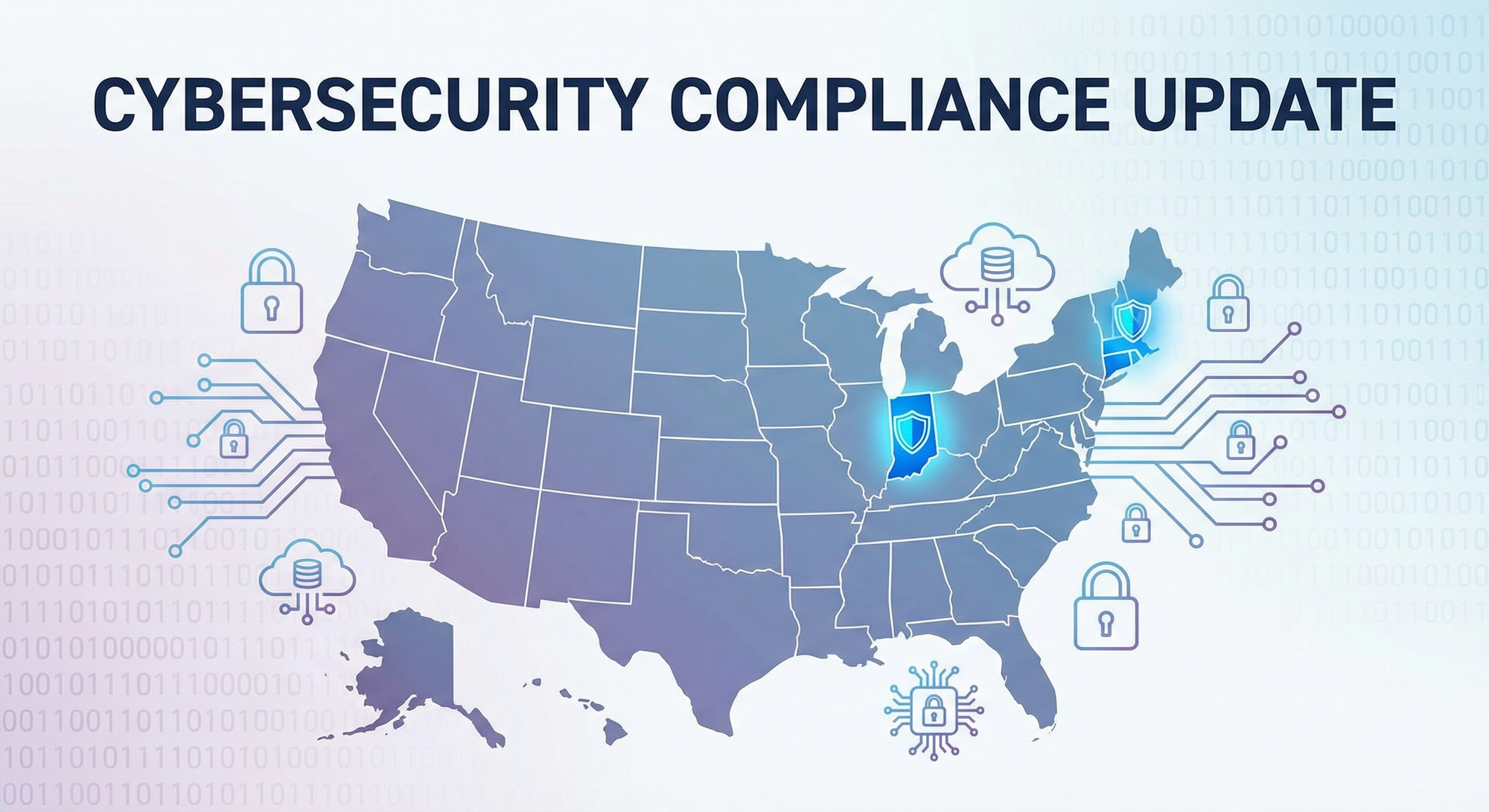
While much attention has focused on Kentucky’s January 1, 2026 privacy law enforcement milestone, two other states quietly joined the comprehensive privacy law club on the same date: Indiana and Rhode Island. Together, these three laws bring the total number of U.S. states with comprehensive consumer data protection frameworks to 18, creating an increasingly complex compliance landscape that demands sophisticated, jurisdiction-aware privacy programs.
Executive Summary
The simultaneous effectiveness of Indiana’s Consumer Data Protection Act (INCDPA), Rhode Island’s Data Transparency and Privacy Protection Act (RIDTPPA), and Kentucky’s Consumer Data Protection Act (KCDPA) on January 1, 2026 represents more than just incremental expansion of state privacy regulation—it signals a fundamental shift in American data governance. With no federal privacy law in sight and the American Privacy Rights Act (APRA) stalled in Congress, states continue to fill the regulatory void with increasingly sophisticated frameworks that draw from, but meaningfully diverge from, earlier Virginia-style models.
Key findings include:
- Indiana’s stricter data broker requirements create new compliance obligations for entities that previously operated in regulatory gray areas- Rhode Island’s lower thresholds (35,000 consumers vs. typical 100,000) bring mid-sized businesses into scope that avoided compliance under other state laws- Diverging enforcement philosophies across the three states create operational complexity even for Virginia-model frameworks- Children’s privacy protections are emerging as the primary area of state-by-state variation, with significant implications for platforms serving youth- Universal opt-out signals (like Global Privacy Control) are becoming de facto mandatory across an expanding number of states
Businesses operating nationally must now navigate 18 different state frameworks with varying thresholds, rights, exemptions, cure periods, and enforcement authorities—making manual compliance increasingly untenable and privacy automation essential.
The 2026 State Privacy Landscape
The Numbers
As of January 1, 2026, 18 U.S. states have comprehensive consumer data privacy laws in effect:
Original Wave (Pre-2024):
- California (CCPA/CPRA)2. Virginia (VCDPA)3. Colorado (CPA)4. Connecticut (CTDPA)5. Utah (UCPA)
2024-2025 Expansion: 6. Montana 7. Oregon (OCPA) 8. Texas (TDPSA) 9. Delaware 10. Iowa 11. Nebraska 12. New Hampshire 13. New Jersey 14. Tennessee 15. Maryland
2026 Trinity: 16. Indiana (INCDPA) – Effective January 1, 2026 17. Kentucky (KCDPA) – Effective January 1, 2026 18. Rhode Island (RIDTPPA) – Effective January 1, 2026
Why Federal Law Remains Elusive
The absence of federal privacy legislation remains a defining feature of U.S. data protection. Two major federal efforts stalled in 2025:
American Data Privacy and Protection Act (ADPPA)
- Died due to disagreements over federal preemption of state laws- Business groups wanted strong preemption to avoid state-by-state compliance- Privacy advocates and state attorneys general opposed gutting state protections
American Privacy Rights Act (APRA)
- Stalled over private right of action provisions- Business community opposed allowing individuals to sue directly- Consumer advocates insisted enforcement couldn’t depend solely on overwhelmed state AGs
With federal action off the table for the foreseeable future, states are accelerating their own legislative efforts, creating a patchwork that businesses describe as “compliance by a thousand cuts.”
Indiana Consumer Data Protection Act (INCDPA): Key Provisions
Scope and Applicability
Indiana’s law applies to entities that:
- Conduct business in Indiana or target Indiana residents, AND- Meet one of two thresholds:100,000+ consumers: Control or process personal data of at least 100,000 Indiana consumers annually, OR- 25,000+ consumers + revenue: Control or process data of 25,000+ Indiana consumers AND derive revenue from selling personal data
Notable Exemptions
Like most Virginia-model laws, Indiana exempts:
- Small businesses (below thresholds)- Nonprofit organizations- Government entities- Financial institutions covered by Gramm-Leach-Bliley Act (GLBA)- Covered entities and business associates under HIPAA- Higher education institutions (with limitations)
Consumer Rights
Indiana grants residents the following rights:
1. Right to Access Consumers can confirm whether a business processes their personal data and access that data in a portable, readily usable format.
2. Right to Correction Consumers can correct inaccuracies in their personal data, considering the nature and purposes of processing.
3. Right to Deletion Consumers can request deletion of personal data provided by or obtained about them, subject to exceptions for completing transactions, detecting fraud, complying with legal obligations, etc.
4. Right to Data Portability Consumers can obtain a copy of personal data they previously provided in a portable, readily usable format that allows transmission to another entity.
5. Right to Opt Out Consumers can opt out of:
- Targeted advertising: Display of ads based on personal data from their activity across nonaffiliated websites or apps- Sale of personal data: The exchange of personal data for monetary or other valuable consideration- Profiling: Automated processing to predict aspects concerning behavior, interests, economic situation, health, etc.
What Makes Indiana Different?
While Indiana largely follows the Virginia framework, several provisions make it notable:
Stronger Data Broker Transparency Indiana’s definition and treatment of data brokers—entities whose primary business involves collecting and selling consumer data from sources other than direct consumer interaction—creates heightened transparency requirements. Data brokers must:
- Clearly identify themselves as data brokers in privacy notices- Provide enhanced disclosure about data sources- Implement more rigorous consent mechanisms
This provision targets companies that previously operated in regulatory gray areas, such as:
- Consumer data aggregators and resellers- Marketing data providers- People search websites- Background check companies (not covered by FCRA for certain purposes)
Purpose Limitation and Data Minimization Indiana explicitly requires controllers to:
- Limit collection to what’s adequate, relevant, and reasonably necessary for disclosed purposes- Not process data for purposes incompatible with those disclosed- Establish, implement, and maintain reasonable administrative, technical, and physical safeguards
While these principles exist in other laws, Indiana’s explicit enumeration creates clearer compliance obligations.
Processor Requirements Indiana places specific obligations on processors (entities that process data on behalf of controllers):
- Must assist controllers in meeting DPIA obligations- Must assist in responding to consumer rights requests- Must delete or return personal data upon contract termination- Must make available information necessary to demonstrate compliance
Enforcement Mechanism
Exclusive Enforcement by Attorney General
- No private right of action- Only the Indiana Attorney General can bring enforcement actions- Violations are treated as deceptive practices under Indiana’s consumer protection laws
Cure Period
- 30-day right to cure for first violations- No cure period for subsequent violations of the same provision- AG must provide notice of violation and opportunity to cure
Penalties
- Civil penalties up to $7,500 per violation- Separate violations for each affected consumer- Courts may award attorney fees and costs- No criminal penalties
Rhode Island Data Transparency and Privacy Protection Act (RIDTPPA): Key Provisions
Scope and Applicability
Rhode Island’s thresholds are notably lower than most state privacy laws:
- Conduct business in Rhode Island or target Rhode Island residents, AND meet either:35,000+ consumers: Control or process personal data of at least 35,000 Rhode Island consumers annually, OR- 10,000+ consumers + revenue: Control or process data of 10,000+ consumers AND derive 20% or more of gross revenue from selling personal data
Why This Matters: Rhode Island’s lower thresholds bring mid-sized businesses into scope that previously avoided compliance under higher-threshold laws. A business with 40,000 Rhode Island customers must comply with RIDTPPA but might not meet thresholds in states requiring 100,000 consumers.
Consumer Rights
Rhode Island grants similar rights to Indiana and Kentucky:
- Right to access personal data2. Right to correct inaccuracies3. Right to delete personal data4. Right to data portability5. Right to opt out of:
- Targeted advertising- Sale of personal data- Certain profiling activities
Distinguishing Features
Data Protection Impact Assessments (DPIAs) Rhode Island explicitly requires controllers to conduct and document DPIAs for processing activities that present heightened risk, including:
-
Targeted advertising- Sale of personal data- Profiling that presents reasonably foreseeable risk of:Unfair or deceptive treatment- Financial or physical harm- Intrusion upon seclusion or private affairs- Other substantial injury Processing sensitive dataAny processing activity that presents heightened risk of harm to consumers Enhanced Transparency Requirements Privacy notices must include:
-
Categories of personal data processed- Purposes for processing- How consumers can exercise their rights- Categories of personal data shared with third parties- Categories of third parties with whom data is shared- If the business sells personal data or uses it for targeted advertising- How consumers can opt out
Sensitive Data Consent Like other modern privacy laws, Rhode Island requires opt-in consent for processing sensitive data, defined to include:
- Personal data revealing racial or ethnic origin- Religious beliefs- Mental or physical health diagnoses- Sexual orientation- Citizenship or immigration status- Genetic or biometric data processed for identification- Personal data from a known child (under 13)- Precise geolocation data
Enforcement
Rhode Island Attorney General Enforcement
- Violations are enforced under Rhode Island’s Deceptive Trade Practices Act- Civil penalties up to $10,000 per violation- AG may seek injunctive relief- No private right of action
30-Day Cure Period
- Applies to violations occurring before January 1, 2028- AG must provide written notice with reasonable detail- Business has 30 days to cure and provide written statement of remediation- After January 1, 2028, no cure period applies
Reputational Consequences Because violations are prosecuted under deceptive trade practices authority, noncompliance can carry reputational and operational consequences beyond privacy-specific penalties, including:
- Increased scrutiny from consumers and partners- Difficulty obtaining business licenses or contracts- Enhanced due diligence requirements from investors- Media attention from consumer protection angle
Comparison: Indiana vs. Rhode Island vs. Kentucky
While all three laws follow Virginia-style frameworks, key differences create compliance complexity:
Threshold Comparison
Metric Indiana Rhode Island Kentucky
Primary Threshold 100,000 consumers 35,000 consumers 100,000 consumers
Alternative Threshold 25,000 + 50% revenue from sales 10,000 + 20% revenue from sales 25,000 + 50% revenue from sales
Implication Standard Virginia-model scope Captures mid-sized businesses Standard Virginia-model scope
Rhode Island’s lower thresholds mean businesses must perform state-specific threshold analyses rather than applying a single nationwide standard.
Consumer Rights Comparison
Right Indiana Rhode Island Kentucky
Access ✓ ✓ ✓
Correction ✓ ✓ ✓
Deletion ✓ ✓ ✓
Portability ✓ ✓ ✓
Opt-Out (Targeted Ads) ✓ ✓ ✓
Opt-Out (Sales) ✓ ✓ ✓
Opt-Out (Profiling) ✓ ✓ (certain profiling) ✓
Universal Opt-Out Mandate No No No
All three states grant substantially similar rights, but Kentucky’s “permanent cure period” and lack of universal opt-out requirement make it the most business-friendly of the trinity.
Data Protection Impact Assessment Requirements
State DPIA Required? Activities Triggering DPIA
Indiana Yes (implicit) Not explicitly enumerated but required for high-risk processing under controller obligations
Rhode Island Yes (explicit) Targeted advertising, sale of personal data, profiling with risk of harm, sensitive data processing, heightened risk activities
Kentucky Yes (implicit) Similar to Virginia model; required for high-risk processing
Rhode Island’s explicit enumeration of DPIA triggers creates clearer compliance requirements and reduces ambiguity about when assessments are necessary.
Cure Period Comparison
State Cure Period Duration Expiration
Indiana Yes (first violation only) 30 days Permanent for subsequent violations
Rhode Island Yes (temporary) 30 days Expires January 1, 2028
Kentucky Yes (permanent) 60 days Never expires
Kentucky’s permanent 60-day cure period makes it the most forgiving for businesses, while Rhode Island’s cure period expires in two years, after which enforcement can be immediate.
Penalty Comparison
State Maximum Penalty Enforcement Authority
Indiana $7,500 per violation Indiana Attorney General
Rhode Island $10,000 per violation Rhode Island Attorney General
Kentucky $7,500 per violation Kentucky Attorney General
Rhode Island’s higher per-violation penalty, combined with lower thresholds bringing more businesses into scope, creates elevated financial risk for noncompliance.
What This Means for Businesses
The Compliance Calculus Has Changed
Before January 1, 2026: A business with nationwide operations could potentially design privacy programs around a few high-bar standards (California, Virginia, Colorado) and reasonably expect to satisfy most state requirements.
After January 1, 2026: With 18 different state frameworks featuring varying thresholds, rights, exemptions, and enforcement mechanisms, businesses face a complex matrix requiring:
- Threshold tracking: Monitoring consumer counts by state to determine which laws apply- Rights management: Handling state-specific rights request processes and timelines- Opt-out orchestration: Managing different opt-out requirements (some require universal opt-out signals, others don’t)- Sensitive data classification: Applying different definitions of “sensitive data” based on consumer location- DPIA procedures: Conducting assessments for different triggers depending on applicable state law- Cure period tracking: Knowing which states offer cure periods, for how long, and whether this is the first violation
The Mid-Market Impact
Rhode Island’s lower thresholds are particularly significant for mid-sized businesses (annual revenue $10-100M) that previously fell below most state privacy law thresholds.
Example Scenario:
-
Company: Regional e-commerce retailer, $50M annual revenue- **Customer base:**150,000 customers nationwide- 40,000 in Rhode Island- 80,000 in Virginia- 30,000 in other states Data practices: Some targeted advertising, no data sales Analysis:
-
California: Not applicable (below 100,000 threshold; doesn’t meet alternative threshold)- Virginia: Not applicable (below 100,000 threshold; doesn’t sell data)- Rhode Island: APPLICABLE (exceeds 35,000 consumer threshold)- Indiana/Kentucky: Not applicable (below 100,000 threshold; doesn’t meet alternative threshold)
This business must now implement a privacy program to comply with Rhode Island (and California if over 100,000 California consumers, which the example doesn’t specify), despite avoiding most other state laws. This creates asymmetric compliance burden based on customer geographic distribution.
The Children’s Privacy Wild Card
While the trinity laws don’t dramatically differ on core consumer rights, children’s privacy is emerging as the primary area of state-by-state divergence—and one that will dominate compliance discussions in 2026.
Alongside the 2026 trinity, multiple states enacted children-specific laws:
Virginia (Effective January 1, 2026):
- Social media platforms must identify users under 16- Minors limited to one hour per day unless parents consent to longer sessions- Tighter restrictions on profiling and targeted advertising to minors
Texas (Effective January 1, 2026):
- App stores must verify user age before account creation- Parental consent required for minors- App stores must transmit age-related signals to developers
Utah (Effective July 1, 2026):
- Social-media-specific data portability requirements- Users must be able to transfer social graph data to other platforms- Controllers must enable interoperable protocols
Arkansas (Effective July 1, 2026):
- Protections extend to age 16- Strict data minimization for minors- Prohibition on targeted advertising without consent
Nebraska (Effective July 1, 2026):
- Mandatory age verification for all social media users- Verifiable parental consent required for users under 18- Parental rights to manage, monitor, and revoke consent
This children’s privacy wave creates significant operational and technical challenges:
- Age verification systems: Must be implemented across platforms- Parental consent workflows: Different requirements by state- Session time limits: Virginia’s one-hour default requires real-time monitoring- Data portability for social graphs: Utah’s requirement demands API infrastructure- Advertising restrictions: Varies by state and age bracket
For platforms serving youth, these divergent requirements are far more impactful than differences in adult consumer rights across the trinity laws.
2026 Enforcement Landscape: What Regulators Are Targeting
The transition from “law creation” to “law enforcement” is well underway. Multiple 2025 enforcement actions provide clear signals of what regulators will prioritize in 2026:
Case Study 1: Honda – The Dark Patterns Enforcement
Violation: California Privacy Protection Agency (CPPA) Penalty: Significant settlement (amount varies by source) Issue:
- Asymmetric cookie consent flows (easier to accept than reject)- Excessive verification requirements for opt-out requests- Confusing privacy choices buried in website navigation
Regulatory Message: The consumer journey matters. Regulators are counting clicks, evaluating color choices, measuring time-to-opt-out, and assessing whether reasonable consumers can actually exercise their rights.
Implications for 2026:
- Cookie banners with confusing paths will face enforcement- Interfaces that bury opt-out options violate the law- Flows requiring more steps for refusal than acceptance are unlawful- Pre-selected preferences that favor data collection are suspect- Misleading toggles or color cues constitute deceptive practices
Case Study 2: Healthline Media – Universal Opt-Out Failure
Violation: California Office of Attorney General Penalty: Over $1.5 million Issue:
- Failed to honor Global Privacy Control (GPC) signals- Misused health-related data for advertising- Insufficient transparency about data sharing
Regulatory Message: Universal opt-out signals are not optional in states that mandate them. Technical detection and system-wide enforcement are required.
States Requiring Universal Opt-Out Recognition (as of 2026):
- California (CPRA)- Colorado (CPA)- Connecticut (CTDPA)- Oregon (OCPA) – Effective January 1, 2026- New Hampshire – Effective January 1, 2025
Implications for 2026:
- Businesses must implement technical detection of GPC signals- Opt-out preferences must propagate to all downstream systems- Health-related data carries heightened scrutiny- Ad-tech data sharing requires detailed transparency
Case Study 3: Blue Shield of California – Analytics Misconfiguration
Violation: Investigation triggered (potential HIPAA and state privacy violations) Impact: 4.7 million members affected Issue:
- Misconfigured analytics tools shared health information with advertising platforms- Google Ads and similar services received sensitive patient data- Inadequate vendor risk management
Regulatory Message: The intersection of healthcare data and ad-tech is a regulatory minefield. Controllers are responsible for third-party processing, even through widely-used tools.
Implications for 2026:
- Analytics and marketing tags must be audited for sensitive data leakage- Healthcare entities face dual exposure (HIPAA + state privacy laws)- Vendor risk management must extend to SaaS and analytics providers- Cookie consent doesn’t necessarily authorize health data sharing
Case Study 4: CPPA’s $1.35M Penalty – Employment and Ad-Tech
Violation: California Privacy Protection Agency Penalty: $1.35 million (record CPPA fine as of case date) Issue:
- Inadequate transparency about employment-related data disclosures- Insufficient clarity about ad-tech data sharing- Failure to maintain compliant privacy notices
Regulatory Message: Employment data is in-scope for state privacy laws (unless specifically exempted). Ad-tech relationships require granular disclosure.
Implications for 2026:
- HR and employment data must be included in privacy program scope- Ad-tech partnerships require detailed privacy notice disclosures- Controllers cannot rely on vague “business partners” language- Regular privacy notice audits are essential
Practical Compliance Steps for 2026
Step 1: Refresh Data Inventories
Conduct a comprehensive data mapping exercise that includes:
- Consumer counts by state: Track how many consumers from each state you process data for- Threshold monitoring: Set up alerts when approaching state-specific thresholds- New data categories: Add fields for:Neural data (Connecticut definition)- Precise geolocation (Oregon’s 1,750-foot radius definition)- Minor data (with age brackets matching state requirements)- Social graph data (Utah portability requirement) Processing purpose documentation: Ensure every data element has a documented, lawful purposeData broker relationships: Identify and document all data broker relationships (critical for Indiana)
Step 2: Implement Universal Opt-Out
Technical requirements:
-
Detect Global Privacy Control (GPC) signals and other universal opt-out mechanisms- Propagate opt-out preferences to all downstream systems- Ensure opt-out applies to:Targeted advertising- Data sales- Profiling (where required) Maintain audit logs of opt-out signal detection and enforcement States requiring universal opt-out recognition in 2026:
-
California- Colorado- Connecticut- Oregon (new as of January 1, 2026)- New Hampshire
Failure to honor universal opt-out has already resulted in six-figure fines. This is no longer a “nice to have” feature.
Step 3: Fix Consent and Cookie UX
Apply the Honda lessons:
- Remove asymmetric flows (opt-in and opt-out must require similar effort)- Reduce friction for refusal- Eliminate dark patterns:Pre-checked boxes favoring data collection- Confusing color schemes (green for “accept,” red for “decline”)- Hidden opt-out options requiring multiple clicks- Misleading language about what choices mean Ensure consent interfaces are tested across:
- Desktop browsers- Mobile browsers- Native apps- Different user personas (including minors where applicable)
Step 4: Audit Ad-Tech and Data Sharing
Critical for avoiding Blue Shield-style incidents:
- Review all tags, pixels, and SDKs for sensitive data leakage- Audit analytics tools for:What data they collect- Where it’s sent- Whether it’s used for advertising- Whether it’s shared with third parties Map ad-tech relationships to privacy notice disclosuresImplement data loss prevention (DLP) for sensitive categoriesEnsure Data Processing Agreements (DPAs) with all processors
Step 5: Update Privacy Notices
Must reflect 2026 state obligations:
- Indiana’s data broker transparency (if applicable)- Rhode Island’s enhanced disclosure requirements- Kentucky’s consumer rights with cure period notice- State-specific definitions of “sale” and “sharing”- Universal opt-out availability (in applicable states)- Children’s privacy protections (if serving minors)- Geolocation restrictions (Oregon and other states)
Best practice: Maintain a jurisdiction-aware privacy notice that adapts based on consumer location.
Step 6: Conduct Data Protection Impact Assessments
Required for processing activities that present heightened risk:
Indiana, Rhode Island, and Kentucky all require DPIAs, though Rhode Island provides the most explicit enumeration of triggers:
- Targeted advertising- Sale of personal data- Profiling with foreseeable risk of harm- Processing sensitive data- Any activity presenting heightened risk to consumers
DPIA process:
- Identify benefits of processing2. Assess necessity and proportionality3. Analyze risks to consumer rights4. Document safeguards to mitigate risks5. Review and update periodically
Step 7: Deploy Privacy Automation
Manual compliance is no longer feasible with 18 state frameworks.
Essential privacy tech capabilities:
- Consent management: Jurisdiction-aware consent collection with universal opt-out support- Data subject rights management: Automated workflows for access, deletion, correction, portability requests with state-specific timelines- Threshold monitoring: Real-time tracking of consumer counts by state- Cookie and tag management: Centralized control of advertising technologies with opt-out enforcement- Data mapping and discovery: Automated discovery of personal data across systems- Vendor risk management: Centralized tracking of processors and DPAs
Leading privacy automation platforms include:
- OneTrust- TrustArc- Ketch- Transcend- Osano- Securiti
Investment in privacy automation is no longer optional for multi-state businesses.
Looking Ahead: What’s Coming in 2026
More State Activity Expected
Several states have privacy legislation pending or likely to be introduced in 2026:
- Massachusetts: Comprehensive privacy bill with strong enforcement- Michigan: Privacy framework modeled on Virginia- Pennsylvania: Data protection legislation under consideration- Illinois: Expansion beyond BIPA to comprehensive privacy rights- Hawaii: Privacy law discussions underway
If even half of these states pass legislation, the U.S. could have 25+ comprehensive state privacy laws by 2027.
Federal Legislation: Still Unlikely
Despite bipartisan acknowledgment that the state patchwork creates business challenges, federal privacy legislation remains stalled due to:
- Preemption disputes: States and privacy advocates won’t accept federal laws that gut existing state protections- Private right of action: Business community opposes, consumer advocates insist on it- Scope disagreements: Which entities and data types should be covered- Enforcement mechanisms: Who enforces and with what penalties
Realistic timeline: Absent a major data breach or privacy scandal that galvanizes public opinion, federal privacy legislation is unlikely before 2028 at earliest.
Enforcement Will Intensify
Expect to see:
- More six-figure fines for dark patterns and consent violations- Increased scrutiny of ad-tech data sharing- Healthcare data intersection with state privacy laws- Employment data enforcement- Cross-state coordination among attorneys general- Industry-specific guidance and enforcement priorities
Regulatory priorities for 2026:
- Universal opt-out enforcement2. Dark pattern elimination3. Children’s privacy compliance (across multiple state frameworks)4. Sensitive data handling (especially health-related data)5. Third-party data sharing transparency
Children’s Privacy Becomes the Battleground
The divergence in state approaches to children’s online safety creates the most significant compliance challenge:
- Age verification methods vary by state- Parental consent mechanisms differ substantially- Usage restrictions (Virginia’s one-hour limit) are unprecedented- Data portability (Utah’s social graph requirement) demands new infrastructure- Advertising restrictions create age-bracket-specific compliance rules
Platforms serving minors will face higher compliance costs and operational complexity than businesses serving only adults.
Conclusion: The New Normal of State Privacy Regulation
The January 1, 2026 effectiveness of Indiana, Rhode Island, and Kentucky’s comprehensive privacy laws marks a pivotal moment in American data governance. With 18 states now regulating consumer data rights and no federal law to provide uniform standards, businesses face a compliance landscape characterized by:
Increasing Complexity
- 18 different threshold calculations- Varying rights request timelines- Different definitions of “sale,” “sharing,” and “sensitive data”- Inconsistent cure period availability- Diverging children’s privacy frameworks
Rising Enforcement Risk
- Six-figure fines are becoming common- Dark pattern enforcement is accelerating- Universal opt-out non-compliance is a priority target- Healthcare and employment data face heightened scrutiny
Operational Challenges
- Manual compliance is increasingly untenable- Privacy automation is becoming essential- Multi-state businesses need sophisticated, jurisdiction-aware systems- Children’s privacy requires platform-level architecture changes
Strategic Implications
- Privacy maturity is a competitive differentiator- Consumer trust depends on transparent, user-friendly privacy practices- Data minimization and purpose limitation reduce compliance burden- Proactive compliance avoids enforcement attention
For compliance officers, the message is clear: reactive compliance is a failed strategy. Businesses must move from checklist compliance to sophisticated privacy governance that can adapt to regulatory change, handle jurisdiction-specific requirements, and demonstrate accountability through documentation, automation, and continuous improvement.
Indiana, Rhode Island, and Kentucky’s entry into the comprehensive privacy law club is not the end of state privacy expansion—it’s an acceleration. By 2027, half of U.S. states may have comprehensive frameworks. The question facing every business is not whether to invest in privacy governance, but how quickly they can mature their programs to handle the complexity ahead.
About This Analysis This report is published by Compliance Hub and CISO Marketplace, providing privacy and security professionals with comprehensive analysis of emerging regulatory requirements and practical compliance guidance.
Sources:
- Indiana Consumer Data Protection Act (INCDPA)- Rhode Island Data Transparency and Privacy Protection Act (RIDTPPA)- Kentucky Consumer Data Protection Act (KCDPA)- California Privacy Protection Agency enforcement actions- International Association of Privacy Professionals (IAPP)- Ketch Privacy Platform Analysis- State Attorney General announcements