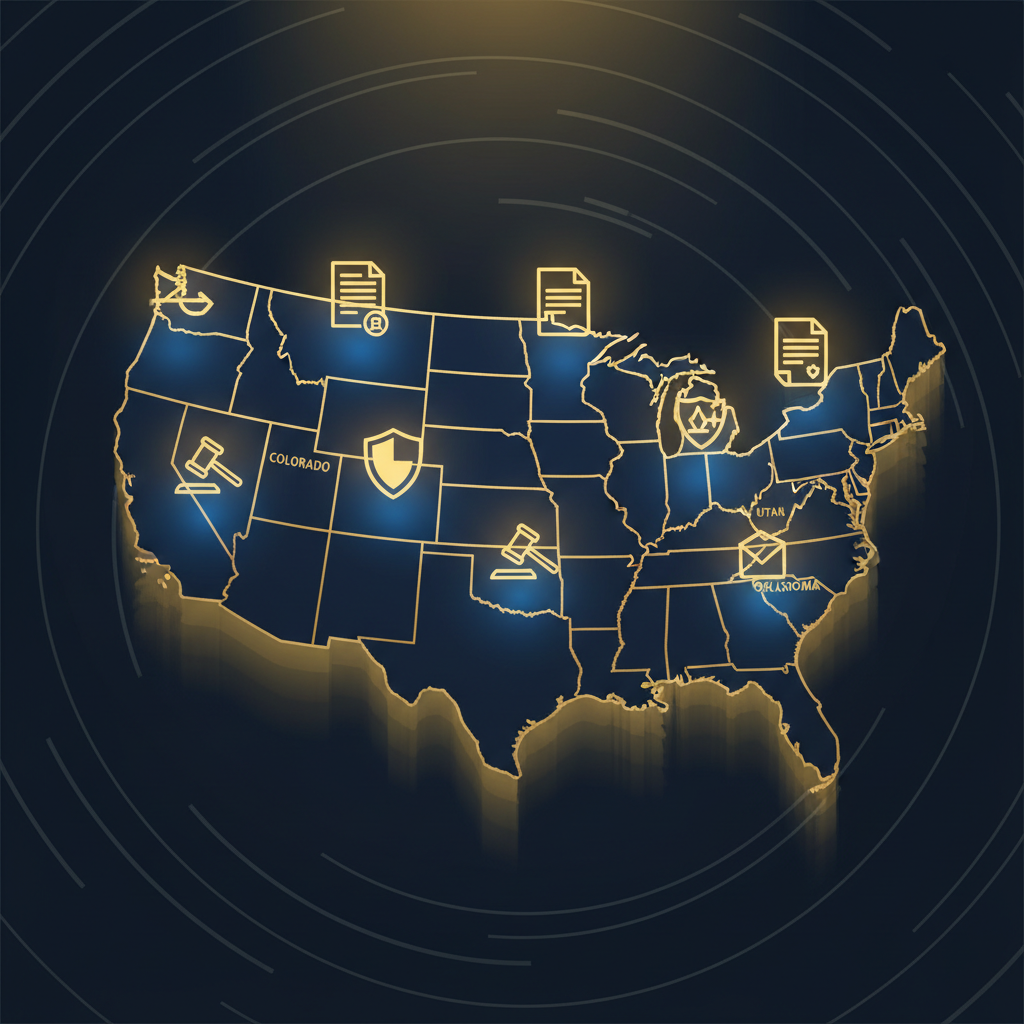
The pace of AI legislation in U.S. state legislatures is accelerating faster than most organizations anticipated. Just one month into 2026, lawmakers are already tracking over 300 AI-related bills across the country — and this past week alone delivered significant movement on chatbot regulation, a direct confrontation between the Trump administration and a Republican-led state, new health care AI restrictions, and a wave of fresh bills targeting pricing, employment, and public health. Here’s what security and compliance professionals need to know.
1. Chatbot Bills Are Dominating the Legislative Calendar
If there’s a headline theme from this week’s legislative activity, it’s chatbots. Bills aimed at regulating AI-powered companion chatbots — particularly those interacting with minors — are advancing rapidly across multiple states simultaneously.
In Virginia, SB 796, the AI Chatbots and Minors Act, unanimously passed out of the Senate General Laws Committee and is now heading to floor votes. The bill focuses on preventing chatbots from deploying human-like features with minors in potentially harmful ways.
In Washington, SB 5984 — which governs companion chatbots — passed the full Senate, while its companion bill HB 2225 is moving through the House on second reading. Washington’s legislative deadline is February 17, creating urgency for both chambers to act.
Chatbot bills also cleared committee hurdles in Utah (HB 438), Arizona (HB 2311), and Hawaii (SB 3001 and HB 2502), while new chatbot-related bills were filed in six additional states.
The catalyst for much of this activity traces back to a high-profile lawsuit following a teenager’s suicide after conversations with a companion chatbot — a tragedy that galvanized lawmakers across party lines. As one legislative tracking firm put it: chatbot regulation “is not a partisan topic; it is a parent topic.”
What this means for organizations: Companies that operate, develop, or deploy AI chatbots — especially those accessible to minors — need to be actively monitoring this space. Requirements around disclosure, behavioral guardrails, and child protection plans are quickly shifting from aspirational policy to enforceable law.
In-Depth Analysis of the Utah Consumer Privacy Act (UCPA)
2. Trump vs. Utah: The First Real Test of the AI Executive Order
The most politically significant development of the week came not from a vote, but from a letter.
According to a report from Axios, the Trump administration sent a letter to Utah’s Senate Majority Leader indicating that Utah’s HB 286, the AI Transparency Act, “goes against the Administration’s AI agenda.” This is widely considered the first known public test of Trump’s January 2025 Executive Order on Ensuring a National Policy Framework for Artificial Intelligence — an order that broadly directed federal agencies to prevent state AI regulations from fragmenting the national AI policy landscape.
What makes this confrontation particularly notable is that HB 286 includes child safety provisions — specifically requiring large frontier model developers operating covered chatbots to develop, implement, and publicly publish a child protection plan. Child safety was broadly considered a safe harbor from the executive order’s intended scope. When the order was originally signed, Utah lawmakers expressed skepticism it would affect their 2026 AI agenda. That calculation now appears to be wrong.
This creates a genuine constitutional and political tension. States have historically regulated consumer protection, child safety, and public welfare without federal interference. Whether the Trump administration will move beyond a letter to actual legal or funding-based pressure remains to be seen.
Meanwhile, HB 276, Utah’s Digital Content Provenance Standards Act, passed out of a House committee and is advancing — suggesting Utah isn’t backing down across the board, even as it navigates federal pressure.
What this means for organizations: Federal preemption of state AI law is no longer a theoretical risk. CISOs and legal teams should begin scenario planning for what a patchwork of state laws with uncertain federal preemption might look like for compliance programs, particularly if you operate in regulated sectors with child or consumer-facing AI tools.
AI Governance and Regulatory Convergence: What CISOs Must Prepare for Now
3. Health Care AI: Tennessee Draws a Clear Line
The Tennessee Senate passed legislation prohibiting any person from developing or deploying an AI system that advertises or represents to the public that it is — or is able to act as — a qualified mental health professional.
This is a targeted but significant bill. As AI-powered “therapy bots,” mental health apps, and crisis chatbots proliferate, Tennessee is drawing a hard line between AI as a supportive tool and AI as a clinical provider. The legislation doesn’t prohibit AI in mental health contexts entirely — it specifically targets deceptive or misleading representations about clinical qualification.
This tracks with a broader national concern. California is simultaneously moving forward with AB 1988, which would require companion chatbots to take specific actions when they detect credible crisis expressions — including directing users to seek professional help. The line between “supportive AI” and “clinical AI” is becoming a major regulatory fault line.
What this means for organizations: Any company operating AI in behavioral health, mental wellness, employee assistance, or crisis intervention contexts should audit how their products are described in marketing, terms of service, and the product itself. Misrepresentation of clinical capability is increasingly becoming a legal liability.
AI Governance and Regulatory Convergence: What CISOs Must Prepare for Now
4. Disclosure and Content Provenance: Washington and California Keep Moving
Washington’s House passed HB 1170, a disclosure and content provenance bill inspired by California’s AI Transparency Act. The Washington bill requires covered providers to:
- Make available a provenance detection tool for AI-generated content- Offer users the option to include a manifest disclosure in certain GenAI-created content- Embed a latent disclosure within such content automatically
The bill reflects a growing consensus among state legislators that users have a right to know when they’re interacting with AI-generated material — whether in news, marketing, legal documents, or interpersonal communication.
In California, the situation is getting more complex. The original AI Transparency Act was passed two years ago, amended last year, and now a California Senator has introduced yet another amendment bill. The churning legislative process in California reflects the difficulty of writing durable AI law in a field that evolves faster than the legislative cycle.
What this means for organizations: Content provenance requirements are spreading. Organizations that generate content at scale using AI — marketing teams, media companies, legal firms, insurance providers — need to begin implementing provenance tracking and disclosure infrastructure now, before this becomes mandatory across multiple states simultaneously.
5. New Bills: Pricing, Employment, and Health in the Crosshairs
Beyond the headline stories, lawmakers filed a significant volume of new AI-related bills this week across three high-impact categories:
Pricing (5 new bills): Lawmakers in multiple states are targeting algorithmic pricing — the practice of using AI to dynamically set prices for goods and services. Surveillance-based price discrimination is already moving in Washington (HB 2481). Expect similar bills to gain traction as consumer advocates push back against AI-driven pricing models in retail, insurance, and housing.
Employment (4 new bills): AI in hiring, firing, promotion, and compensation decisions continues to draw legislative attention. Notable bills include California’s AB 1883 (workplace surveillance tools) and AB 1898 (workplace AI tools), New York’s A 10251 (limiting automated decision systems in employment), and Rhode Island’s H 7767. Virginia’s HB 1514, which had passed through the General Laws committee 21-0, was unfortunately laid on the table by a subcommittee.
Health (2 new bills): Building on Tennessee’s action, new health-related AI bills are emerging targeting AI’s role in insurance coverage determinations, clinical decision support, and patient communication.
The New Era of Digital Gatekeeping: Alabama Joins the App Store Regulation Wave
The Bigger Picture: What Organizations Should Be Doing Now
The legislative environment for AI in 2026 is not a future concern — it’s a present operational reality. Several practical takeaways emerge from this week’s activity:
Inventory your AI deployments. Know which tools you use, what they do, who they interact with, and how they’re described to users. Chatbot and health care bills are specifically targeting misrepresentation and minor-facing AI.
Watch the short-session states closely. Utah closes March 6, Virginia closes March 14, and Washington closes March 21. Bills in these states are moving fast. What’s in committee this week could be law in 30 days.
Don’t assume federal preemption protects you. The Trump executive order may slow some state legislation, but the Utah confrontation shows it won’t eliminate it — and the legal standing of that order to preempt state laws on child safety and consumer protection remains genuinely unclear.
Start building provenance and disclosure infrastructure. Multiple states are converging on similar disclosure and provenance requirements for AI-generated content. Getting ahead of this now prevents a compliance scramble later.
Engage your legal team on sector-specific exposure. Employment AI bills, pricing AI bills, and health care AI bills each carry distinct liability frameworks. A CISO or compliance officer can’t manage this alone — legal, HR, and marketing stakeholders all have exposure here.