The most actionable federal Zero Trust compliance guidance ever released—77 mandatory activities for defense contractors and federal agencies
Executive Summary
The National Security Agency has fundamentally changed the compliance landscape for defense contractors, federal agencies, and security-conscious enterprises. With the release of the Zero Trust Implementation Guidelines (ZIGs), organizations now have unprecedented clarity on exactly what Zero Trust means—and exactly what they must do to achieve it.
The numbers are stark: 77 Target-level activities (36 in Phase One + 41 in Phase Two) by FY2027. No exceptions. No extensions.
This isn’t another theoretical framework. The ZIGs translate high-level mandates into discrete, measurable tasks spanning 784 pages of implementation guidance. For Defense Industrial Base (DIB) contractors, this is the compliance baseline that will determine contract eligibility. For enterprises outside the federal ecosystem, this is the most sophisticated Zero Trust blueprint ever made public.
This guide breaks down what you need to know, who’s affected, and how to build a realistic compliance roadmap before the 2027 deadline arrives.
What Are the Zero Trust Implementation Guidelines?
The Zero Trust Implementation Guidelines represent the NSA’s answer to a persistent problem: organizations understand why they need Zero Trust, but struggle with how to implement it.
Unlike conceptual frameworks such as NIST SP 800-207 or assessment-focused models like CISA’s Zero Trust Maturity Model, the ZIGs are execution documents. They tell you specifically what to do, in what order, with what expected outcomes.
The ZIG Document Series
DocumentPurposeStatusPrimerFoundational concepts, terminology, and mindsetReleased January 2026Discovery PhaseVisibility requirements and inventory baselineReleased January 2026Phase One36 activities establishing secure foundationReleased January 30, 2026Phase Two41 activities for core ZT solution integrationReleased January 30, 2026Phase ThreeAdvanced-level capabilitiesFuture releasePhase FourAdvanced-level capabilitiesFuture release
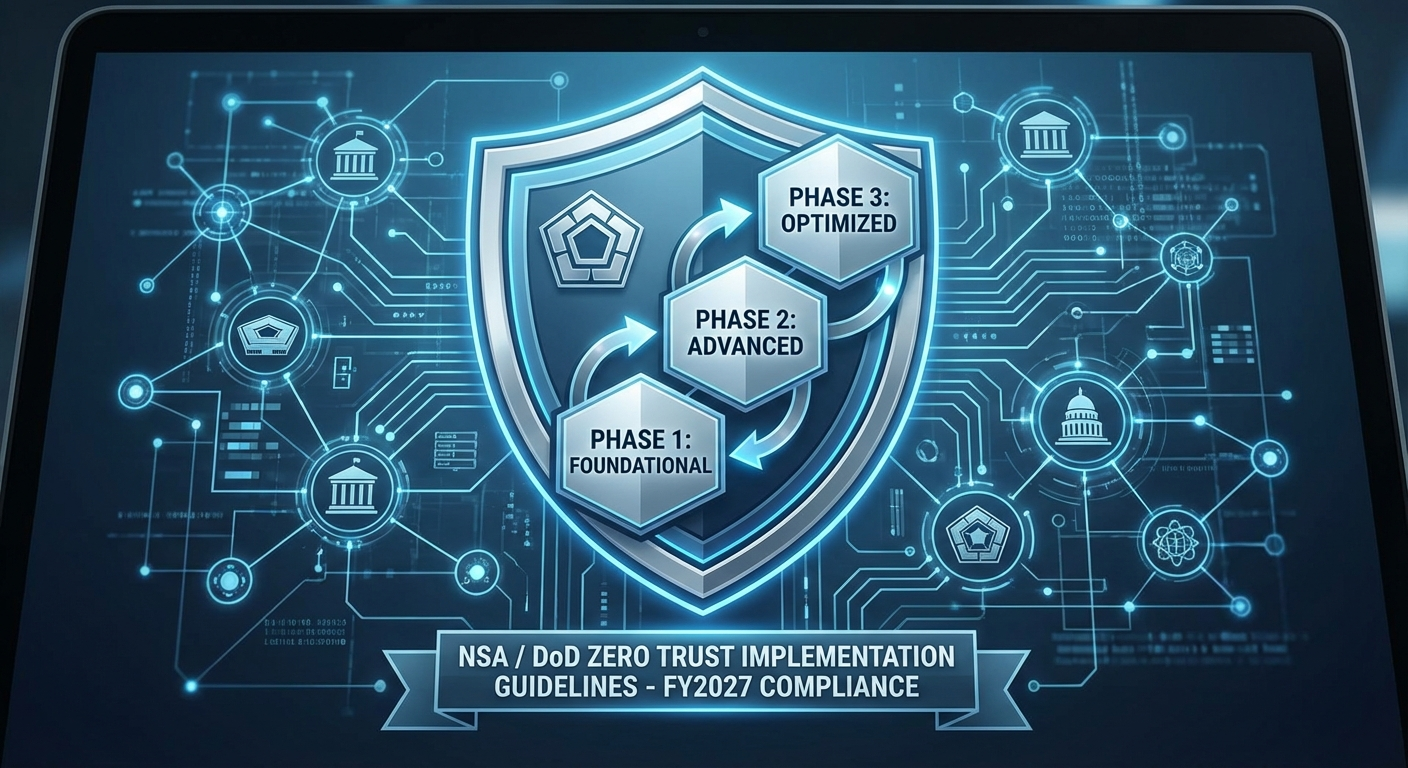
Together, Phase One and Phase Two deliver the 77 activities (36 + 41) required to achieve Target-level maturity by FY2027. Phases Three and Four will add 61 additional activities for Advanced-level maturity by FY2032—but that’s a problem for another budget cycle.
What Makes ZIGs Different
If your organization has already invested in NIST 800-207 alignment or CISA ZTMM assessments, the ZIGs don’t replace that work—they operationalize it.
NIST SP 800-207 provides the conceptual architecture. It tells you what Zero Trust should look like in the abstract.
CISA ZTMM v2.0 provides the maturity assessment framework. It tells you where you stand on the Zero Trust journey.
NSA ZIGs provide the implementation playbook. They tell you how to get from where you are to where you need to be, activity by activity.
Think of it this way: NIST is the architectural blueprint, CISA is the building inspector’s checklist, and the ZIGs are the general contractor’s construction manual. You need all three, but only the ZIGs tell you exactly what to build on Monday morning.
Who Must Comply—And Who Should
Mandatory Compliance
The ZIGs are authoritative guidance for three categories of organizations:
1. Department of Defense Components Every DoD organization falls under the DoD Zero Trust Strategy, which mandates Target-level maturity by FY2027. The ZIGs are the official implementation guide for meeting that mandate.
2. National Security Systems (NSS) Organizations operating systems that process classified information or are critical to military operations must align with ZIG guidance. This includes intelligence community systems and defense-critical infrastructure.
3. Defense Industrial Base Contractors This is where the compliance pressure becomes immediate. DIB contractors handling Controlled Unclassified Information (CUI) or operating on DoD networks will face ZIG alignment requirements through contract language, security assessment criteria, and supply chain flow-down provisions.
Strongly Recommended Compliance
Federal Contractors (Non-DIB) Civilian agencies are pursuing parallel Zero Trust mandates under Executive Order 14028 and CISA guidance. While the ZIGs are DoD-focused, federal procurement officers increasingly expect contractors to demonstrate Zero Trust capabilities. The ZIGs provide the most detailed implementation reference available.
Critical Infrastructure Operators CISA has designated 16 critical infrastructure sectors for enhanced cybersecurity requirements. Organizations in energy, healthcare, financial services, and transportation can use the ZIGs as a best-practice implementation guide aligned with federal expectations.
Enterprises Seeking Zero Trust Rigor For any organization serious about Zero Trust—not as marketing positioning, but as operational reality—the ZIGs offer a level of implementation specificity unavailable elsewhere. If you want to know what mature Zero Trust actually looks like, this is the reference.
Phase-by-Phase Compliance Requirements
Quick Reference: ZIG Phases Overview
PhaseActivitiesCapabilitiesFocusDeadlineDiscoveryN/AVisibility baselineComplete inventories of users, devices, apps, dataBefore Phase OnePhase One3630Secure foundation (ICAM, segmentation, monitoring)FY2027Phase Two4134Dynamic enforcement (continuous auth, automation, analytics)FY2027Phase ThreeTBDTBDAdvanced capabilitiesFY2032Phase FourTBDTBDAdvanced capabilitiesFY2032
Target-level maturity = Discovery + Phase One + Phase Two (77 activities total) by September 30, 2027
Discovery Phase: You Cannot Protect What You Cannot See
Before any enforcement begins, the Discovery Phase establishes complete visibility across your environment. This isn’t optional preparation—it’s the prerequisite that makes everything else possible.
Required Inventories:
- User accounts and privileged identities- Devices (managed and unmanaged)- Applications and code deployments- Data repositories and classifications- Data flows between systems- Existing security policies- Logging and telemetry capabilities
The Discovery Phase answers a fundamental question: What exists in your environment that could be exploited, exfiltrated, or compromised? Without authoritative answers, Zero Trust enforcement becomes guesswork.
Compliance Action: Complete Discovery Phase inventories before proceeding to Phase One. Many organizations underestimate this requirement—inventories must be authoritative, not approximate.
Phase One: The Secure Foundation (36 Activities)
Phase One establishes the security baseline that enables Zero Trust enforcement. The 368-page Phase One document details 36 discrete activities supporting 30 distinct capabilities across five focus areas.
Identity, Credential, and Access Management (ICAM)
This is where most organizations start—and where many stall. Phase One requires:
- Standardized identity providers: Consolidate legacy authentication systems into approved identity infrastructure. No more shadow directories or application-specific credential stores.- Universal multi-factor authentication: MFA everywhere, for everyone, with no exceptions for convenience.- Least-privilege access controls: Default-deny posture with documented justification for every access grant.
The hard truth: If your organization still has applications authenticating against local databases or allows single-factor access for “low-risk” systems, Phase One compliance requires architectural changes, not configuration tweaks.
Network Segmentation
Zero Trust assumes breach. Network segmentation limits blast radius when—not if—that breach occurs.
- Micro-segmentation implementation: Workload-level isolation, not just VLAN separation- Software-defined networking preparation: Infrastructure capable of dynamic policy enforcement- East-west traffic visibility: You cannot segment what you cannot monitor
Device Visibility and Health
Every device accessing your resources must be known, assessed, and continuously validated.
- Endpoint detection and response (EDR): Required, not optional- Device posture assessment: Real-time health checks before access decisions- Asset inventory maintenance: Authoritative device registry updated continuously
Data Protection
Data is the ultimate target. Phase One establishes baseline protections.
- Encryption at rest and in transit: No exceptions, no exemptions- Data classification baseline: You must know what you’re protecting to protect it appropriately
Continuous Monitoring
Zero Trust requires continuous verification. That requires comprehensive telemetry.
- Logging infrastructure: Centralized, tamper-resistant, complete- Security information aggregation: SIEM capabilities for correlation and analysis
Phase One Outcome: A secure foundation ready for Zero Trust enforcement. Your environment is visible, your identities are verified, your network is segmented, and your monitoring infrastructure captures the telemetry needed for continuous assessment.
Phase Two: Dynamic Enforcement (41 Activities)
Phase Two transforms static security controls into dynamic, risk-adaptive enforcement. The 416-page document details 41 activities supporting 34 capabilities that operationalize Zero Trust principles.
Continuous Authentication
Authentication at login is insufficient. Phase Two implements continuous verification throughout session lifecycle.
- Periodic re-authentication: Risk-based triggers for credential re-verification- Behavioral authentication triggers: Unusual activity prompts additional verification- Session-based access decisions: Every action evaluated, not just initial access
Dynamic Policy Enforcement
Static access control lists cannot respond to emerging threats. Phase Two deploys adaptive enforcement.
- Policy Decision Points (PDPs): Centralized policy evaluation- Policy Enforcement Points (PEPs): Distributed enforcement at every access boundary- Real-time risk scoring: Continuous assessment informing access decisions- Adaptive access controls: Permissions that change based on context and risk
Automation and Orchestration
Manual security operations cannot scale to Zero Trust requirements. Automation is mandatory.
- Security Orchestration, Automation, and Response (SOAR): Automated incident response and policy adjustment- Integration across security tools: Coordinated action, not siloed response- Automated policy adjustment: Dynamic response to changing risk conditions
Advanced Analytics
Detection requires understanding normal behavior to identify anomalies.
- User and Entity Behavior Analytics (UEBA): Baseline behavior modeling and deviation detection- Anomaly detection: Statistical identification of suspicious activity- AI/ML-driven threat detection: Pattern recognition beyond human analysis capabilities
Just-in-Time Access
Standing privileges are standing risks. Phase Two minimizes persistent access.
- Temporary privilege elevation: Access granted for specific tasks, automatically revoked- Time-bound access grants: No indefinite permissions- Automated access expiration: Privileges removed without manual intervention
Phase Two Outcome: A dynamically-enforced Zero Trust environment where access decisions happen continuously, policies adapt to risk, and automation handles the operational complexity that would otherwise overwhelm security teams.
The FY2027 Compliance Timeline
The deadline is not negotiable. Organizations must achieve Target-level maturity—completion of Discovery Phase, Phase One, and Phase Two—by the end of Fiscal Year 2027 (September 30, 2027).
Time remaining from February 2026: 19 months
Visual Timeline: February 2026 → September 2027
2026 Q1 (NOW)           Q2                  Q3                  Q4                 2027 Q1              Q2                  Q3
├──────────────┼──────────────┼──────────────┼──────────────┼──────────────┼──────────────┼──────────────┤
│ Gap          │ Discovery    │ Phase 1      │ Phase 1      │ Phase 1      │ Phase 2      │ Phase 2      │
│ Assessment   │ Complete     │ Activities   │ Activities   │ Activities   │ Intensive    │ Final        │
│ & Planning   │ Inventories  │ 1-12         │ 13-24        │ 25-36 ✓      │ 1-30         │ 31-41 ✓      │
│              │              │              │ + Phase 2    │ + Phase 2    │              │              │
│              │              │              │ Start 1-10   │ 11-20        │              │              │
└──────────────┴──────────────┴──────────────┴──────────────┴──────────────┴──────────────┴──────────────┘
                                             ↑                              ↑              ↑
                                          Budget                         Technology     Documentation
                                          Approvals                      Deployments    & Validation
                                          Required                       Complete       Complete
DEADLINE: September 30, 2027 ← All 77 activities complete, documented, and audit-ready
Realistic Timeline Planning
Current State Assessment (Q1 2026) Where do you stand against Discovery Phase requirements? How many Phase One activities are partially or fully implemented? This assessment determines your compliance gap.
Discovery Phase Completion (Q2 2026) If your inventories aren’t authoritative, everything downstream fails. Prioritize Discovery Phase closure.
Phase One Implementation (Q3 2026 - Q2 2027) 36 activities across 12 months averages 3 per month. However, implementation complexity varies dramatically—some activities are configuration changes completed in days, while others require vendor procurement, infrastructure deployment, and cross-team integration spanning months. Front-load the complex activities.
Phase Two Implementation (Q3 2026 - Q3 2027) Phase Two activities can proceed in parallel with later Phase One activities where dependencies allow. The 41 Phase Two activities must complete before fiscal year end. Prioritize automation and UEBA implementation early—these capabilities require behavioral baseline establishment that cannot be rushed.
Validation and Documentation (Q4 2027) Compliance requires evidence. Ensure implementation is documented, tested, and audit-ready before September 30, 2027.
The Math Problem
77 activities in approximately 20 months (from February 2026 to September 2027) requires sustained execution velocity—averaging nearly 4 activities per month with zero margin for delay. Organizations discovering significant gaps now face compressed timelines.
This is not a problem that additional budget alone can solve. Zero Trust implementation requires organizational change, process redesign, and technology integration that cannot be accelerated arbitrarily.
Start now. Organizations beginning in late 2026 will struggle to achieve compliance without significant compromise.
Practical Implementation Guidance
The Technology Stack You’ll Need
The ZIGs explicitly identify five fundamental technology capabilities required for Target-level maturity:
CapabilityPurposePhaseTypical Solutions**Audit and Logging Systems (SIEM)Comprehensive, centralized, tamper-resistant log collection and correlationPhase OneSplunk, Microsoft Sentinel, Elastic Security, ChronicleEndpoint Detection and Response (EDR)Real-time device visibility, threat detection, and automated responsePhase OneCrowdStrike, Microsoft Defender for Endpoint, SentinelOne, Carbon BlackMulti-Factor Authentication (MFA)**Universal authentication, phishing-resistant for privileged usersPhase OneOkta, Microsoft Entra ID, Duo, YubiKey (hardware tokens)User and Entity Behavior Analytics (UEBA)Behavioral baseline and anomaly detection for users and systemsPhase TwoExabeam, Microsoft Sentinel UEBA, Splunk UBA, SecuronixJust-in-Time (JIT) Access ProvisioningDynamic privilege management with time-bound accessPhase TwoCyberArk, BeyondTrust, HashiCorp Vault, AWS IAM Access Analyzer
Additional Capabilities Required:
- Policy Decision Points (PDPs): Centralized policy evaluation engines (often integrated with identity platforms)- Policy Enforcement Points (PEPs): Distributed enforcement at application layer (ZTNA solutions, API gateways, application proxies)- Security Orchestration, Automation, and Response (SOAR): Automated incident response and workflow orchestration (Palo Alto Cortex XSOAR, IBM Resilient, Splunk SOAR)- Network Segmentation: Micro-segmentation capabilities (Illumio, VMware NSX, Cisco ACI, Zscaler)
Procurement Timeline Considerations:
- Enterprise software procurement typically requires 3-6 months (RFP, evaluation, contracting)- Implementation and integration add 2-6 months depending on environment complexity- Behavioral analytics require 30-90 day learning periods before operational- Critical path item: Start UEBA procurement immediately—behavioral baselines cannot be rushed
These aren’t optional components. Organizations lacking any of these capabilities face immediate procurement requirements. Budget requests should be escalated now for FY2026 and FY2027 funding cycles.
Estimated Cost Ranges (Annual, for mid-size organization ~1,000 users):
- SIEM/Logging: $150K - $500K (depends on data volume, retention requirements)- EDR: $50 - $150 per endpoint ($50K - $150K total)- MFA: $3 - $10 per user per month ($36K - $120K annually)- UEBA: $100K - $400K (standalone) or included with advanced SIEM tiers- JIT Access/PAM: $100K - $300K- SOAR Platform: $150K - $500K- ZTNA/Network Segmentation: $200K - $600K
Total estimated technology investment: $800K - $2.7M annually for software licenses, plus implementation services (typically 20-40% of software costs) and ongoing operational FTEs (minimum 3-5 dedicated staff for sustained operations).
Organizations should budget $1M - $3.5M total for FY2026-FY2027 technology acquisition and implementation, with ongoing annual costs of $600K - $2M for licensing and operations.
These are illustrative ranges. Actual costs vary based on organization size, environment complexity, existing infrastructure, and vendor selection.
Common Implementation Failures
Failure 1: “We deployed ZTNA, so we’re Zero Trust compliant.”
Zero Trust Network Access controls access to applications. It does not control activity within applications. The ZIGs explicitly require application-layer enforcement—each application must have its own Policy Decision Point and Policy Enforcement Point.
Failure 2: Treating Zero Trust as a project instead of an operating model.
Zero Trust is not a deployment that finishes. It’s an ongoing operational posture requiring continuous verification, policy adjustment, and architectural evolution. Budget and staff accordingly.
Failure 3: Ignoring post-authentication threats.
The attacks succeeding today happen after legitimate authentication. Credential theft, session hijacking, and insider threats all occur within authenticated sessions. Device posture checks at login provide limited protection when abuse occurs during active sessions.
Failure 4: Network-centric implementation.
Many identities—customers, partners, third-party integrations, API connections—never pass through enterprise network gateways. Application-layer visibility and control are essential, not optional.
Implementation Checklist for Compliance Officers
💡 Pro Tip: Print or export this checklist as your working compliance tracker. Update weekly and review with your steering committee monthly.
Discovery Phase (Complete First):
- Complete user and privileged account inventory (authoritative, not approximate)- [ ] Complete device inventory with asset owners identified- [ ] Document all applications and code repositories- [ ] Map all data flows between systems- [ ] Catalog all data repositories with classification levels- [ ] Inventory existing security policies and procedures- [ ] Verify logging and telemetry capabilities across environment
Phase One Foundation (36 Activities):
Identity & Access (ICAM):
- Authoritative identity provider established (consolidated authentication)- [ ] MFA deployed universally with phishing-resistant options for privileged users- [ ] Least-privilege access model implemented (default-deny posture)- [ ] Privileged account management system operational
Network & Devices:
- Network micro-segmentation implemented (workload-level isolation)- [ ] EDR deployed on 100% of managed endpoints- [ ] Device health assessment integrated with access decisions- [ ] Unmanaged device inventory and remediation process established
Data Protection:
- Data classification baseline documented and communicated- [ ] Encryption verified for data at rest (databases, file shares, backups)- [ ] Encryption verified for data in transit (TLS 1.2+ minimum)- [ ] Data Loss Prevention (DLP) controls deployed for sensitive data
Monitoring & Logging:
- Centralized logging infrastructure operational (SIEM/log aggregation)- [ ] Log retention meets compliance requirements (minimum 90 days)- [ ] Tamper-resistant log storage configured- [ ] Security event correlation rules established
Phase Two Dynamic Enforcement (41 Activities):
Continuous Verification:
- Continuous authentication triggers configured (risk-based re-authentication)- [ ] Session-based access monitoring implemented- [ ] Behavioral analytics baseline established (30-90 day learning period)- [ ] UEBA capabilities integrated with identity infrastructure
Dynamic Policy:
- Policy Decision Points (PDPs) deployed at application layer- [ ] Policy Enforcement Points (PEPs) integrated at all access boundaries- [ ] Real-time risk scoring integrated with access decisions- [ ] Adaptive access controls respond to risk score changes
Automation:
- SOAR platform deployed for automated incident response- [ ] Security tool integration completed (API connections between systems)- [ ] Automated policy adjustment workflows configured- [ ] Automated access revocation upon risk threshold
Advanced Access Control:
- Just-in-time access provisioning operational for privileged accounts- [ ] Time-bound access grants with automatic expiration- [ ] Break-glass access procedures documented and monitored- [ ] Access reviews automated (quarterly minimum for privileged access)
Documentation & Evidence (Required for Audits):
- Implementation evidence collected for each completed activity- [ ] Configuration baselines documented and version controlled- [ ] Testing and validation results archived- [ ] Exception documentation with risk acceptance signatures- [ ] Continuous monitoring reports generated and reviewed
First Steps for Compliance Officers (Start This Week)
Week 1: Gap Assessment
- Download all official ZIG documents from NSA.gov2. Assemble cross-functional team (IT, security, compliance, procurement, legal)3. Conduct Discovery Phase self-assessment using the checklist above4. Document current state against Phase One requirements5. Identify which of the 36 Phase One activities are already complete or in progress
Week 2: Resource Planning
- Estimate budget requirements for missing technology capabilities (EDR, UEBA, SOAR, MFA)2. Identify vendor solutions for capability gaps3. Calculate FTE requirements for implementation and ongoing operations4. Present preliminary findings to executive leadership with budget request5. Establish program governance structure (steering committee, working groups)
Week 3: Roadmap Development
- Sequence activities based on dependencies (e.g., ICAM before dynamic policy)2. Assign owners for each of the 77 activities3. Create detailed project timeline with monthly milestones4. Identify procurement lead times for technology acquisitions5. Schedule recurring program review meetings through FY2027
Week 4: Execution Begins
- Kick off Discovery Phase inventory activities2. Issue RFPs for technology gaps requiring vendor solutions3. Begin Phase One activities that require no additional procurement4. Establish documentation repository for compliance evidence5. Communicate ZIG compliance program to organization
Red Flags Requiring Immediate Escalation:
- No centralized identity provider exists- MFA not deployed organization-wide- No EDR solution on endpoints- Data classification program doesn’t exist- Logging infrastructure inadequate for comprehensive telemetry- Budget cycle makes FY2027 procurement impossible
If two or more red flags apply, your organization faces significant compliance risk. Executive intervention is required immediately.
Strategic Implications for Defense Contractors
Contract Eligibility at Stake
For Defense Industrial Base contractors, ZIG alignment is becoming table stakes. Expect:
- RFP language requiring ZIG compliance for contracts involving CUI or DoD network access- Security assessment criteria evaluating Zero Trust maturity- Supply chain flow-down where prime contractors impose ZIG requirements on subcontractors- CMMC intersection where Zero Trust capabilities complement existing compliance obligations
The Supply Chain Pressure Campaign
Prime contractors face their own FY2027 deadlines. They cannot achieve compliance if their supply chain partners remain security liabilities. Expect aggressive flow-down of Zero Trust requirements throughout 2026 and 2027.
Subcontractors receiving Zero Trust compliance requirements from primes should treat these as non-negotiable. The alternative is losing contract eligibility.
Documentation Requirements
Compliance without evidence is not compliance. The activity-level specificity of the ZIGs enables—and requires—detailed documentation:
- Implementation evidence for each activity- Configuration verification records- Testing and validation results- Exception documentation with risk acceptance- Continuous monitoring evidence
Build documentation practices into implementation workflows. Retrofitting compliance evidence is expensive and unreliable.
Common Compliance Questions
Q: Can we claim ZIG compliance based on our existing NIST 800-207 or CISA ZTMM work?
No. While NIST and CISA frameworks provide valuable context, the ZIGs require specific activity completion. You must map your existing implementations to the 77 ZIG activities and document gaps. Previous work accelerates compliance but doesn’t automatically satisfy it.
Q: What if we can’t complete all 77 activities by FY2027?
Expect contract eligibility impact. For defense contractors, incomplete ZIG compliance may result in disqualification from RFPs, contract modifications imposing compliance as a requirement, or enhanced scrutiny during security assessments. Plan for full compliance—partial implementation carries full risk.
Q: Can we outsource ZIG implementation to a managed service provider?
Certain capabilities (SIEM, SOAR, UEBA) can be delivered as managed services, but organizational responsibility for compliance cannot be outsourced. You must maintain policy authority, access control decisions, and compliance evidence even when leveraging external providers. Ensure MSP contracts explicitly address ZIG activity support and documentation.
Q: How do the ZIGs intersect with CMMC requirements?
The ZIGs and CMMC address overlapping but distinct requirements. CMMC focuses on CUI protection controls; ZIGs focus on Zero Trust architecture implementation. Organizations pursuing CMMC certification should map ZIG activities to CMMC practices to identify synergies and avoid duplicate effort. Expect future CMMC assessments to evaluate Zero Trust maturity as evidence of advanced security posture.
Q: What evidence do auditors expect for each activity?
The ZIGs identify expected outcomes for each activity. Compliance evidence should include:
- Configuration exports showing policy implementation- System architecture diagrams reflecting ZT principles- Access logs demonstrating continuous verification- Testing results validating enforcement- Policy documents defining procedures- Training records showing organizational awareness
Build evidence collection into your implementation process—retrofitting documentation is expensive and unreliable.
Q: Can we request deadline extensions due to budget constraints or resource limitations?
No formal extension process has been announced. Organizations facing insurmountable challenges should engage with their contracting officers early to discuss risk mitigation strategies, but should not assume flexibility. The federal government has been signaling Zero Trust urgency since 2021—FY2027 represents years of notice, not a surprise deadline.
Q: What happens after FY2027? Is this a one-time compliance requirement?
Zero Trust is an operating model, not a project. Achieving Target-level maturity by FY2027 establishes the baseline. Organizations must maintain compliance through continuous operation, monitoring, and improvement. Phases Three and Four (Advanced-level maturity by FY2032) will add 61 additional activities. Expect ongoing compliance validation through audits, assessments, and contract requirements.
Q: Should small defense contractors with limited IT resources attempt ZIG compliance?
Yes, if you intend to maintain defense contracts involving CUI or DoD network access. The alternative is exiting the defense market. Small contractors should consider:
- Cloud-native Zero Trust solutions with lower operational overhead- Managed service providers for SIEM, SOAR, and UEBA capabilities- Industry partnerships or shared services for expensive capabilities- Early engagement with primes to understand specific compliance expectations
Size does not exempt organizations from compliance requirements, but it may influence implementation approach.
Key Resources
Official NSA Publications
- Phase One ZIG: CTR_ZIG_PHASE_ONE.PDF (368 pages)- Phase Two ZIG: CTR_ZIG_PHASE_TWO.PDF (416 pages)- Discovery Phase: CTR_ZIG_DISCOVERY_PHASE.PDF- NSA Zero Trust Portal: nsa.gov/Cybersecurity/Zero-Trust-Implementation-Guidelines/
Complementary Frameworks
- NIST SP 800-207: Zero Trust Architecture- CISA Zero Trust Maturity Model v2.0- DoD Zero Trust Strategy Execution Roadmap
The Bottom Line: Your Compliance Imperative
The NSA’s Zero Trust Implementation Guidelines represent the most comprehensive, actionable Zero Trust compliance framework ever released by the federal government. For organizations in the defense supply chain, achieving Target-level maturity by FY2027 is a mandatory compliance requirement that will determine contract eligibility. For enterprises outside the federal ecosystem, the ZIGs provide the most rigorous best-practice implementation blueprint available.
Compliance Risk Assessment
Evaluate your organization’s current risk profile:
Current StateRisk LevelAction RequiredNo formal Zero Trust programCRITICALExecutive escalation, immediate program launchConceptual planning only, no implementationHIGHAccelerated roadmap, quarterly executive reviewsDiscovery Phase incompleteHIGHPrioritize inventory completion before enforcementPhase One partially implemented (<50%)MODERATE-HIGHAccelerate implementation, consider external assistancePhase One mostly complete (>75%)MODERATEFocus on Phase Two planning and parallel executionPhase One complete, Phase Two in progressLOW-MODERATEMaintain velocity, document evidence continuouslyBoth phases near completionLOWFocus on validation, documentation, audit readiness
The NSA’s message is unambiguous: Zero Trust is not a product to purchase but an operating model to implement. Discovery must precede enforcement. Network access controls are necessary but insufficient. Applications themselves must become enforcement points. And continuous verification must replace static trust assumptions.
What Compliance Officers Must Understand
- The deadline is non-negotiable. FY2027 ends September 30, 2027. No extensions have been announced.2. Partial compliance is insufficient. All 77 activities must demonstrate completion.3. Documentation is mandatory. Implementation without evidence fails audit.4. Supply chain pressure is intensifying. Prime contractors will impose these requirements on subcontractors.5. Budget constraints are not excuses. Contract eligibility requires compliance regardless of budget cycles.
Your Next Action
Download the official ZIG documents, assemble your compliance team, and conduct the Week 1 gap assessment outlined above. Every week of delay increases implementation risk.
The clock is running. FY2027 is 19 months away.
Start this week.