Federal agencies now required to procure quantum-safe technology as breakthrough algorithms slash hardware requirements from 20 million to under 1 million qubits
Executive Summary
On January 30, 2026, the Cybersecurity and Infrastructure Security Agency (CISA) issued comprehensive guidance that fundamentally shifts U.S. cybersecurity policy: federal agencies must now procure only quantum-resistant technology products across specific hardware and software categories. This mandate, enacted pursuant to Executive Order 14306 signed by President Trump in June 2025, marks the transition from theoretical preparation to operational imperative.
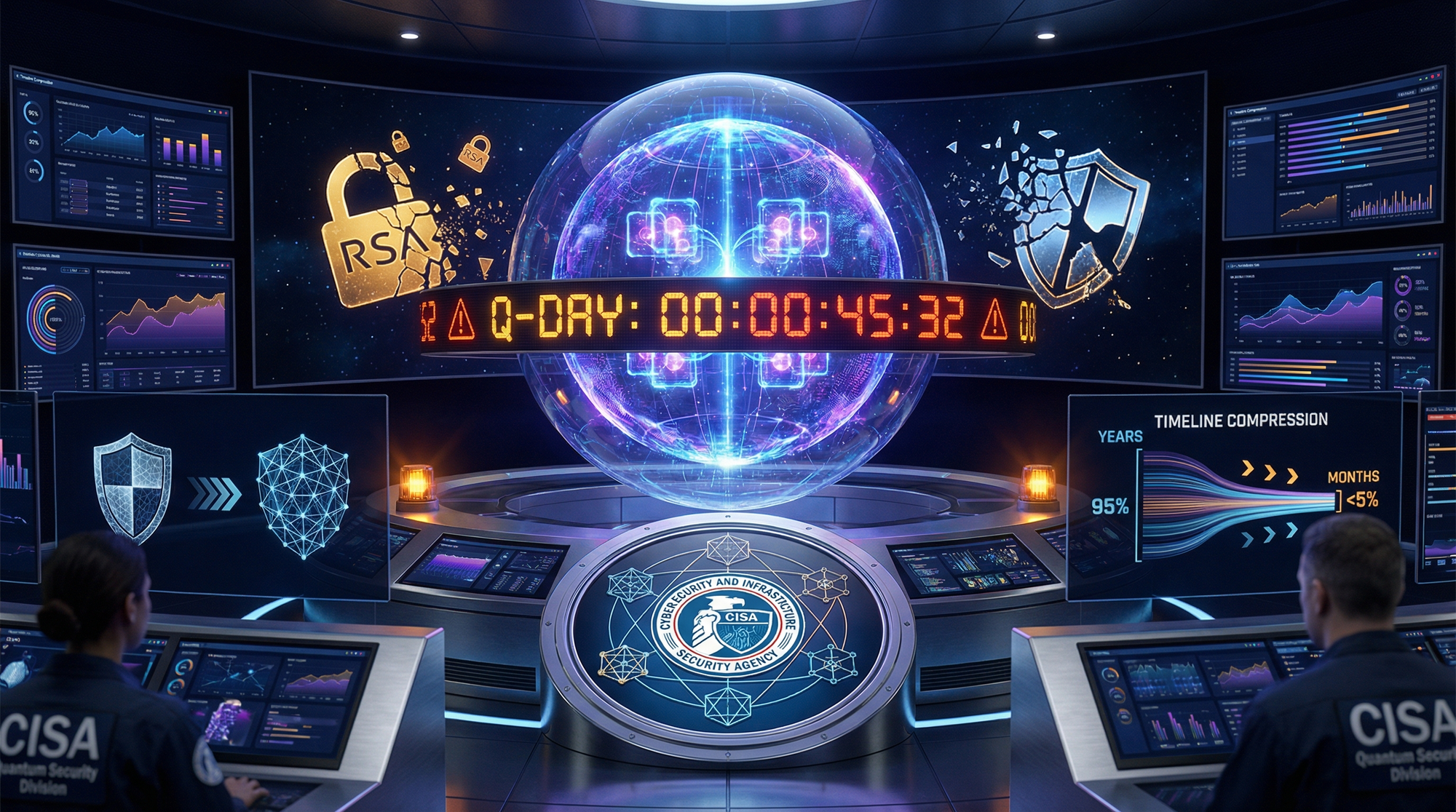
The urgency behind this directive stems from two converging developments that compress the timeline to “Q-Day”—the point at which quantum computers can break today’s encryption—by an estimated 95%. First, algorithmic breakthroughs revealed in 2025 reduced the hardware requirements for breaking RSA-2048 encryption from an estimated 20 million physical qubits to fewer than one million qubits—achievable in less than a week with advanced systems. Second, IBM’s quantum roadmap now projects fault-tolerant systems with hundreds of logical qubits by 2029, while competitors like IonQ target 80,000 logical qubits by 2030.
For compliance officers, this guidance creates immediate action requirements. Organizations handling federal contracts, processing sensitive government data, or operating within critical infrastructure sectors must now demonstrate quantum-resistant procurement practices, conduct cryptographic inventories, and plan migration roadmaps—with federal deadlines as early as January 1, 2027, for new National Security Systems. The compressed timeline, global coordination across Malaysia, the European Union, the United Kingdom, and Australia, and projected market growth from $420 million in 2025 to $2.84 billion by 2030 signal that post-quantum cryptography (PQC) has moved from research labs to procurement requirements.
The threat is not merely theoretical: adversaries are already executing “harvest now, decrypt later” attacks, collecting encrypted data today for decryption once quantum computers mature. Any data requiring confidentiality beyond 2035 needs quantum-resistant protection now.
What Changed: The CISA Mandate
The Directive’s Core Requirements
CISA’s January 30, 2026, guidance identifies specific categories of IT products commonly procured by federal agencies that employ cryptographic algorithms for encryption or authentication. When a product category appears on CISA’s list as having widely available post-quantum cryptography capabilities, federal agencies must procure only quantum-resistant products within that category. The initial mandate covers:
- Cloud Services: Platform-as-a-Service (PaaS) and Infrastructure-as-a-Service (IaaS) offerings implementing or transitioning to PQC standards2. Collaboration Software: Enterprise communication platforms handling encrypted data transmission3. Web Infrastructure: Browsers and servers securing online communications4. Endpoint Security: Full-disk encryption and data-at-rest encryption solutions5. Networking Hardware and Software: Equipment and applications managing secure network communications
CISA has committed to regular updates as quantum-resistant technologies evolve, expanding the list as more product categories achieve PQC readiness.
Federal Procurement Implications
The mandate operates through federal acquisition regulations, not voluntary adoption. Agencies must:
- Verify vendor PQC implementation roadmaps during procurement evaluations- Require contractual commitments for PQC migration timelines- Prioritize products already implementing NIST-standardized algorithms (FIPS 203, 204, 205)- Reject bids for products lacking quantum-resistant capabilities in designated categories
This creates a cascading effect: federal contractors who supply these technologies must now accelerate their own PQC adoption to remain eligible for government contracts. For vendors, exclusion from the federal marketplace—worth hundreds of billions annually—provides existential motivation for rapid compliance.
Timeline for Compliance
The CISA guidance operates within broader federal PQC timelines established through National Security Memorandum 10 and reinforced by the Quantum Cybersecurity Preparedness Act:
- January 1, 2027: All new National Security Systems acquisitions must be compliant with Commercial National Security Algorithm Suite 2.0 (CNSA 2.0)- 2033: Mandatory compliance for most National Security Systems- 2035: Comprehensive migration target for all federal systems
CISA’s product category list accelerates civilian agency timelines to match national security requirements, eliminating the previous bifurcation between defense and civilian cybersecurity standards.
Penalties for Non-Compliance
While the guidance does not specify monetary penalties, non-compliance carries severe consequences:
- Contract disqualification: Vendors failing to meet PQC requirements lose federal contracts- Security clearance implications: Agencies using non-compliant products may face audits and compliance reviews- Federal Acquisition Regulation (FAR) violations: Non-compliant procurements expose agencies to inspector general investigations- Cybersecurity framework failures: Non-compliance creates gaps in required Zero Trust Architecture implementations
For federal contractors, the practical penalty is exclusion from the government marketplace. For agencies, the penalty is operational risk, audit findings, and potential data breaches that could have been prevented.
The 95% Breakthrough: How Algorithmic Advances Changed Everything
What Algorithmic Advancement Occurred?
The “95% breakthrough” refers to research published in 2025 that dramatically reduced the quantum computing resources required to break widely deployed encryption. Specifically:
Previous estimates (pre-2025):
- Breaking RSA-2048 encryption required approximately 20 million physical qubits- Timeframe: Multiple weeks of computation- Hardware: Far beyond current capabilities (today’s most advanced systems have ~1,000 qubits)
New algorithmic optimizations (2025):
- Breaking RSA-2048 encryption requires fewer than 1 million physical qubits- Timeframe: Less than one week of computation- Hardware: Within reach of projected 2029-2030 systems
The breakthrough came from Oded Regev’s efficient quantum factoring algorithm, published in February 2025. Regev’s approach optimized Shor’s algorithm—the foundational quantum attack against public-key cryptography—by reducing the number of quantum gates required and improving error tolerance. This means that quantum computers don’t need to be as large or as stable as previously thought to pose a cryptanalytic threat.
Hardware Requirement Reduction
The 95% reduction in qubit requirements transforms quantum computing from a distant theoretical threat to an imminent practical concern:
Metric Pre-2025 Estimate Post-2025 Breakthrough Reduction
Physical qubits needed 20,000,000 <1,000,000 95%
Logical qubits (error-corrected) ~100,000 ~5,000 95%
Computation time Weeks <1 week 85%+
Engineering feasibility 2040s+ Late 2020s Decade+
This compression matters because quantum computing hardware development follows a predictable trajectory. While physical qubits remain noisy and error-prone, advances in quantum error correction continuously improve the ratio of physical to logical qubits. As this ratio improves, the 1 million qubit threshold becomes achievable with systems much smaller than previously projected.
How This Accelerates Q-Day Timeline
The algorithmic breakthrough doesn’t just reduce hardware requirements—it fundamentally changes the Q-Day timeline risk analysis:
Pre-2025 consensus:
- Optimistic estimates: 2035-2040 for cryptanalytically relevant quantum computers (CRQCs)- Pessimistic estimates: 2045-2050 or never- Planning horizon: Organizations had 10-25 years to migrate
Post-2025 reality:
- Optimistic estimates: 2029-2033 for CRQCs- Realistic estimates: 2030-2035- Planning horizon: Organizations have 3-9 years to complete migration
This timeline compression creates urgency for several reasons:
- Migration takes time: Complete organizational PQC migration averages 7-10 years for large enterprises2. Legacy systems persist: Embedded systems, operational technology, and IoT devices may lack upgrade paths3. Supply chain dependencies: Organizations must wait for vendors to provide quantum-resistant products4. Testing requirements: Cryptographic changes require extensive compatibility testing and validation
IBM’s 2029 Fault-Tolerant Quantum Announcement
In November 2025, IBM unveiled its Quantum Nighthawk processor with 120 qubits and advanced connectivity, alongside demonstrations of all key components needed for fault-tolerant quantum computing. More significantly, IBM’s updated roadmap projects:
- 2027: Systems with 1,000+ physical qubits and improved error rates- 2029: Fault-tolerant systems with hundreds of logical qubits- 2030: Scalable architectures supporting 10,000+ logical qubits
“Fault-tolerant” is the critical term: it means quantum computers that can correct their own errors faster than new errors accumulate, enabling long computations with reliable results. This is the threshold at which quantum computers become cryptanalytically dangerous.
Competing timelines:
- IonQ: Announced 80,000 logical qubits by 2030- Google: Willow processor (2025) achieved below-threshold error correction—halving error rates when scaling from 9 to 49 encoded qubits- Microsoft: Majorana 1 topological qubit processor (Feb 2025) designed to scale to one million qubits using hardware-protected qubits
These competing announcements create a “quantum race” dynamic: multiple organizations pursuing different technological approaches, any of which could achieve cryptanalytic capability earlier than consensus estimates.
Global Coordination: A Quantum-Safe World Order Emerges
Malaysia’s Quantum Readiness Roadmap
In October 2025, Malaysia became the first Southeast Asian nation to unveil a National Post-Quantum Cryptography Readiness Roadmap, positioning itself as a regional leader in quantum preparedness. The roadmap includes:
- Critical infrastructure assessment: Identifying quantum-vulnerable systems across banking, telecommunications, energy, and government sectors- NIST standard adoption: Mandate for federal agencies to implement FIPS 203, 204, and 205 by 2028- Regional collaboration: Coordination with Singapore, Indonesia, and Thailand on cross-border cryptographic standards- Workforce development: University programs training cryptographers in post-quantum algorithms
Malaysia’s proactive stance stems from its position as a regional financial hub and its participation in Belt and Road Initiative infrastructure projects where long-term data confidentiality matters. The country’s approach demonstrates how emerging economies recognize quantum threats as opportunities to leapfrog Western nations in cybersecurity infrastructure.
European Union PQC Initiatives
The European Union published its coordinated PQC roadmap in early 2025, establishing differentiated compliance deadlines based on application criticality:
Tier 1 (Critical National Security Systems):
- Deadline: 2030- Scope: Defense communications, intelligence systems, critical infrastructure control systems- Requirements: Mandatory NIST PQC standards, hardware security modules (HSMs) with quantum-resistant firmware
Tier 2 (High-Value Economic Systems):
- Deadline: 2033- Scope: Banking, payment processing, healthcare data systems, energy grid management- Requirements: Hybrid classical/post-quantum cryptography, cryptographic agility frameworks
Tier 3 (General Government and Commercial Systems):
- Deadline: 2035- Scope: All other encrypted systems- Requirements: Full migration to post-quantum algorithms
The EU’s approach emphasizes crypto-agility—the ability to rapidly swap cryptographic algorithms without extensive system redesigns. This reflects lessons learned from previous cryptographic transitions (SHA-1 to SHA-256, SSL to TLS 1.3) where rigid implementations caused decade-long migration pain.
ENISA (European Union Agency for Cybersecurity) coordinates implementation, providing:
- Technical guidelines for PQC deployment- Conformity assessment frameworks for quantum-resistant products- Incident response protocols for quantum-related cryptographic failures
United Kingdom and Australia Efforts
United Kingdom: The UK’s National Cyber Security Centre (NCSC) set a 2035 deadline for full national migration to quantum-resistant systems, aligning with U.S. timelines. The NCSC’s approach focuses on:
- Quantum-readiness assessments: Free toolkits for small and medium enterprises (SMEs) to identify cryptographic dependencies- Supply chain security: Requirements for defense contractors to demonstrate PQC roadmaps in procurement- Public-private partnerships: Collaboration with ARM, BAE Systems, and BT Group on quantum-safe networking protocols
Australia: Australia established the most aggressive timeline among major economies: 2030 mandatory compliance for all federal systems and critical infrastructure. The Australian Signals Directorate (ASD) justifies this urgency by citing:
- Geographic isolation creating dependency on encrypted communications for government and commerce- Participation in Five Eyes intelligence sharing (requiring alignment with U.S./UK standards)- Role as a target for state-sponsored cyber espionage with long-term intelligence collection goals
Australia’s 2030 deadline creates procurement pressure three years ahead of U.S. civilian timelines, effectively forcing vendors serving the Australian market to accelerate PQC adoption.
Why Global Coordination Matters
The synchronized timelines across major economies create powerful incentives for technology vendors:
- Unified standards: NIST’s FIPS 203/204/205 achieve global acceptance, avoiding fragmentation into competing regional standards2. Market access requirements: Vendors must implement PQC to sell into U.S., EU, UK, and Australian markets—collectively representing >50% of global IT spending3. Supply chain harmonization: Component manufacturers (semiconductors, networking equipment) build quantum-resistant capabilities into baseline products4. Interoperability assurance: Cross-border data flows require compatible cryptography; global coordination ensures systems can communicate securely
Without coordination, the world risks a cryptographic balkanization scenario where regional standards incompatibly fragment the internet, creating barriers to international commerce and collaboration.
Market Response: From $420M to $2.84B in Five Years
Vendor Adoption Rates
The post-quantum cryptography market is experiencing explosive growth as vendors race to capture early-mover advantages:
Current adoption (2025-2026):
- Cloud providers: AWS, Microsoft Azure, Google Cloud all offer PQC-enabled key management services (KMS) in preview or general availability- Networking equipment: Cisco, Juniper, Arista integrate ML-KEM into VPN and TLS implementations- Enterprise software: SAP, Oracle, Salesforce roadmap PQC for database encryption and authentication
Market projections:
- 2025 market size: $420 million (primarily consulting, cryptographic assessment tools, specialized hardware)- 2030 projected size: $2.84 billion (47%+ compound annual growth rate)- Alternative forecasts: Some analysts predict $5.3 billion by 2029, factoring in accelerated government mandates
Revenue breakdown:
- Professional services: 40% (cryptographic inventories, migration planning, implementation)- Hardware security modules (HSMs): 25% (quantum-resistant cryptographic accelerators)- Software licensing: 20% (PQC libraries, key management systems)- Compliance and certification: 15% (FIPS validation, third-party audits)
Cloudflare’s PQC Deployment Statistics
In October 2025, Cloudflare achieved a milestone validation of PQC feasibility: the majority of human-initiated traffic to its network became protected by post-quantum encryption. This achievement demonstrates:
Technical feasibility:
- Performance overhead: Hybrid X25519+ML-KEM key exchange adds <5% latency vs. classical X25519 alone- Bandwidth impact: Initial TLS handshakes increase by ~1.5 KB (PQC public keys larger than elliptic curve keys)- Client compatibility: Modern browsers (Chrome 116+, Firefox 128+, Safari 17+) support PQC key exchange
Adoption drivers:
- Browser defaults: Chrome enabled ML-KEM by default in August 2025; Firefox followed in September- CDN coverage: Cloudflare’s network serves >20% of global web traffic, creating natural deployment leverage- Developer transparency: Most website operators didn’t need to change configurations—PQC activated automatically via TLS 1.3 negotiation
Cloudflare’s deployment provides real-world performance data contradicting earlier concerns that PQC algorithms would be prohibitively slow. The company reports:
- 99.5% success rate for PQC handshakes (failures primarily from legacy clients)- Median latency increase: 4.2ms globally (imperceptible to end users)- No significant increase in connection failures vs. classical-only cryptography
Enterprise Readiness Surveys
Despite vendor progress, enterprise readiness lags significantly:
Current state (2025-2026 surveys):
- 48% of organizations have taken no preparatory actions for PQC migration- 31% conducted initial cryptographic inventories but lack migration plans- 18% have active PQC pilot projects in limited environments- 3% deployed production PQC systems at scale
Barriers to adoption:
- Lack of expertise: 67% of organizations report insufficient in-house cryptographic knowledge- Legacy system constraints: 58% cite embedded systems and IoT devices without upgrade paths- Budget uncertainty: 44% lack approved budgets for PQC migration- Vendor dependency: 52% waiting for third-party software vendors to provide quantum-resistant versions
The gap between technical feasibility (demonstrated by Cloudflare) and organizational readiness creates both risk and opportunity—risk for unprepared organizations, opportunity for service providers offering migration expertise.
Investment Trends
Venture capital and government investment signal confidence in the PQC market:
Private sector investment:
- Q1-Q3 2025: Quantum computing companies raised $3.77 billion in equity funding (triple the $1.3 billion raised in all of 2024)- PQC startups: Companies like PQShield, ISARA, and Quantum Xchange raised significant Series B/C rounds for PQC consulting and software
Government investment:
- April 2025: National governments invested $10 billion in quantum technologies (up from $1.8 billion throughout 2024)- U.S. allocation: $1.2 billion via the CHIPS and Science Act for quantum-resistant semiconductor research- EU Quantum Flagship: €7.2 billion committed through 2030 for quantum computing and quantum-safe cryptography
Mergers and acquisitions:
- Cybersecurity firms acquiring PQC expertise: Palo Alto Networks acquired a quantum cryptography startup for $230M in mid-2025- Defense contractors entering the space: Lockheed Martin, Northrop Grumman establishing quantum cybersecurity divisions
The investment surge reflects recognition that PQC is transitioning from research to mandatory infrastructure upgrade, comparable to IPv6 adoption or cloud migration—events that create multi-billion dollar markets.
The Harvest Now, Decrypt Later Threat
How the Attack Works
“Harvest now, decrypt later” (also called “store now, decrypt later” or “retrospective decryption”) is a threat model unique to quantum cryptography:
Attack phases:
Phase 1: Harvest (Current)
- Adversaries intercept and store encrypted network traffic- No decryption attempted—adversaries cannot currently break the encryption- Storage costs are negligible: 1 petabyte of encrypted data costs <$10,000 to store indefinitely- Attack targets: Internet backbone taps, compromised routers, malicious VPN providers, state-sponsored intelligence collection
Phase 2: Wait (2026-2035)
- Encrypted data stored awaiting quantum computer development- No active operations required- Adversaries monitor quantum computing progress
Phase 3: Decrypt (Post-Q-Day)
- Once cryptanalytically relevant quantum computers (CRQCs) exist, adversaries decrypt the stored traffic- Attacks retroactively compromise:Government communications (diplomatic cables, military planning)- Corporate trade secrets (M&A negotiations, R&D data, strategic plans)- Personal communications (journalist sources, whistleblower identities, medical records)- Financial transactions (bank transfers, cryptocurrency transactions)
Why this works:
- Encrypted data has no expiration date—it remains encrypted until broken- Public-key cryptography (RSA, ECC, Diffie-Hellman) uses mathematical problems that quantum computers can solve- Symmetric encryption (AES-256) remains quantum-resistant, but the keys used for AES are often exchanged using vulnerable public-key algorithms
Who Is at Risk?
High-risk organizations and data types:
1. Government and defense:
- Classified communications: Even “Secret” level data may remain sensitive for 25-75 years- Intelligence sources and methods: Identifying confidential informants, surveillance techniques- Military planning: Long-term strategic documents, weapons system specifications- Diplomatic negotiations: Trade agreements, alliance discussions, geopolitical strategies
2. Healthcare and research:
- Genomic data: Personal genetic information has lifetime sensitivity- Clinical trial data: Pharmaceutical R&D protected for 20+ years under patents- Patient records: Medical histories remain sensitive indefinitely under HIPAA
3. Financial services:
- M&A communications: Merger negotiations, acquisition strategies- Proprietary trading algorithms: High-frequency trading strategies, risk models- Customer data: Account credentials, transaction histories
4. Critical infrastructure:
- SCADA communications: Industrial control system credentials and operational data- Energy sector data: Grid topology, vulnerability assessments- Telecommunications metadata: Network architecture, customer surveillance capabilities
5. Individuals:
- Journalists and activists: Source identities, confidential communications- Whistleblowers: Communications with investigators, media outlets- Political dissidents: Opposition planning in authoritarian regimes
Why We Can’t Wait for Q-Day
The “harvest now” attack creates a unique urgency: organizations must protect data now based on its future confidentiality requirements, not current threat capabilities.
The confidentiality timeline question: “Do you have data today that must remain confidential beyond 2035?”
If the answer is yes, that data requires quantum-resistant protection immediately, because:
- Adversaries are harvesting now: Evidence suggests nation-state actors have operated bulk encrypted data collection programs for over a decade2. Migration takes years: Even if quantum computers remain 10 years away, migration timelines mean starting today3. No retroactive protection: Once harvested, data cannot be un-collected; post-Q-Day encryption doesn’t help data already stolen4. Asymmetric risk: The cost of migrating to PQC is finite and manageable; the cost of compromised state secrets, trade secrets, or personal data is unbounded
Risk calculation framework:
Risk = (Value of data confidentiality) × (Likelihood of harvest) × (Probability Q-Day occurs before data expiration)

If Risk > Cost of PQC migration, migrate now.
For most organizations handling long-term sensitive data, this calculation strongly favors immediate action.
Evidence of Active Harvesting
While direct evidence of harvest-now attacks remains classified or unavailable, several indicators suggest active operations:
1. Known intelligence collection programs:
- PRISM / Upstream (revealed 2013): NSA bulk collection of internet communications at fiber optic cable taps- Tempora (revealed 2013): GCHQ interception of transatlantic fiber cables, storing encrypted traffic- Chinese APT activity: Persistent access to U.S. telecommunications infrastructure (Salt Typhoon, 2024-2025)
2. Strategic storage infrastructure:
- NSA Utah Data Center: 1-1.5 million square feet, estimated exabyte-scale storage capacity—far exceeding decryptable data volumes, suggesting storage for future decryption- State-sponsored cloud platforms: National cloud services in China, Russia offering “unlimited storage” could support bulk encrypted data retention
3. Expert assessments:
- CISA: Explicitly warns of harvest-now attacks in official guidance- NSA: Recommends organizations assume harvest-now is actively occurring- NIST: Cites retrospective decryption as primary motivation for PQC urgency
4. Cryptanalytic precedent:
- Historical encrypted communications from WWII (Enigma) and Cold War (Soviet ciphers) were decrypted decades later- Encrypted data from the 1990s (DES, early RSA) is now trivially breakable and has been retrospectively decrypted for historical research
The harvest-now threat model inverts traditional risk assessment: rather than evaluating current adversary capabilities, organizations must evaluate the lifetime confidentiality requirements of their data and protect accordingly.
Compliance Roadmap for Organizations
Immediate Actions: 30/60/90 Day Framework
Days 1-30: Assessment and Awareness
Week 1: Executive briefing and stakeholder identification
- Action: Present PQC overview to executive leadership and board of directors- Deliverable: One-page risk summary highlighting regulatory requirements (CISA mandate, CNSA 2.0 timelines), industry-specific vulnerabilities- Stakeholders: CEO, CFO, CISO, CIO, General Counsel, Chief Compliance Officer- Resources: CISA PQC guidance, NIST Migration to PQC guide
Week 2: Initial cryptographic inventory
- Action: Identify systems using public-key cryptography for encryption or digital signatures- **Methodology:**Network traffic analysis (identify TLS/SSL versions, cipher suites)- Configuration audits (review web servers, VPNs, databases, email gateways)- Code review (identify cryptographic libraries: OpenSSL, BouncyCastle, Microsoft CNG) Tools: OpenSSL scanning tools, commercial cryptographic discovery software (Gemalto, Entrust)Deliverable: Spreadsheet categorizing systems by:
- Algorithm type (RSA-2048, ECC P-256, Diffie-Hellman)- Criticality (Tier 1: National security / Tier 2: High-value / Tier 3: General)- Upgrade path (vendor-supported / requires replacement / no path)
Week 3: Regulatory and contractual obligations review
-
Action: Identify PQC-related compliance requirements- **Review areas:**Federal contracts (DFARS, FAR clauses requiring CNSA 2.0 compliance)- Industry regulations (HIPAA for healthcare, PCI-DSS for payments, FedRAMP for cloud)- Customer contracts (data residency, encryption requirements, breach notification) Deliverable: Compliance matrix mapping PQC requirements to deadlines Week 4: Initial risk assessment
-
Action: Evaluate organizational exposure to quantum threats- **Questions:**What data must remain confidential beyond 2035?- Are we subject to harvest-now attacks (government, defense, critical infrastructure)?- What is our current cryptographic posture (algorithms, key lengths, rotation frequency)?- What dependencies exist on third-party vendors for cryptographic services? Deliverable: Risk register prioritizing systems for migration Days 31-60: Vendor Engagement and Planning
Week 5-6: Vendor assessment
-
Action: Survey technology vendors on PQC readiness- **Vendor questionnaire topics:**PQC roadmap and timeline commitments- NIST algorithm support (ML-KEM, ML-DSA, SLH-DSA)- Backward compatibility and hybrid encryption support- FIPS 140-3 validation status for PQC modules- Migration support (documentation, professional services, training) Deliverable: Vendor scorecard identifying migration-ready vs. laggard vendors Week 7-8: Architecture review and gap analysis
-
Action: Assess technical feasibility of PQC migration- **Review areas:**Network infrastructure: Do firewalls, load balancers, VPN concentrators support larger PQC key sizes?- Application compatibility: Can legacy applications handle increased handshake times and certificate sizes?- Hardware constraints: Do HSMs, smart cards, embedded devices have sufficient memory/processing power?- Operational technology: Can SCADA systems, PLCs, IoT devices be upgraded or must they be replaced? Deliverable: Gap analysis identifying blockers and required investments Days 61-90: Pilot and Budget Planning
Week 9-10: Pilot project scoping
- Action: Select low-risk system for initial PQC deployment- **Ideal pilot characteristics:**Non-production or isolated environment- Active vendor support for PQC- Measurable performance metrics (latency, throughput)- Representative of broader infrastructure (if successful, approach scales) Example pilots:
- Internal web application with TLS 1.3 + ML-KEM- VPN concentrator supporting hybrid X25519+ML-KEM- Document signing system using ML-DSA digital signatures
Week 11-12: Budget and resource planning
- Action: Develop multi-year PQC migration budget- **Cost categories:**Professional services: Cryptographic inventory tools, migration consulting ($500K-$2M for large enterprises)- Software licensing: PQC libraries, key management systems ($200K-$1M annually)- Hardware refresh: HSMs, network appliances, endpoint devices ($1M-$10M depending on scale)- Training and certifications: Staff education on PQC algorithms and operations ($50K-$200K)- Compliance and audit: FIPS validation, third-party assessments ($100K-$500K) Deliverable: Board-ready budget proposal with 3-5 year migration timeline
Inventory Sensitive Data
Data classification for quantum risk:
Tier 1: Immediate protection required (migrate by 2027)
- National security information (classified data, CUI)- Intelligence sources and methods- Critical infrastructure control systems- Long-term state secrets (diplomatic communications, military planning)
Tier 2: High-priority protection (migrate by 2030)
- Trade secrets and intellectual property (R&D, patents, proprietary algorithms)- M&A and strategic planning documents- Healthcare data (genomics, clinical trials, patient records)- Financial records (account credentials, transaction histories, trading algorithms)
Tier 3: Standard protection (migrate by 2033-2035)
- General corporate communications- Customer databases- Marketing and sales data- Public-facing web services
Data inventory process:
- Identify data repositories: Databases, file shares, cloud storage, backup systems, email archives2. Classify by sensitivity: Apply Tier 1/2/3 framework based on confidentiality lifetime requirements3. Map cryptographic dependencies: Identify which systems encrypt each data type and with which algorithms4. Assess transmission paths: Trace data flows through networks, identifying points where encryption occurs (TLS, VPN, database encryption)5. Prioritize migration: Start with Tier 1 data using quantum-vulnerable algorithms
Assess Cryptographic Dependencies
Key questions:
- Where is cryptography used?
- Data in transit (TLS/SSL, IPsec, SSH)- Data at rest (database encryption, file/disk encryption, backups)- Authentication (digital certificates, code signing, API keys)- Integrity (digital signatures, blockchain/distributed ledger)2. What algorithms are deployed?
- Quantum-vulnerable: RSA, DSA, ECDSA, ECDH, Diffie-Hellman- Quantum-resistant (current): AES-256, SHA-3 (but often combined with vulnerable key exchange)3. Who controls the cryptography?
- In-house systems (full control, but requires internal expertise)- Vendor-managed SaaS (dependent on vendor roadmaps)- Third-party APIs (may have no visibility into cryptographic implementations)4. What are the upgrade paths?
- Software update (library/application upgrade)- Firmware update (network devices, IoT)- Hardware replacement (legacy systems lacking computational resources)- No path (embedded systems, end-of-life products)
Dependency mapping deliverable: Create a matrix showing:
- System/application name- Data handled (Tier 1/2/3)- Cryptographic algorithms used- Upgrade path and timeline- Owner/responsible team- Vendor dependencies
Vendor Questionnaires
Comprehensive vendor PQC questionnaire:
Section 1: PQC Roadmap
- Does your product roadmap include support for NIST PQC standards (FIPS 203, 204, 205)?2. What is your timeline for PQC implementation? (Specific versions and release dates)3. Will PQC support be available for current product versions, or only future releases?4. Do you support hybrid cryptography (classical + post-quantum) during transition?
Section 2: Standards Compliance 5. Which NIST PQC algorithms will you implement? (ML-KEM, ML-DSA, SLH-DSA, Falcon, HQC) 6. Will your PQC implementations undergo FIPS 140-3 validation? 7. Do you support CNSA 2.0 requirements for National Security Systems? 8. What other standards do you comply with? (Common Criteria, ETSI, ISO/IEC)
Section 3: Technical Implementation 9. What is the performance impact of PQC vs. current algorithms? (Latency, throughput, computational overhead) 10. What are the increased key/certificate/signature sizes? (Bandwidth implications) 11. Do you support cryptographic agility (ability to swap algorithms post-deployment)? 12. What backward compatibility is provided for clients not supporting PQC?
Section 4: Migration Support 13. What documentation/guides are available for PQC migration? 14. Do you offer professional services for migration planning and implementation? 15. What training is available for administrators and developers? 16. What is your support policy for customers migrating to PQC?
Section 5: Dependencies and Integration 17. What third-party components does your product use for cryptography? (Libraries, hardware) 18. How do PQC changes affect integration with other systems? 19. Are there known compatibility issues with other vendors’ products?
Section 6: Risk and Contingency 20. What is your plan if a NIST PQC algorithm is found to be vulnerable? 21. Do you maintain multiple algorithm implementations for redundancy? 22. How quickly can you respond to security advisories or algorithm deprecations?
Using questionnaire results:
- Assign vendors PQC maturity scores (1-5 scale)- Identify vendors requiring replacement vs. those migration-ready- Factor PQC readiness into procurement decisions and contract renewals- Establish SLAs for PQC implementation in vendor contracts
Budget Planning
PQC migration budget framework:
Capital Expenses (CapEx):
- Hardware refresh: $1M-$10M
- Quantum-resistant HSMs (Hardware Security Modules)- Network appliances supporting larger key sizes (firewalls, load balancers, VPN concentrators)- Endpoint devices (smart cards, authentication tokens)- Increased storage for larger cryptographic keys and certificates2. Software licensing: $200K-$1M
- PQC cryptographic libraries (commercial vs. open-source)- Key management systems with PQC support- Monitoring and discovery tools for cryptographic inventory
Operating Expenses (OpEx):
- Professional services: $500K-$2M
- Migration consulting and architecture review- Implementation support and integration services- Project management for multi-year migration2. Training and certifications: $50K-$200K
- Staff education on PQC algorithms- Vendor-specific product training- Industry certifications (CISSP, CISM with PQC modules)3. Compliance and audit: $100K-$500K
- FIPS 140-3 validation testing ($50K-$100K per cryptographic module)- Third-party security assessments- Ongoing compliance monitoring and reporting4. Ongoing maintenance: $100K-$500K annually
- Increased computational costs (PQC algorithms are more resource-intensive)- Bandwidth overhead (larger keys/certificates)- Support and subscription renewals
Budget justification strategies:
- Regulatory compliance framing:
- “CISA mandate requires quantum-resistant procurement for federal contracts”- “CNSA 2.0 compliance deadline January 1, 2027, for new National Security Systems”- “Non-compliance creates contract disqualification risk worth $X million annually”2. Risk-based quantification:
- Calculate value of data requiring confidentiality beyond 2035- Estimate breach costs if quantum decryption occurs (regulatory fines, reputation damage, competitive disadvantage)- Compare migration costs to potential breach costs3. Competitive advantage positioning:
- “Early PQC adoption differentiates us in federal procurement”- “Quantum-safe certification provides marketing advantage”- “Proactive migration avoids last-minute crisis spending in 2034”4. Phased investment approach:
- Year 1 (2026-2027): Pilot projects and Tier 1 systems ($500K-$1M)- Year 2 (2027-2028): Tier 2 systems and vendor migrations ($1M-$2M)- Year 3 (2028-2029): Tier 3 systems and legacy replacement ($1M-$3M)- Years 4-5 (2029-2031): Complete migration and optimization ($500K-$1M)
Training Requirements
Role-based PQC training:
1. Executive leadership (C-suite, board):
-
Duration: 2-hour briefing- **Topics:**Business impact of quantum computing threats- Regulatory landscape (CISA, CNSA 2.0, industry-specific requirements)- Budget and timeline for organizational migration- Competitive implications and market positioning Delivery: External consultant presentation or recorded webinar 2. IT leadership (CISO, CIO, IT directors):
-
Duration: 8-hour workshop- **Topics:**Technical overview of PQC algorithms (ML-KEM, ML-DSA, SLH-DSA)- Migration methodologies and best practices- Vendor evaluation criteria- Risk assessment frameworks- Project management for multi-year transitions Delivery: In-person workshop with hands-on exercises 3. Security architects and engineers:
-
Duration: 40-hour comprehensive course- **Topics:**Deep dive into NIST PQC standards (FIPS 203, 204, 205)- Cryptographic protocol design (TLS 1.3, IPsec, SSH with PQC)- Hybrid classical/post-quantum implementations- Performance testing and optimization- FIPS 140-3 validation processes- Incident response for quantum-related cryptographic failures Delivery: Multi-week online course or bootcamp (SANS, ISC², vendor-specific training)Certifications: NIST PQC Certificate, vendor-specific credentials 4. Developers and DevOps:
-
Duration: 16-hour course- **Topics:**Integrating PQC libraries into applications (OpenSSL, BouncyCastle)- API changes for quantum-resistant cryptography- Cryptographic agility patterns (algorithm negotiation, key management)- Testing and validation of PQC implementations- CI/CD pipeline integration for automated crypto checks Delivery: Online training with coding labs 5. Compliance and audit teams:
-
Duration: 4-hour briefing- **Topics:**Regulatory requirements (CISA, CNSA 2.0, FedRAMP, HIPAA)- Audit frameworks for quantum-resistant systems- Documentation and evidence requirements for compliance- Third-party assessment criteria Delivery: Webinar or in-person workshop 6. General IT staff and end users:
-
Duration: 1-hour awareness training- **Topics:**What is quantum computing and why it matters- Organizational PQC migration timeline- Changes to user experience (slightly longer connection times, larger certificates)- Incident reporting (identifying and escalating PQC-related issues) Delivery: Learning management system (LMS) module Training resources:
-
NIST: Free online resources and PQC documentation (csrc.nist.gov/pqc)- CISA: Migration guides and awareness materials (cisa.gov/quantum)- Industry training: SANS Institute, ISC², (ISC)² offer PQC courses- Vendor training: Cisco, Palo Alto Networks, AWS, Microsoft provide product-specific PQC training- Academic institutions: Universities offering quantum cryptography courses (Stanford, MIT, University of Waterloo)
Conclusion
Timeline Urgency
The compression of Q-Day timelines from 2040s to late 2020s fundamentally changes the calculus for organizational cybersecurity. What was once a distant theoretical concern is now an operational planning requirement with enforceable deadlines:
- January 1, 2027: New National Security Systems must support CNSA 2.0 (18 months away)- 2029: IBM’s fault-tolerant quantum systems projected (3 years away)- 2030: IonQ’s 80,000 logical qubit systems targeted (4 years away)- 2033: Mandatory compliance for most National Security Systems (7 years away)- 2035: Full federal migration deadline (9 years away)
Given that complete organizational migration averages 7-10 years for large enterprises, organizations starting today are already operating with minimal buffer. Those delaying face compressed timelines, limited vendor availability, crisis spending, and regulatory non-compliance risk.
The CISA mandate transforms PQC from optional preparation to mandatory procurement requirement, creating immediate consequences for organizations selling to or contracting with the federal government.
Compliance Imperative
For compliance officers, the PQC transition represents a perfect storm of regulatory, contractual, and operational requirements:
Federal contractors: Must demonstrate quantum-resistant capabilities to remain eligible for government contracts. Failure to comply equals loss of market access.
Critical infrastructure operators: CISA identifies 55 National Critical Functions at risk from quantum computing, with expectations that operators will proactively migrate high-priority systems.
Healthcare organizations: HIPAA-regulated entities must ensure long-term confidentiality of patient records, many of which remain sensitive for lifetimes—requiring PQC protection now to prevent harvest-now attacks.
Financial services: Banks, payment processors, and trading firms face both regulatory requirements (PCI-DSS evolution) and fiduciary duties to protect customer assets and prevent retrospective decryption of transaction data.
State and local governments: Federal grants increasingly include cybersecurity requirements; PQC compliance may become a condition for funding in infrastructure, education, and public safety sectors.
The compliance landscape will only intensify as:
- SEC considers PQC readiness as material cybersecurity risk requiring disclosure- Cyber insurance underwriters add PQC migration status to policy applications- Industry standards bodies (PCI SSC, HITRUST, FedRAMP) update frameworks to require quantum-resistant cryptography
Long-Term Security Posture
Beyond regulatory compliance, PQC migration offers strategic security benefits:
1. Cryptographic agility: Organizations building PQC capabilities inherently develop crypto-agility—the ability to rapidly swap cryptographic algorithms without extensive redesigns. This prepares organizations for:
- Future algorithm deprecations (when quantum or classical vulnerabilities emerge)- Regional regulatory divergence (different countries mandating different algorithms)- Performance optimizations (as PQC implementations improve)
2. Defense in depth: Hybrid classical/post-quantum implementations provide layered security—protecting against both current threats (which PQC algorithms are equally effective against) and future quantum threats. This “belt and suspenders” approach ensures security even if one algorithm family proves vulnerable.
3. Competitive differentiation: Early adopters gain:
- Federal contract advantages: Preference in procurement for quantum-ready vendors- Customer confidence: Enterprise customers increasingly evaluate vendor quantum readiness- Talent attraction: Cryptography expertise becomes a differentiator in recruiting- Partnership opportunities: Collaboration with government research programs (NIST, NCCoE)
4. Resilience against surprise breakthroughs: While consensus estimates place cryptanalytically relevant quantum computers (CRQCs) in the 2029-2035 timeframe, history warns against complacency. Cryptographic breakthroughs often arrive unexpectedly:
- RSA-512 was considered secure until efficient factoring algorithms were developed- SHA-1 collapsed faster than predicted once collision attacks were demonstrated- Heartbleed (2014) exposed that a widely deployed cryptographic implementation had a critical vulnerability for two years before discovery
Organizations migrated to PQC gain insurance against a surprise CRQC announcement, whether from a nation-state quantum program, a private sector breakthrough, or an algorithmic optimization that further reduces qubit requirements.
Final Recommendations
For federal agencies:
- Immediately audit current procurement processes to ensure compliance with CISA’s quantum-resistant product category list- Engage vendors to verify PQC roadmaps and contractual commitments- Prioritize Tier 1 systems (national security, classified data) for migration by 2027 CNSA 2.0 deadline
For federal contractors:
- Accelerate PQC implementation to maintain contract eligibility- Market quantum-safe capabilities as competitive differentiator in proposals- Invest in FIPS validation for cryptographic modules to demonstrate compliance
For critical infrastructure operators:
- Conduct quantum risk assessments identifying long-term confidential data- Engage with ISACs (Information Sharing and Analysis Centers) to coordinate sector-wide migration strategies- Establish vendor requirements for PQC in supply chain contracts
For all organizations:
- Start with cryptographic inventory to understand current posture and dependencies- Implement pilot projects to gain operational experience with PQC before full-scale deployment- Build internal expertise through training and certification programs- Monitor NIST guidance for algorithm updates and best practices- Plan for 7-10 year migration rather than treating PQC as a quick fix
The quantum computing era is no longer a distant hypothetical—it is an engineering challenge with visible milestones and enforceable deadlines. Organizations that treat PQC migration as a strategic priority today will be secure, compliant, and competitive. Those that delay will face crisis spending, regulatory penalties, and potential catastrophic data breaches when adversaries decrypt their harvested archives.
The quantum clock is ticking. The time to act is now.
Additional Resources
- CISA Post-Quantum Cryptography Initiative- NIST Post-Quantum Cryptography Project- National Cybersecurity Center of Excellence - Migration to PQC- DHS Post-Quantum Cryptography Roadmap- Commercial National Security Algorithm Suite 2.0 (CNSA 2.0)
Related articles:
- Indiana & Rhode Island Privacy Laws 2026 Trinity- EU Data Act German Implementation & Enforcement 2026- Israel Amendment 13 DPO Enforcement Wave 2026